Reglas de Pericles: The Peloponnesian Wars
Resumen
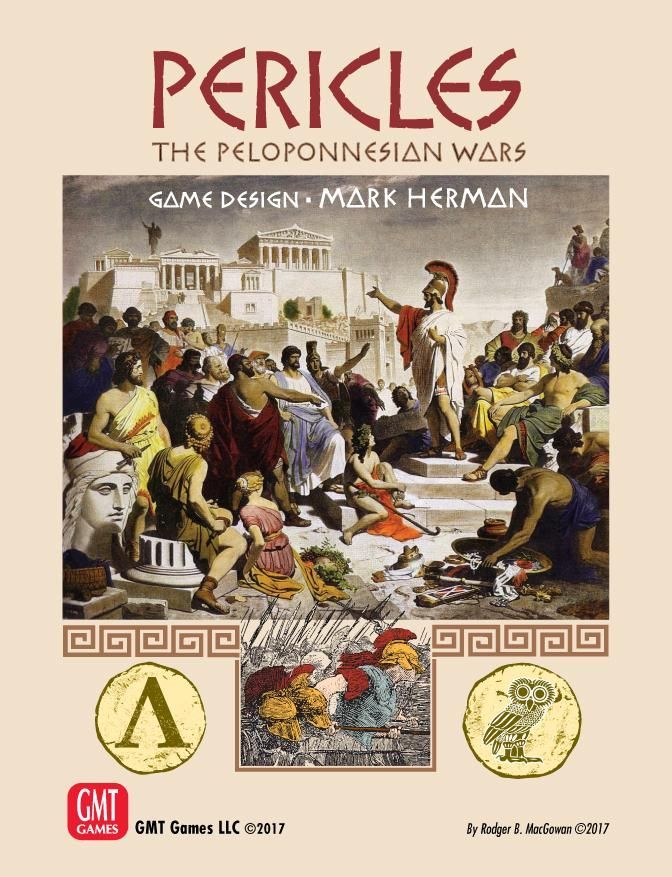
Pericles is a game for one to four players covering 460-400 BC, when Athens and Sparta contested control of Greece. Each City-State's Factions debate issues in their Assembly, and the winning issues are turned into military, diplomatic, league and oracle actions on the map. A Faction wins by holding the most Honor within its City-State, which is usually tied to controlling the war, and by meeting any automatic-victory conditions.
Preparación
Choose one of the scenarios in the Playbook (section 14.0) and set up the pieces as that scenario directs. Shuffle the Aristophanes deck and the Athens and Sparta Political decks separately. Begin by drawing the top Aristophanes card and then proceed through the sequence of play. First-time players are advised to use the simplified first-time sequence in the Playbook (14.01).
Un turno
Each turn runs through these phases in order.
- Aristophanes Phase: Reveal and resolve the top Aristophanes card. Plague effects remove units, and any Will of the Assembly pawns it places are checked later.
- Political Cards: Each Faction discards or keeps Entourage cards, then draws to a hand of nine cards, or six if its Entourage was used as a Brain Trust last turn. Each Faction then gets its Leader card, giving a seven-card hand. Factions that did not use a Brain Trust may set aside three non-Leader cards as a new Entourage.
- Boule: The Controlling Faction may spend a Hostages marker to place the War/Peace issue on the opposing Faction's track. Controlling Factions pick one issue for the 2 space and three for the center space. Opposition Factions pick one for the 1 space and two for the center space. Ostracism and War/Peace always go to the center space.
- Assembly: Starting with the Controlling Faction, Factions alternate choosing debate issues until each has chosen three of the six debates. Each Faction plays a card face down, and the cards are revealed together. The higher modified value wins and moves the issue marker toward its own end of the track by the difference. Ties leave the marker where it is. Issues moved into the seventh space are captured.
- Political Phase: Oration Honor is calculated, the Controlling Faction is determined, Strategos tokens are handed out from the Strategy Board, and non-military issues are resolved (War/Peace, Games, and the unique Athenian and Spartan issues).
- Theater Phase: Theater Issue markers are awarded and then placed face down in Honor order, creating last-in-first-out queues. Markers are revealed and resolved in Honor order, with each owner resolving its own issue.
- End Phase: Check for automatic victory, then run Maintenance, Redeployment and the Will of the Assembly checks, and begin the next turn.
Fin de la partida
The game ends by one of these routes.
- Honor automatic victory: A Controlling Faction wins if it has more Honor than its Opposition Faction, at least three times the Honor of any Faction on the other Side, and more combined Honor with its Compatriot than the other Side.
- Conquest: If Sparta controls the Athens Theater or Athens controls the Spartan Theater, the Faction on the capturing Side wins. If both are captured, the game is a draw.
- Athenian Granaries: If Athens begins a turn without a base in a granary Theater and still has none at the End Phase, Sparta wins.
- Final turn: When the scenario's last turn is over and no earlier victory has occurred, the End of Game procedure decides the winner.
Puntuación
On the final turn, the following Honor adjustments are made in order:
- Political Bonus: each Controlling Faction gains 5 Honor and each Opposition Faction loses 5.
- Economic Bonus: each Side gains 3 Honor per base on the map, split evenly between its two Factions, with any odd point going to the Controlling Faction.
- Athenian Geography Bonus: Athens gains 3 Honor per Theater it controls, split evenly between its Factions, with any odd point going to the Controlling Faction.
- Spartan Geography Bonus: Sparta gains 6 Honor per Theater it controls, split evenly between its Factions.
Then total the Honor of each City-State. The City-State with more total Honor wins the war, and the Faction on that Side with more Honor wins the game. The Controlling Faction wins any tie within a Side. If the City-States are tied, the Faction with more Honor wins. If still tied, Athens wins the war and the Athenian Faction with more Honor wins the game.
Variantes
The rulebook gives these options.
- Ordered play: Instead of having both Sides act simultaneously, groups may take turns, with Athens acting first. The rulebook recommends this for a first game and for the Assembly debates.
- Team play: Compatriots may discuss strategy openly, though the rulebook asks players to keep it brief.
- Entourage and Brain Trust: Players may keep, discard or use Entourage cards as they choose.
- Solitaire: A d20 is used to select the Theater where a 'Bot action occurs, but the full solitaire rules are in the Playbook (15.0), not in this rulebook.
- Campaign rules: Campaign options such as permanent Plague losses are in the Playbook (14.43), not in this rulebook.
- House rules: The rulebook allows groups to substitute other variants if they make the session more enjoyable.
Cambios
- Variantes, por el borrador del reglamento, 22 de noviembre de 2026 (se muestra ahora)
- Puntuación, por el borrador del reglamento, 22 de noviembre de 2026 (se muestra ahora)
- Fin de la partida, por el borrador del reglamento, 22 de noviembre de 2026 (se muestra ahora)
- Un turno, por el borrador del reglamento, 22 de noviembre de 2026 (se muestra ahora)
- Preparación, por el borrador del reglamento, 22 de noviembre de 2026 (se muestra ahora)
- Resumen, por el borrador del reglamento, 22 de noviembre de 2026 (se muestra ahora)