Reglas de Reykholt
Resumen
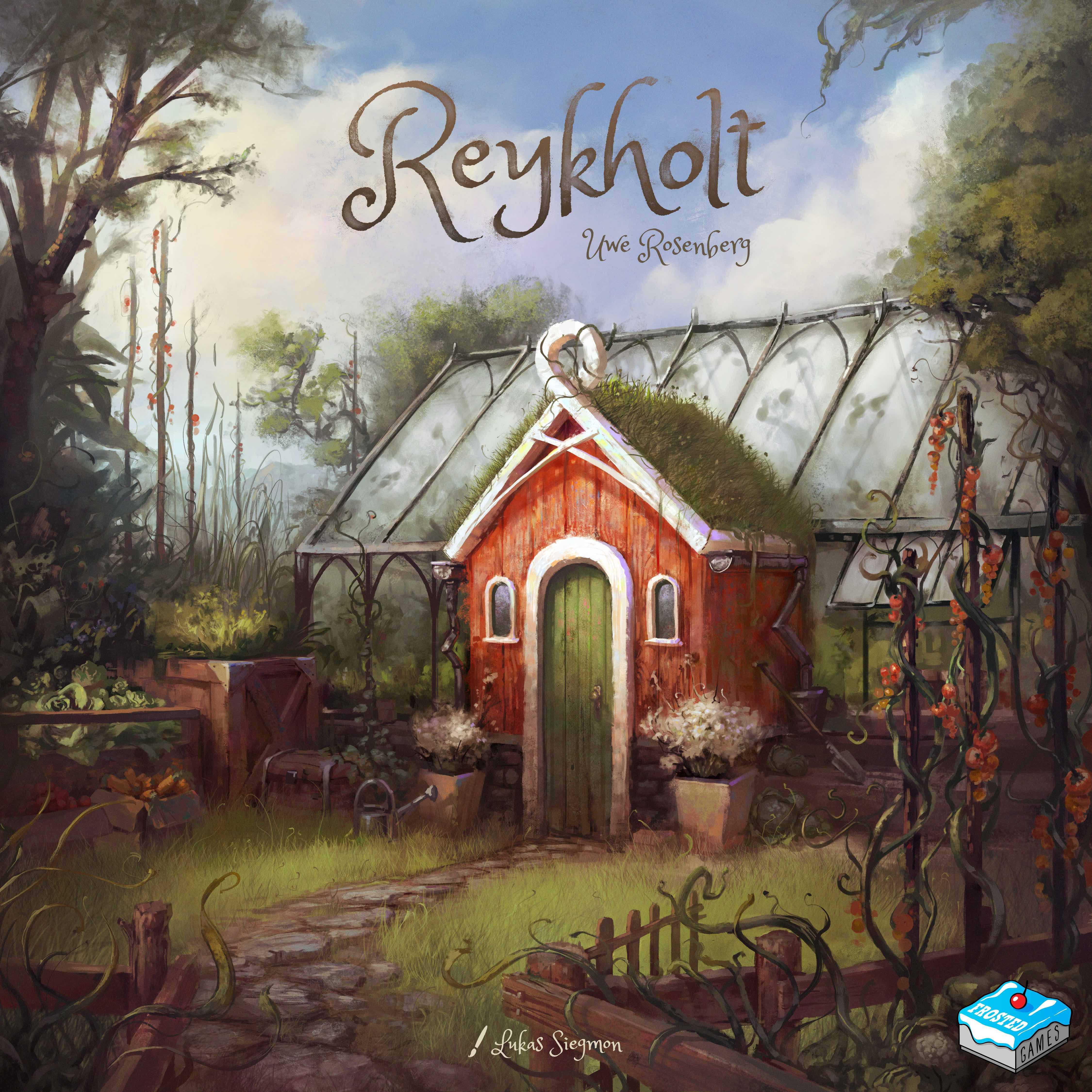
Vegetable farmers in Iceland grow tomatoes, lettuce, mushrooms, cauliflowers and carrots in greenhouses over seven rounds while their managers climb the tourism track. The player whose manager advances furthest along the track at the end wins.
Preparación
Place the game board in the middle of the table, using the side for your player count. In a 2-player game, put the covering tile face down above the board. In a 3-player game, put it on the board's top row. In a 4-player game it is not used. Remove the greenhouse cards marked above your player count and return them to the box. Sort the rest into face-up piles by parcel count beside the board. Shuffle the random greenhouse cards, set one card aside, and place the rest as a face-up pile. Put the set-aside card face down on top of that pile to form the random greenhouses pile. Choose a service card set, shuffle it, and place 5 random cards in an open display next to the board; return the other cards to the box. Stack the game round tiles 1 to 7 in ascending order on the marked space, with 1 on top. Put all wooden goods in their goods boxes as the supply, and set the goods tiles nearby. Each player chooses a color and takes 3 workers, 1 manager and 1 player card; return unused pieces to the box. Stack 1 mushroom, 1 lettuce and 1 tomato, bottom to top, at one end of the service card display. The player who most recently bought a tomato becomes the start player and takes the start player card. Starting with the start player and going clockwise, each player places their manager on the start table of the tourism track. Before the first game, apply the stickers to the worker discs by matching colors.
Un turno
Each round has four times, played in order: Work Time, Harvest Time, Tourism Time and Homecoming Time. In Work Time, starting with the start player and going clockwise, each player places one worker on a free action space and performs that action, until everyone has placed all three workers. A free action space has no workers on it at all. You may only place a worker where you can perform at least one of the actions, and you must perform every action of the space you choose if you can. Seeding means taking a good from your stock and placing it in an empty greenhouse, then filling its other parcels with that good from the supply. Spaces that say seed at least a number of times require at least that many seedings. In the Property and Town Hall columns, each player may use only one flag space per column each round. In Harvest Time, each player harvests once from each greenhouse that has goods, taking one good each time. In Tourism Time, players take turns starting with the player furthest ahead on the track and moving toward the back of the track; each player finishes their turn before the next begins. On your turn, you may advance your manager by as many tables as you like and can afford, discarding the goods shown on each table's signpost back to the supply. Once per round you must use the bonus while advancing, taking the required goods from the supply instead of discarding them. If your manager joins other managers at a table, place yours at the front. In Homecoming Time, each player returns their workers from the board, the topmost round tile is discarded, and the start player card passes to the player on the start player's left.
Puntuación
The player whose manager advanced furthest on the tourism track wins. If players are tied, the tied player who is at the front of the furthest table reached, meaning the one who arrived there last, wins.
Variantes
Solo game: Use the 2-player rules with these changes. Set up 1, 2, 2 and 1 greenhouses with 3, 4, 5 and 6 parcels respectively, and take two worker colors plus one manager. Place unused workers on the two flag spaces in the Property column to block them all game. Use only 3 service cards in the display and only game round tiles 1 to 5. At the start of each Work Time, take a random greenhouse and one tomato from the supply. Alternate worker colors each round, so the first color is used in rounds 1, 3 and 5 and the second in rounds 2 and 4, with inactive workers blocking their spaces. Your goal is to reach the tomato table with 5 dishes. Scoring: each table beyond that counts 10 points, and each good you hold for the next table counts 1 point, up to 9. Optional variant: once per game you may place a worker on a blocked space.
Story Mode: Uses the base rules with a scenario card chosen for setup, which sets the number of round tiles and victory requirements. Shuffle the 13 event cards into a deck. At the start of each Work Time, the start player reveals the top event card and applies its effect to all players, then discards it. The scenario card explains the number of rounds and any extra victory conditions.
Cambios
- Variantes, por el borrador del reglamento, 22 de noviembre de 2026 (se muestra ahora)
- Puntuación, por el borrador del reglamento, 22 de noviembre de 2026 (se muestra ahora)
- Un turno, por el borrador del reglamento, 22 de noviembre de 2026 (se muestra ahora)
- Preparación, por el borrador del reglamento, 22 de noviembre de 2026 (se muestra ahora)
- Resumen, por el borrador del reglamento, 22 de noviembre de 2026 (se muestra ahora)