Reglas de Roll Camera!: The Filmmaking Board Game
Resumen
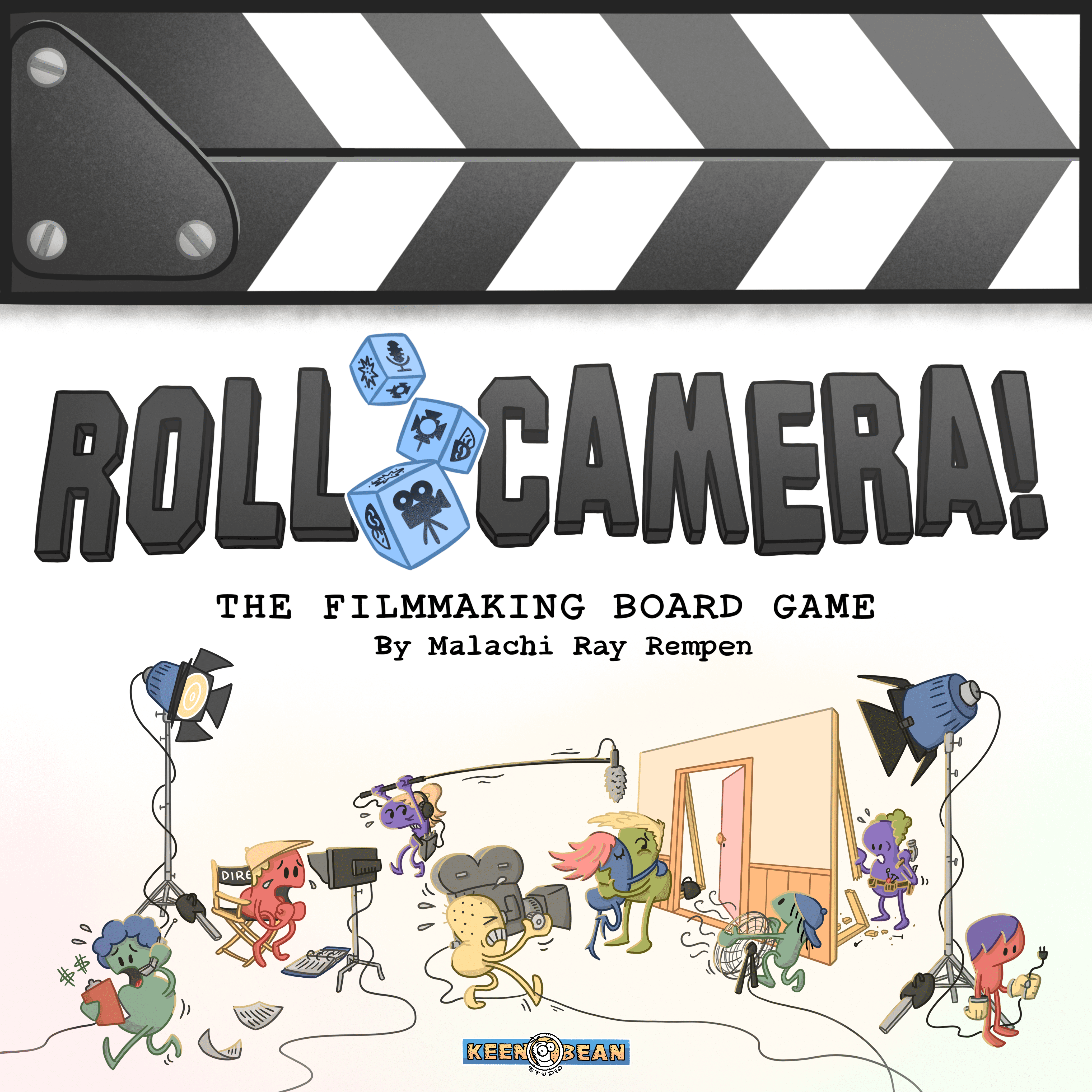
Roll Camera! is a cooperative game in which the players, each a department head at a struggling film company, make a film together. Using Crew dice to take actions and shoot Scenes, they must keep the film on schedule and within budget while handling Problems. The team wins if the film ends with Quality outside the red mediocre zone and the game is not lost.
Preparación
- Place the main game board in the center of the table. Give each player a player board and its matching Player Aid card, placing the board in front of them.
- Shuffle the top and bottom Script cards separately, then pick five of each to form two Script decks. Place them face-up on the board. The top cards form the starting Script; return the rest to the box.
- Shuffle the Problem, Idea, and Scene decks separately. Place the Problem deck above the board and the Ideas deck below it. Place the Scene deck in the Storyboard with its top card sketch-side up, then draw two Scenes into the empty Storyboard slots.
- Each player draws three Idea cards and keeps them hidden.
- Mix the Set Piece tiles and place them face-up in two stacks on the grey spaces above the Set.
- Set the Budget and Schedule dials to a difficulty of your choice (printed on the reverse of the dials).
- Place the Quality marker on the START space of the Quality track.
- Place the Blocked tokens near the Problem deck.
- The player who most recently made a film is the starting player, or choose one at random. They receive the six Crew dice and the Budget/Schedule dials.
Un turno
On your turn, follow five steps:
- Draw a Problem card and place it in the leftmost empty slot of the Problem queue, sliding any existing Problems to the right. If the queue already has three Problems, you do not draw one.
- Roll the Crew dice. Normally roll all six. Dice locked in on Set Pieces from earlier turns stay out of the roll unless you choose to re-roll and reassign them. Each die face is a department: Camera, Light, Sound, Actors, Art Department, or Visual Effects. The VFX face is wild and counts as any other face.
- Assign the Crew dice and take actions. Place dice on available blue action spaces on the main board, on Set Pieces, or on your own player board. Each action requires a particular dice pattern, such as one die, a matching pair, a matching triple, or a specific face. You may pay costs in Budget, and you may lock in dice you cannot fully use so a later player can complete the action. You do not have to use all dice.
- Clear the Crew dice. Remove the dice used for actions and for shooting a Scene, leaving locked-in dice in place, and hand the remaining dice to the next player.
- Advance the Schedule by turning the Schedule dial down by one, then pass the dials to the player on your left. (Do not advance the Schedule at the end of the final turn.)
Main board actions include Resolve (solving the leftmost Problems with matching dice), Build New Piece or Rearrange Set, Play This Idea, Get Intern, and Production Meeting (pitching Idea cards, which then take effect). Each player board also offers two unique actions plus the shared Refresh action.
Fin de la partida
The game ends when the Editing Room holds five Scenes. The turn in which the fifth Scene is shot is the final turn; finish it, including any Problem effects that occur at the end of the turn, but do not advance the Schedule. Then apply the Script to award or remove Quality based on the colors and arrangement of Scenes in the Editing Room.
You lose immediately if the Schedule or Budget markers reach the end of their tracks ("SHUT DOWN PRODUCTION"). You also lose if the Quality marker is inside the red mediocre zone at the end of the game. Otherwise you win.
Puntuación
There is no points total. The result is decided by the Quality marker after the final Script is applied at game end. The film is a win if the marker sits outside the middle red zone of mediocrity, whether toward "Cinematic Masterpiece" or "So Bad It's Great!". Script bonuses and penalties are counted only at the end of the game, based on the colors and arrangement of Scenes in the Editing Room. The rulebook does not describe a tie.
Variantes
- Solo: The rules are the same. If you draw an Idea or Problem card that needs more players (marked with a player-count symbol), discard it and draw another.
- Player count: With 2 players, each pitches 1 Idea card and the active player draws and pitches 1 more. With 3 players, each pitches 1 Idea card. With 4 players, 3 players pitch Ideas, chosen by the active player, who may include or exclude themselves. In a 5 or 6 player game, players hold at most two Idea cards, and 3 players pitch Ideas, chosen by the active player.
- Solo and 2-player Idea pitching: As described above, the Idea deck determines how many cards are pitched.
- Production Company cards: Optional scenarios, each with a new limitation or alternate rule. Where a scenario conflicts with other cards, the Production Company card takes precedence. Ideas or Problems that cannot be played under the scenario are discarded and redrawn.
- Player Privileges: Optional role-play abilities printed on player boards, with no direct effect on gameplay. Agree at the start whether to use them.
Cambios
- Variantes, por el borrador del reglamento, 23 de noviembre de 2026 (se muestra ahora)
- Puntuación, por el borrador del reglamento, 23 de noviembre de 2026 (se muestra ahora)
- Fin de la partida, por el borrador del reglamento, 23 de noviembre de 2026 (se muestra ahora)
- Un turno, por el borrador del reglamento, 23 de noviembre de 2026 (se muestra ahora)
- Preparación, por el borrador del reglamento, 23 de noviembre de 2026 (se muestra ahora)
- Resumen, por el borrador del reglamento, 23 de noviembre de 2026 (se muestra ahora)