Reglas de Rush M.D.
Resumen
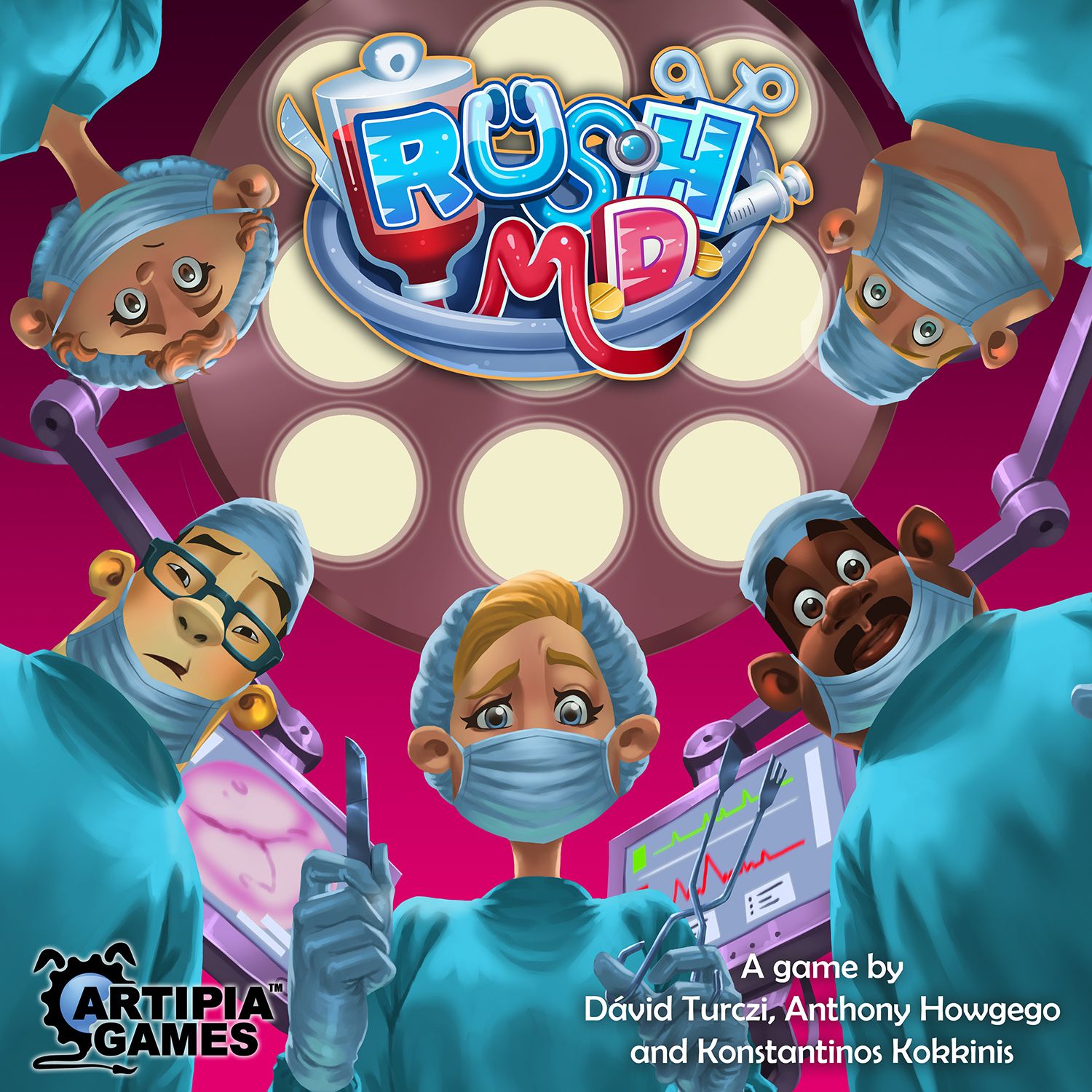
Rush M.D. is a cooperative game where players work as hospital doctors who admit, diagnose and treat patients over four rounds. Each player contributes through their Doctor hourglass, and the Nurse hourglasses are shared. Players win as a team by meeting every requirement on their Objective card at the end of round 4, which usually involves gathering Reputation without letting Medical Points reach 0.
Preparación
- Shuffle the Regular Patient cards into a face-down pile by the Outpatient Clinic, and the Hospitalized Patient cards into a pile by the Patient Admission board.
- Sort the Diagnosis cards by exam type, shuffle each type, and place the four piles on the Labs & Diagnostic Imaging board.
- Stock the Blood Bank and Pharmacy storage areas using the table in the rulebook for your player count.
- Choose an Objective card matching the player count and a difficulty (Easy, Normal or Hard). Show the requirements to everyone and set the Medical Point marker on the Score Board as the Objective indicates.
- Place the Reputation marker on the first space of the Score Board and the Round marker on the first Round Track space.
- Shuffle the 8 Cultures tokens face-down, place the MRI tile by the MRI area, and place the Blood Exam tile by its area with discs arranged as shown in the rulebook.
- Set the Condition tokens beside the boards.
- Assemble the six 3D Beds and place each on its matching ward space (A1, A2, A3, B1, B2, B3).
- Give each player a Doctor hourglass of their colour and a pair of Tweezers. Place the four Nurse hourglasses within everyone's reach.
- Shuffle the Epidemic cards into a face-down pile.
- Set a timer for 4 minutes.
Un turno
The game lasts four rounds. Each round has three phases.
- Medical Council: Advance the Round marker (skip this in round 1). Discuss and plan the round together.
2. Action Phase: This is played in real time while the timer runs. To act, take your own Doctor hourglass or any Nurse hourglass, turn it over, and place it on an open action space that matches its type. You may act immediately and take as long as the round allows. Sand only limits you after the timer runs out. You may not move an hourglass while its sand is running, and you may not move another player's Doctor hourglass off its space. Starting a new action ends the previous one. Available actions include:
- Admit Patients (Nurse): draw up to 3 patients into open admission slots.
- Hospitalize a Patient (Doctor): move a Hospitalized Patient into an empty bed in a Ward.
- Run an exam (Doctor): Cultures, Blood Exam, X-Ray or MRI, as shown on the Labs board.
- Treat a Regular Patient (either type).
- Treat a Hospitalized Patient or apply an Epidemic in a Ward (Nurse).
- Donate blood (either type) and store medicine (Nurse, one item type per use) or organs (Doctor, two of the same type, at most six stored).
- Perform surgery steps in an Operating Room: add organs (Doctor) or medication (Nurse). Organs, blood and medication must be handled with Tweezers.
Breaking an hourglass or action restriction costs 1 Medical Point, and the action must be undone and redone.
3. Patient Evaluation Phase: First check Epidemics. Then check each patient against the treatment on their card and Diagnosis card.
- Exact treatment: the patient is discharged.
- Correct treatment plus extra items: the patient is discharged, but you lose 2 Medical Points.
- Missing or wrong treatment: the patient stays in place and their Condition worsens. A Mild patient loses 1 Medical Point and becomes Serious. A Serious patient loses 3 and becomes Critical. A Critical patient loses 8 and dies.
For discharged patients, gain the listed Reputation, return their items to the Supply, and put their Diagnosis cards at the bottom of their decks. Keep the Patient cards aside for the final Objective check. Extra unneeded items may be returned to the Supply.
Fin de la partida
The game ends after the Patient Evaluation Phase of round 4. The game also ends immediately if your Medical Points reach 0, and the team loses.
Puntuación
At the end, count the discharged Patient cards, the Reputation on the Score Board, and the remaining Medical Points. Then check the Objective card. The team wins only if every requirement on the Objective is met. Reputation comes from discharged patients and Epidemics treated in full. Medical Points are lost from errors, overtreatment, untreated Epidemics, missed Contagious symbols and rule breaks. The rulebook gives no tie rule.
Variantes
- Epidemics: the Epidemic cards are optional and can be left out in your first games.
- Research cards: after a few games, shuffle them at setup and draw 3 face-up. Task cards award Medical Points during the Evaluation Phase if their instruction was followed. Action cards add stronger actions usable like the normal actions. At the start of each round, discard them and draw 3 new ones.
- Solo: set up as a 2-player game with both Doctor hourglasses controlled by one player, and choose a 1-player Objective. The Action Phase lasts 5 minutes instead of 4. Finish one action before starting the next, even when it means returning to a ward to finish a treatment.
Cambios
- Variantes, por el borrador del reglamento, 23 de noviembre de 2026 (se muestra ahora)
- Puntuación, por el borrador del reglamento, 23 de noviembre de 2026 (se muestra ahora)
- Fin de la partida, por el borrador del reglamento, 23 de noviembre de 2026 (se muestra ahora)
- Un turno, por el borrador del reglamento, 23 de noviembre de 2026 (se muestra ahora)
- Preparación, por el borrador del reglamento, 23 de noviembre de 2026 (se muestra ahora)
- Resumen, por el borrador del reglamento, 23 de noviembre de 2026 (se muestra ahora)