Reglas de Santiago
Resumen
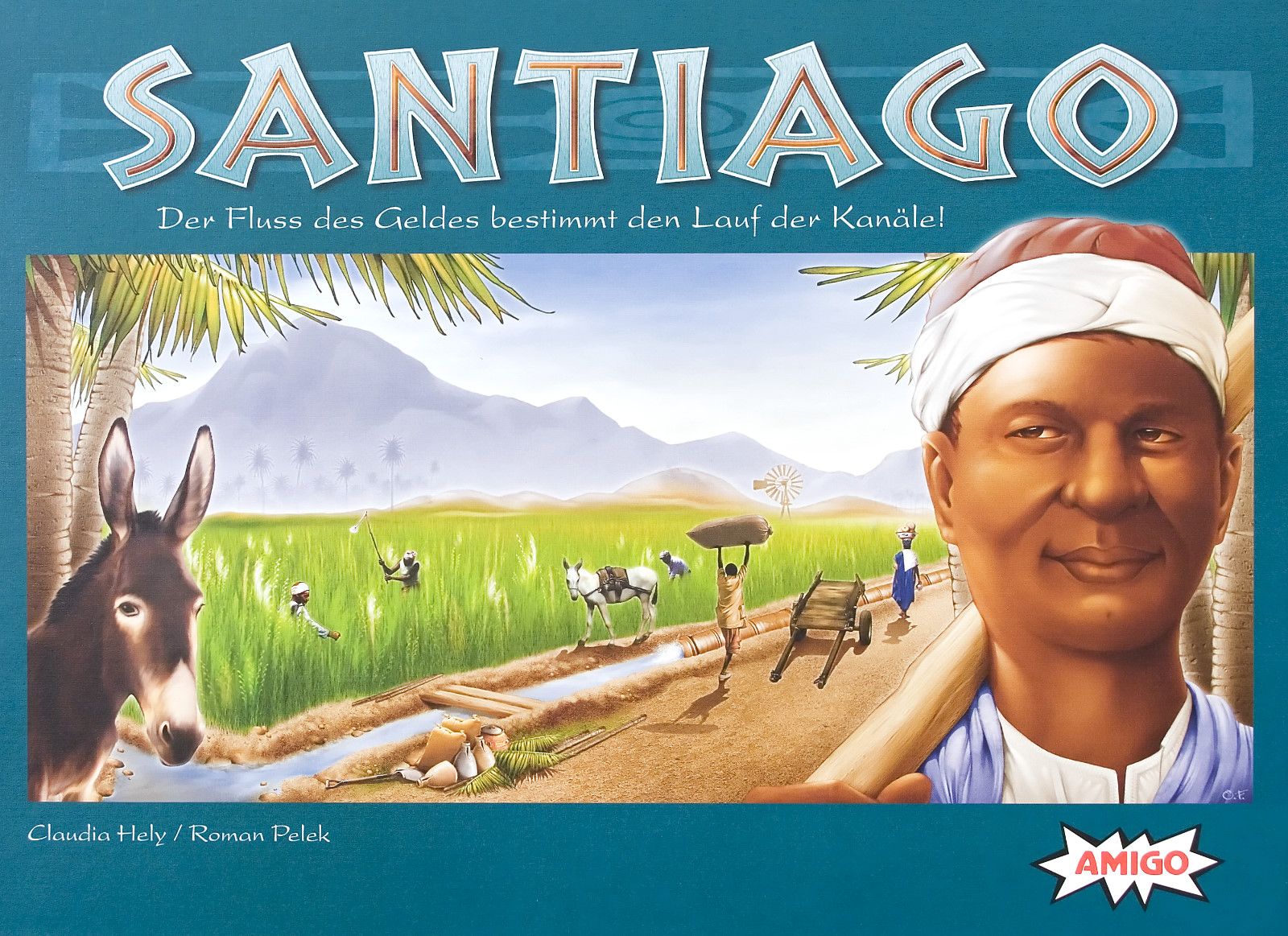
Players are plantation owners who grow bananas, red peppers, watermelons, grapes and coconuts by bidding for plantation tiles and placing farmers on them. Plantations need irrigation from a canal network or they run dry and lose their farmers. The player with the most points at the end of the game wins.
Preparación
- Place the board and put the spring marker on a thick brown intersection. A spot nearer the edge makes the game harder; a central spot makes the first game easier.
- Place the 3 palm trees on three squares that do not touch by side or corner and are not next to the spring.
- Shuffle the plantation tiles face down into stacks: 4 stacks of 11 for 3 or 4 players, 5 stacks of 9 for 5 players.
- Give each player 1 blue canal, 1 canal marker, 22 farmers in their colour and 10 escudos. Put the remaining canals, farmers and banknotes aside as the bank and supply.
- Give the Canal Overseer marker to a randomly or otherwise chosen starting player.
Un turno
Each round has seven phases:
1. Bidding: Flip one tile from each stack beside the village. Starting left of the Overseer, each player makes a unique bid or passes. Each player bids only once per round.
2. New Overseer: The first player to pass becomes the new Overseer. If nobody passed, the lowest bidder takes the marker.
3. Establishing plantations: From highest bid to lowest, each player pays their bid to the bank, takes a tile and places it on any free square with the matching number of farmers. Passing players choose last, in reverse order of passing, and place one fewer farmer. A tile needing only one farmer then stays neutral.
4. Building the canal: Starting left of the Overseer, players propose canal locations and may offer escudos to the Overseer. The Overseer either accepts one offer (not necessarily the highest), takes that money and places a blue canal there, or rejects all offers, returns the money and places the canal elsewhere, paying the bank one escudo more than the highest offer.
5. Extra irrigation: Starting left of the Overseer, players may use their single bonus canal, placed on a thick brown line connected to the network. Only one extra canal may be built per round, and each player may do this only once in the game.
6. Drought: Each non-irrigated plantation loses one farmer. A plantation keeping two farmers stays owned, one left with a single farmer becomes neutral, and a neutral plantation with no irrigation dries out (flip the tile).
7. Collecting escudos: Each player collects 3 escudos from the bank.
Fin de la partida
The game ends after the last tile and canal are used: round 11 with 3 or 4 players, or round 9 with 5 players. In the last round, every non-irrigated plantation becomes dry ground even if farmers are still on it, and Phase 7 is skipped so no money is collected.
Puntuación
Each player first counts their escudos, with one point per escudo, and marks the total on the Scoring Track using farmer markers. Then each player scores their plantations: the size of the expanded plantation (number of tiles) times the number of their farmers on it. A palm tree on a plantation a player cultivates counts as one extra farmer for that player. Dry ground divides plantations into smaller parts. The player with the highest total wins, and tied players share the victory. The rulebook suggests scoring one player at a time and removing that player's farmers after counting.
Variantes
- 3-player game: Before play, show one random plantation tile to the others and return it to the box. Each round one tile goes unchosen. The highest bidder places it on the board next to an irrigated plantation (or a dried-out one if none is possible), with no farmers, so it stays neutral.
- 5-player game: Use 5 stacks of 9 tiles, 9 blue canals and 9 rounds, as described in setup and the end of the game.
Cambios
- Variantes, por el borrador del reglamento, 23 de noviembre de 2026 (se muestra ahora)
- Puntuación, por el borrador del reglamento, 23 de noviembre de 2026 (se muestra ahora)
- Fin de la partida, por el borrador del reglamento, 23 de noviembre de 2026 (se muestra ahora)
- Un turno, por el borrador del reglamento, 23 de noviembre de 2026 (se muestra ahora)
- Preparación, por el borrador del reglamento, 23 de noviembre de 2026 (se muestra ahora)
- Resumen, por el borrador del reglamento, 23 de noviembre de 2026 (se muestra ahora)