Reglas de Seikatsu
Resumen
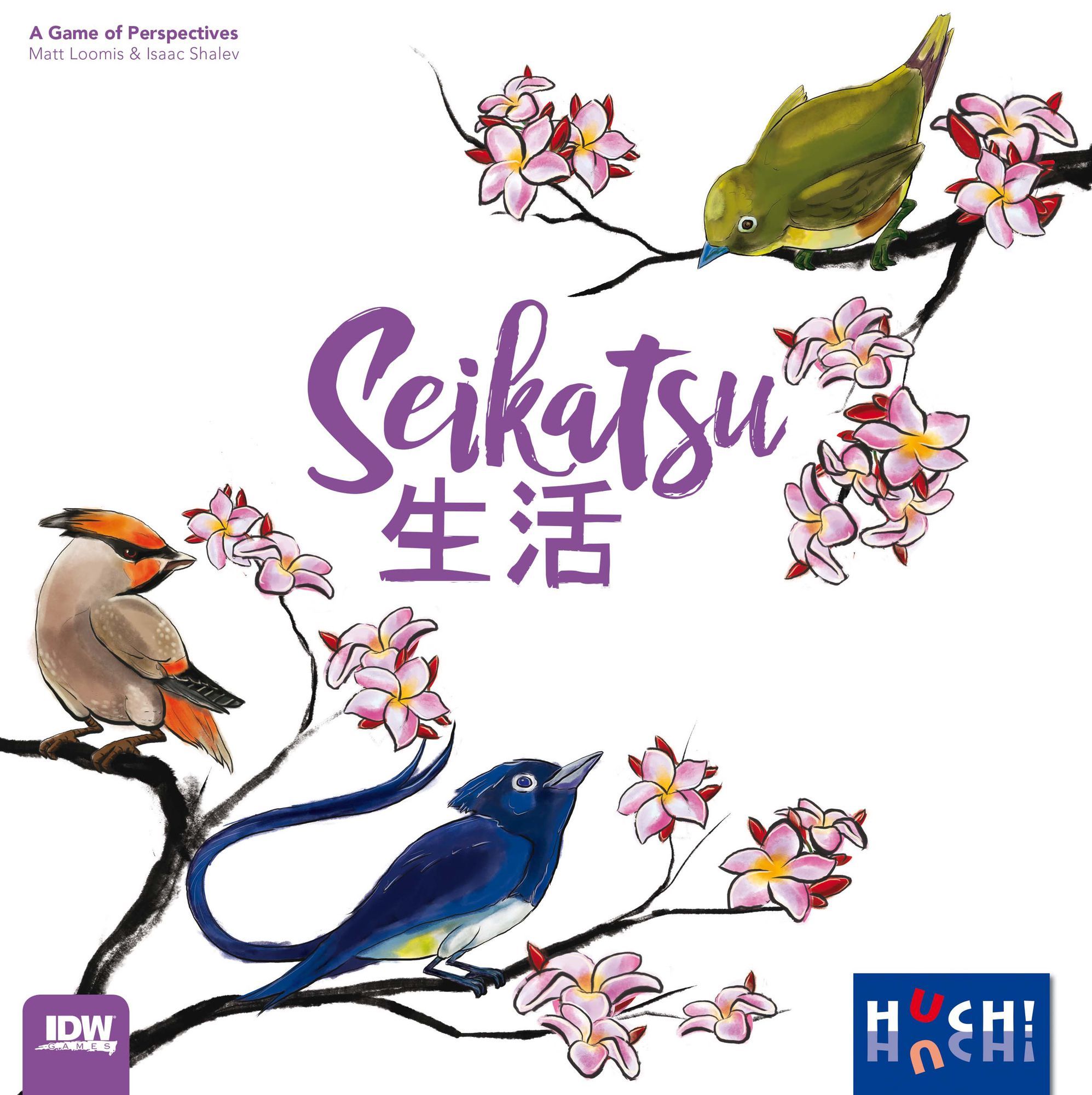
Seikatsu is a tile-laying game in which players build a shared garden and score from their own pagoda's view. Each turn, players place a tile to form Flocks of matching birds and to build rows of flowers. The player with the most total points after the board is full wins.
Preparación
Place the Garden board in the center and rotate it so each player faces one pagoda, which sets that player's color. In a 2-player game, use only the pink and blue pagodas. Put each player's Scoring pawn on 0 of the Score track.
Put all Garden tiles in the Cloth bag and mix them. In a 2-player game, draw 2 tiles at random and place them on the flower-bearing spaces next to the central Koi Pond. In a 3-player game, draw 3 tiles and place them the same way. Add the 4 Koi Pond tiles to the bag and mix again.
Each player draws 2 tiles into a hidden hand. The wisest player takes the bag and goes first.
Un turno
Players take turns clockwise. On your turn, do these three steps in order:
- Play a tile. Place a tile from your hand on an empty space adjacent to a tile already on the board. You may not place a Garden or Koi tile in the center space.
- Score Flocks. A bird on your tile that is identical to an adjacent bird forms a Flock. Score 1 point for the bird on the tile you played and 1 point for each matching adjacent bird. If the bird matches nothing, score nothing. Move your pawn to show your total.
A Koi Pond tile counts as a bird of your choice, but only on the turn you play it. Score it as part of a Flock that turn. On later turns it no longer counts as a bird.
- Draw a new tile. Draw one tile from the bag if any remain, then pass the bag clockwise.
Fin de la partida
The game ends when every player has played the last tile from their hand and the board is full.
Each player then scores their flower rows, and these points are added to the Flock points earned during play.
Puntuación
Flower scoring: look down the rows of tiles from your pagoda's perspective. In each row, find your largest flower set, meaning the most tiles of one flower type. The tiles need not be adjacent. Score only that largest set. If sets are tied, score any one of them. Each Koi Pond tile counts as any flower you choose during this step, and different players may score it as different flowers.
Set values: 1 flower = 1 point, 2 = 3, 3 = 6, 4 = 10, 5 = 15, 6 = 21.
Score one player at a time, starting with the player in last place and moving in reverse turn order. If a score goes past 50 on the track, keep counting around the track and add 50 to the final score.
The player with the most total points wins. If players tie, the tied player who was last in turn order wins.
Variantes
Four players (partnership): Sit in two teams with teammates across from each other. Use only the pink and blue pagodas. Set up with 4 tiles on the flower spaces next to the central Koi Pond, and leave the spaces in front of and directly across from the green pagoda empty. Each player draws 2 tiles, and players take turns placing tiles. Teams share one Scoring pawn. Players may not show their hands to teammates. Otherwise the standard rules apply.
Solo: Play from one pagoda and compete against the combined scores of the other two pagodas. Set up as a 3-player game, but place 3 random tiles with different flowers next to the central Koi Pond. Discard and redraw any tile that repeats a flower. Draw one Garden tile and keep all 4 Koi Pond tiles in hand.
On your turn, either play a Garden tile from your hand next to the last tile you played (on your first turn, next to any of the 3 starting tiles), or play a Koi Pond tile next to any Garden tile. Then score Flocks according to the chosen difficulty:
- Easy: you score Flocks normally.
- Medium: ignore Flock scoring.
- Hard: Flock points go to your opponent.
Keep taking turns until no legal moves remain. Leave empty spaces unfilled. Score your flower sets and add them to your total. Score the other two pagodas' flower sets and add them to your opponent's total. Your score must be higher than your opponent's to win.
Tournament mode: Instead of drawing 2 random tiles at setup, place the 4 Koi Pond tiles face up. In a 2-player game, each player gets 2. In a 3-player game, each player gets 1, and the last player in turn order gets the remaining one. In a 4-player game, each player gets 1.
Cambios
- Variantes, por el borrador del reglamento, 22 de noviembre de 2026 (se muestra ahora)
- Puntuación, por el borrador del reglamento, 22 de noviembre de 2026 (se muestra ahora)
- Fin de la partida, por el borrador del reglamento, 22 de noviembre de 2026 (se muestra ahora)
- Un turno, por el borrador del reglamento, 22 de noviembre de 2026 (se muestra ahora)
- Preparación, por el borrador del reglamento, 22 de noviembre de 2026 (se muestra ahora)
- Resumen, por el borrador del reglamento, 22 de noviembre de 2026 (se muestra ahora)