Reglas de Silverton
Resumen
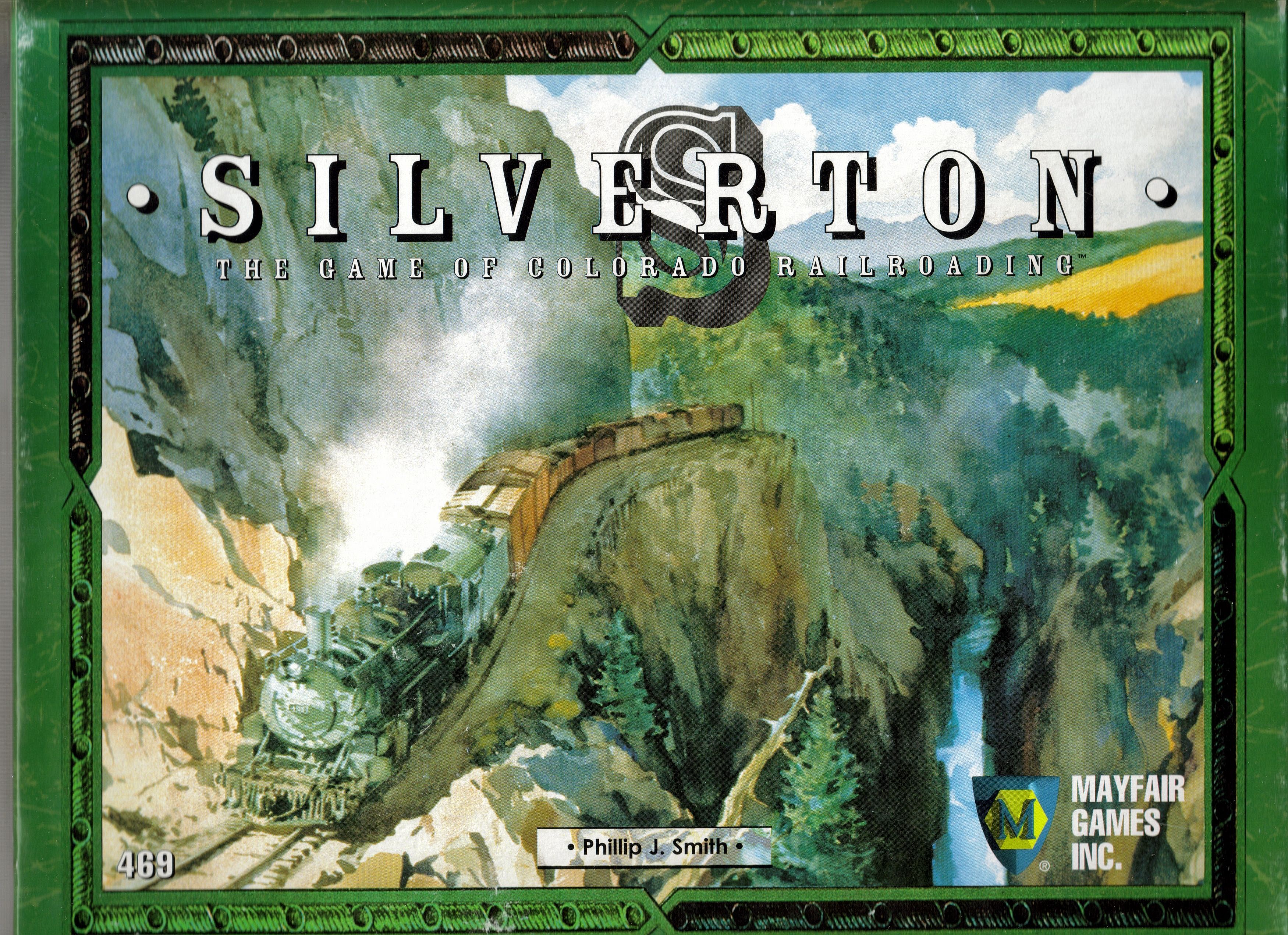
Silverton is a rail-building and prospecting game set in the Rocky Mountains of the Colorado-Utah-New Mexico area in the late 1800s. Players build track between cities, stake claims on mines and mills, and deliver freight to markets, with optional passenger routes for steady income. The player with the most money when the game ends wins.
Preparación
Choose a game length (Standard, Short, Long, or Campaign) and lay out the board. Each player picks a color, takes the matching wooden pieces, and receives a turn order card. Place each player's surveyors and prospectors on their starting cities according to the Basic Game Starting Positions chart, and give each player the starting cash for the number of players. Choose a banker to lay out the money and place the black selling price markers in the START boxes of the Selling Price Chart, using only the markers for the number of players. Shuffle the claim deck and turn up eight cards. Shuffle the eight C passenger cards face down, put a B card on each, then put an A card face up on each B. Place the game turn marker on space 1.
Un turno
Each game turn has seven phases:
- Deal turn order cards to set the order for the turn.
- Place prospectors and surveyors in turn order, choosing track segments, claims, or passenger routes. Surveyors cannot go on white snow track in winter turns.
- Resolve disputes when two or more pieces target the same segment, claim, or card. Each player rolls two dice and adds any bonus; the highest total wins. Rolling a 2 before bonuses sends the piece to jail.
- Construction and operation, in turn order: buy claims or contracts, build track, operate claims, make trades and deals, collect passenger revenue, deliver loads, and pay any fines.
- Roll for price changes on the Selling Price Chart, starting with the last player.
- Replenish the open claims to eight and refill passenger cards.
- Advance the game turn marker.
Fin de la partida
The game ends only at the end of a game turn, so every player has the same number of turns. Play continues until a player reaches the winning total for the chosen game: $10,000 in the Standard Game, $6,000 in the Short Game, and $20,000 in the Long Game. In the Campaign Game, play 24 turns. Once a player reaches the threshold, the game still finishes that turn, and the player with the most money then wins.
Puntuación
The winner is the player with the most money at the end of the game turn. In the Standard, Short, and Long games, the game ends when a player reaches the target total, and that player with the most money wins. The rulebook does not describe a separate tie-break rule.
Variantes
Scenarios provide alternate starting positions and goals, including Denver, Salt Lake City, and Denver Campaign solitaire games, and two-, three-, and four-player Golden Spike, Nickel Spike, Silver Spike, and Copper Spike scenarios. Advanced Game rules add player choice of prospectors and surveyors, trains, snow plows, and trades and deals. Optional rules include passenger card slide, joint passenger routes, multiple snow plows, freight transfer, improved passenger routes, a simplified selling price chart, and hiring and advancing pieces.
Cambios
- Variantes, por el borrador del reglamento, 23 de noviembre de 2026 (se muestra ahora)
- Puntuación, por el borrador del reglamento, 23 de noviembre de 2026 (se muestra ahora)
- Fin de la partida, por el borrador del reglamento, 23 de noviembre de 2026 (se muestra ahora)
- Un turno, por el borrador del reglamento, 23 de noviembre de 2026 (se muestra ahora)
- Preparación, por el borrador del reglamento, 23 de noviembre de 2026 (se muestra ahora)
- Resumen, por el borrador del reglamento, 23 de noviembre de 2026 (se muestra ahora)