Reglas de Skull & Roses
Resumen
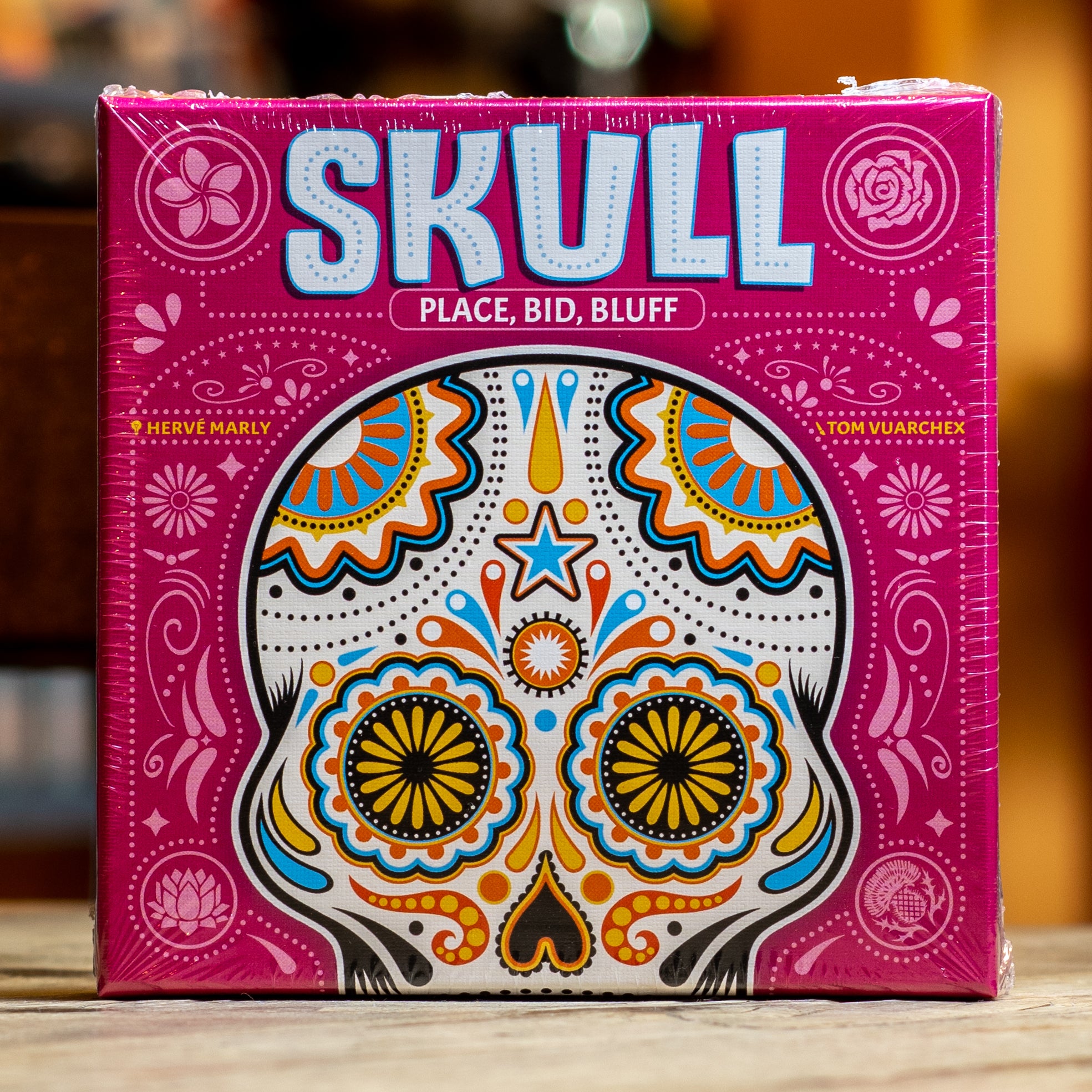
Skull is a bluffing game for three or more players in which each player secretly hides discs on their mat and players try to flip discs without revealing a Skull. A player wins by succeeding at two challenges, or by being the only player who has not been eliminated.
Preparación
- Each player chooses the 4 discs and the play mat of one tribe.
- Each player places their mat in front of them, Skull side visible.
- Each player holds their discs so that the faces stay hidden from the others.
- Choose a first player.
Un turno
Step 1 - Turn preparation: each player secretly places one disc face-down on their mat. Once everyone has placed a disc, play moves to step 2.
Step 2 - Adding or challenge: starting with the first player, and going clockwise, each player either adds one more face-down disc on top of the stack or issues a challenge. The first players may hold back their first disc until others have played. A player with no discs left must challenge. A challenge cannot be zero or exceed the total number of discs on all mats.
When issuing a challenge, the player announces how many discs they will flip from all mats. Then, going clockwise, each player must either raise the bid with a higher number or pass by sliding their mat toward the center. Bids may increase by more than one, and the maximum number of discs on the mats may be bid directly. Bidding continues until all but one player has passed; the highest bidder becomes the Challenger.
Step 3 - The attempt: the Challenger must flip the announced number of discs, starting with all of their own discs, then discs of other players in the order they choose. Discs are flipped one by one, and a player does not have to flip all of an opponent's discs. If the challenge equals all discs played, flip one by one and stop at the first Skull. If the Challenger has more discs than the challenge, they flip from the top of their stack.
If no Skull is flipped, the Challenger succeeds: they flip their mat to the Flower side, and if it was already Flower side up, they win the game. If a Skull is flipped, the attempt fails: all discs return to hands, and the Challenger loses one disc for good. The owner of the flipped Skull chooses which of the Challenger's remaining discs is removed, face-down and unseen. If the Challenger flipped their own Skull, they choose the disc they lose.
New round: whether the Challenger succeeded or failed, they are the first player of the next round, starting again at step 1, unless they were eliminated. If the Challenger is eliminated, the first player of the next round is the player whose Skull was flipped, or the Challenger's choice if they flipped their own Skull. A player who loses their last disc is eliminated and returns their mat.
Fin de la partida
The game ends as soon as a player wins a second challenge, or when only one player has not been eliminated, who then wins.
Puntuación
There is no points scoring. The winner is the first player to succeed at two challenges, or the only player left who has not been eliminated.
Variantes
- Experienced players: combine two boxes of Skull to play with more than 6 players; the best games stay under 10 players.
- Two tribes per player: each player chooses 2 tribes at the start and seats them facing each other on opposite sides of the table. A player wins by winning a second challenge with only one of their tribes.
- For new players, the rulebook advises avoiding 3-player games, as they are very tactical and unforgiving.
Cambios
- Variantes, por el borrador del reglamento, 23 de noviembre de 2026 (se muestra ahora)
- Puntuación, por el borrador del reglamento, 23 de noviembre de 2026 (se muestra ahora)
- Fin de la partida, por el borrador del reglamento, 23 de noviembre de 2026 (se muestra ahora)
- Un turno, por el borrador del reglamento, 23 de noviembre de 2026 (se muestra ahora)
- Preparación, por el borrador del reglamento, 23 de noviembre de 2026 (se muestra ahora)
- Resumen, por el borrador del reglamento, 23 de noviembre de 2026 (se muestra ahora)