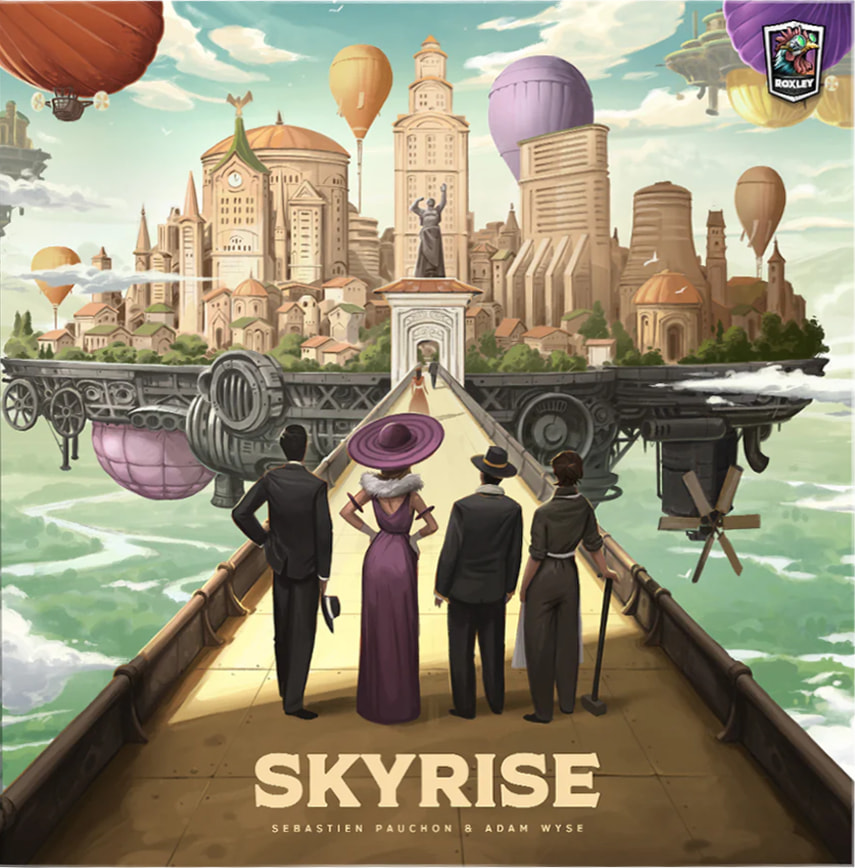
Reglas de Skyrise
Resumen
Skyrise is an auction game in which players bid for sites on floating islands to construct buildings and Wonders, creating a city in the sky. Players earn Prestige through island control, panorama cards, collected discs, secret objectives and Wonder effects over two Eras. The player with the most Prestige at the end wins.
Preparación
- Place the Game Board in the center. Set out one Outer Island per player and the Central Island among them so the bridges connect.
- Remove discs by player count: with 3 players, remove one wild disc, one commissions disc and three of each neighborhood disc. With 2 players, remove two of each patron disc and five of each neighborhood disc. With 4 players, remove nothing.
- Put the remaining neighborhood, patron, commissions and wild discs into the Draw Bag. Draw one disc for each colored neighborhood on each island and place it there.
- Shuffle the Wonder cards and deal 3 face-down to each player (5 each in a 2-player game). Return the rest to the box unseen.
- Shuffle the Secret Objective cards and deal one face-down to each player.
- Place the Island Control Card face-up. Shuffle the 5 Panorama cards, draw 2 face-up beside it and return the others.
- Shuffle the Patron Value Tiles and place one face-down on each patron space A to D.
- Place the Large Key to the City nearby. With 3 or 4 players, also place the Small Key.
- Each player takes a Player Board, places their chosen visionary face-up, and places their scoring disc on 0 of the Prestige track. Each takes the 12 buildings and Wonder in their color (in a 2-player game, each takes 2 Wonders, using an unused color's Wonder and scoring disc for the second).
- Buildings with a dot below the number, and the Wonder, go to the left of the board as unavailable. The other buildings go to the right of the board in ascending order, number-side up.
- Look at your secret objective and Wonder cards. New players may wait until later to view Wonders.
- Randomly choose the player who starts the first auction.
Un turno
The game is played as a series of auctions. Each auction has these steps:
- Start bidder: The player who won the previous auction starts. At the start of Era 1, a random player (chosen in setup) starts. At the start of Era 2, the player with the lowest Wonder initiative starts. When a player builds their last Era 2 structure, the lowest-initiative remaining player starts.
- Starting bid: The starter places one available bid number-side up in an unoccupied neighborhood on the central island or next to any constructed structure.
- Bidding: Play moves clockwise. On their turn a player either outbids by placing a higher bid in an unoccupied neighborhood adjacent to the latest bid, passes (and is out for the rest of the auction), or, in Era 2 only, places their Wonder adjacent to the latest bid. You cannot outbid yourself.
- End: The auction ends when everyone but the latest bidder has passed, when no unoccupied neighborhood is adjacent to the latest bid, or when a Wonder is placed.
When the auction ends, the winning bid is flipped number-side down and becomes a constructed building (Wonders are not flipped). Losing bids return to their owners. If the neighborhood holds a disc, the winner collects it. If a Wonder was built, its effect resolves now. Then the next auction begins.
Collecting discs: Neighborhood discs go to the leftmost empty space in their color row on your board. A fifth disc of the same color goes on your visionary instead. Wild discs must be assigned a color when collected and cannot move afterward. Patron discs and commissions discs go on your visionary illustration.
Fin de la partida
Era 1 ends when any player has constructed all their Era 1 buildings. Era 2 starts after scoring, unlocking the Wonder figures and five Era 2 buildings per player.
Era 2 ends when all players have constructed all their buildings and Wonders. The first player to finish all their Era 2 structures takes the Large Key. In a 3 or 4 player game, the second to finish takes the Small Key.
Puntuación
End of Era 1:
- Island control: On each island, the player with the most tall buildings scores 5 Prestige. Ties are broken by medium buildings, then short buildings. If still tied, every tied player scores 5. Wonders do not count.
- Panorama cards: Each card's Prestige is gained once per instance its objective is met. One structure can count for several cards or several times.
- Wonder choice: Each player secretly chooses one of their Wonder cards and reveals it at the same time. In a 2-player game, each also chooses a second one. The lowest initiative value starts the first Era 2 auction. Unchosen Wonders go back to the box.
- Era 2 unlock: Add Wonders and Era 2 buildings to the available pool as described above.
- Keys: The large key scores 10 Prestige and the small key scores 4.
- Commissions discs: For each commissions disc held, score 1 Prestige per patron disc, excess neighborhood disc, key and commissions disc on your visionary.
- Structures: Remove all your structures in each neighborhood color, one color at a time (yellow, green, white, then brown). Score each removed structure the amount at the top of the column of your right-most disc of that color. Each structure scores at least 2 Prestige.
End of Era 2:
- Score island control and panorama cards again as above. Wonders now count for panorama objectives, but not for island control.
- Reveal secret objectives and score the Prestige for each one completed.
- Flip the patron value tiles and score each collected patron disc at its revealed value.
- Score 10 Prestige for each excess neighborhood disc or wild disc on your visionary.
Game end: The player with the most Prestige wins. If tied, the tied player who constructed their final structure first wins.
Cambios
- Puntuación, por el borrador del reglamento, 23 de noviembre de 2026 (se muestra ahora)
- Fin de la partida, por el borrador del reglamento, 23 de noviembre de 2026 (se muestra ahora)
- Un turno, por el borrador del reglamento, 23 de noviembre de 2026 (se muestra ahora)
- Preparación, por el borrador del reglamento, 23 de noviembre de 2026 (se muestra ahora)
- Resumen, por el borrador del reglamento, 23 de noviembre de 2026 (se muestra ahora)