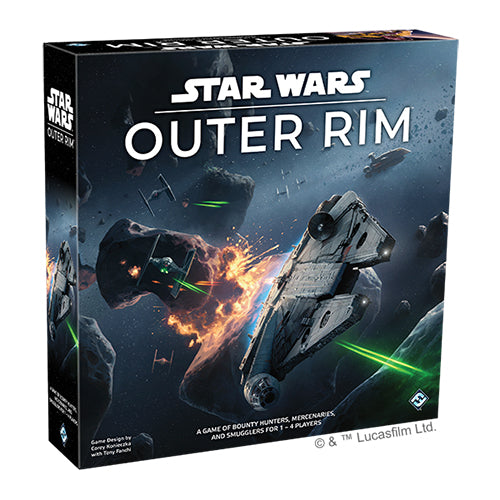
Reglas de Star Wars: Outer Rim
Resumen
Outer Rim is a game where each player takes on a bounty hunter, smuggler, or mercenary, travels the galaxy in their ship, recruits crew, and works for or against factions. The goal is to gain fame; the first player to acquire 10 fame wins the game.
Preparación
- Build the map from the map tiles as shown in the setup diagram.
- Patrol tokens: Place each faction's level-1 patrol token faceup on the navpoint space next to the matching faction endcap. Make a facedown stack of the remaining tokens for each faction, sorted in numerical order by level with level-2 on top and level-4 on the bottom. Place each stack on the matching endcap.
- Contacts: Mix all contact tokens facedown, then place one facedown on each contact space so that the color and pip count match the token.
- Token supply: Sort credit, damage, and goal tokens into piles within reach of all players.
- Characters: Each player rolls all six dice. The player with the most hit and crit results goes first. Going clockwise, each player chooses a character and receives a character card, standee, player board with fame marker on 0, four reputation tokens (one per faction) on the neutral space, a starter ship sheet, a reference card, and starting credits. Starting credits are 4,000 for the first player, then 6,000, 8,000, and 10,000 going clockwise.
- Character setup: Each player takes the databank card named on their character card. Cargo cards go in the cargo slot of the ship; other cards go in a job or bounty slot below the player board. Place the standee on the starting planet listed on that card. Adjust reputation if the character card says so.
- Decks: Split market cards into six decks by card back, shuffle each, and reveal the top card of each. Split encounter cards into seven decks by back and shuffle them near their planets. Keep the databank deck in numeric order. Set unused ship sheets aside as the ship supply.
Un turno
Players take turns clockwise. Each turn has three steps in order.
- Planning step: Choose one: move up to your ship's hyperdrive value in spaces; recover all damage; or gain 2,000 credits. Some card abilities marked "Planning" may also be used.
- Action step: Perform any number of actions, each action at most once per step: Trade cards with another player in your space; Market (on a planet) to discard the top card of a market deck and/or buy a card; Deliver cargo and bounties at their destination planet; and resolve card abilities marked "Action" (each once per turn).
- Encounter step: Choose one: fight a patrol in your space (required if you have negative reputation with that patrol's faction); draw an encounter card matching your space; encounter a contact token on your planet; or resolve an ability marked "Encounter."
Movement stops when you enter the Maelstrom or a patrol's space, unless you have positive reputation with that patrol's faction.
Fin de la partida
The game ends immediately when a player acquires enough fame to win. The first player to reach 10 fame wins. Fame is gained through completed personal and ship goals, bounties and jobs, delivering illegal cargo, winning combat against level-2 and level-3 patrols, and using luxury market cards.
Variantes
Shorter first game: For a first game, each player's goal is 8 fame instead of 10.
Extended game: Experienced players may play to 12 fame instead of 10. All players should agree on the target before setup.
Modular map: If all players agree, build a map by randomizing the six map tiles in a facedown stack, flipping the top tile and attaching it to the Rebel and Syndicate patrol endcap, then drawing and connecting each remaining tile in turn. The Hutt and Imperial endcap connects to the last tile.
Single-player game: Play against one AI character that starts with databank card #91 or #92 and uses the G9 Rigger. You go first and start with 4,000 credits; the AI starts with 6,000. After each of your turns, draw and resolve the top AI card, then discard it to the bottom of the AI deck. The AI moves toward its nearest goal token, buys cards according to the AI card, and does not use most card abilities or goals. The first player to 10 fame wins.
Cambios
- Variantes, por el borrador del reglamento, 22 de noviembre de 2026 (se muestra ahora)
- Fin de la partida, por el borrador del reglamento, 22 de noviembre de 2026 (se muestra ahora)
- Un turno, por el borrador del reglamento, 22 de noviembre de 2026 (se muestra ahora)
- Preparación, por el borrador del reglamento, 22 de noviembre de 2026 (se muestra ahora)
- Resumen, por el borrador del reglamento, 22 de noviembre de 2026 (se muestra ahora)