Reglas de Star Wars: Rebellion
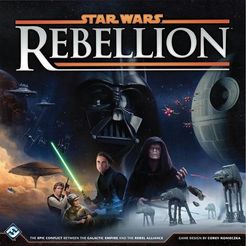
Resumen
Star Wars: Rebellion is a two-faction game where the Rebel Alliance tries to stir a galactic revolt and the Galactic Empire tries to find and conquer the hidden Rebel base. Players use leaders to attempt missions, move units, and fight combats. The Rebels win when their reputation marker reaches the same space as the time marker, mostly by playing objective cards. The Empire wins by conquering the system with the Rebel base.
Preparación
Each player takes his faction's miniatures, leaders, loyalty markers, faction sheet, mission cards, and action cards. Place the four leaders without a recruit icon in your leader pool, and set the recruit-icon leaders aside near the board. Join the two board halves, put the time marker on space 1 and the reputation marker on space 14. Sort the objective cards into piles I, II, and III, shuffle each, and stack them into one deck with pile III at the bottom. The Rebel player secretly draws one objective card. Build each action deck from the cards with a recruit icon. Shuffle the space and ground tactic decks nearby. Sort mission cards into starting missions (set aside, four per player), projects (the Imperial player's shuffled project deck), and remaining missions (each player's mission deck). Place starting units and loyalty as the first-game diagram shows, or use the advanced setup. The Rebel player secretly places a probe card for the base's location under the Location space, removing Imperial-occupied systems from the probe deck first, and shuffles the rest into the probe deck. Each player draws two cards from his mission deck to make a starting hand of two cards plus his four starting missions.
Un turno
The game is played in rounds of three phases. In the Assignment Phase, the Rebel player assigns leaders from his pool to missions first, then the Imperial player does the same. In the Command Phase, starting with the Rebel player, players alternate either activating a system with a leader from their pool to move ships and ground units, or revealing a mission that a leader is assigned to. A player may pass at any time, and once he passes he skips the rest of the phase. In the Refresh Phase, leaders return to pools, players draw mission cards (keeping a hand of at most 10), the Imperial player draws two probe cards, the Rebel player draws an objective card, and the time marker advances. Any recruit or build icon on the new time space triggers recruiting or building, and then units are slid along each build queue and deployed to loyal or subjugated systems, up to two per system. Combat happens when units move into an enemy-occupied system and follows steps for adding a leader, drawing tactic cards, combat rounds of space and ground battle with dice and damage, retreat, and continuing until one side leaves a theater.
Fin de la partida
The game ends immediately when the Imperial player conquers the Rebel base's system, meaning Imperial units are there and no Rebel units are. The Rebel player wins immediately when the reputation marker and time marker share a space on the time track. The Death Star destroying the Rebel base's system also ends the game in the Empire's favor.
Variantes
A three- or four-player team game lets up to two players share each faction, with one player taking the Admiral role (space battles, building, deploying, and recruiting) and the other the General role (ground battles, mission cards, probes, and objectives). Teammates may share information openly, and the Admiral and General each control separate leaders. In a three-player game, one player takes the Rebels and the other two split the Empire into Admiral and General, with the Rebel player taking two turns each round. The advanced rules add a variable setup that places loyalty and units differently, and action cards that give leaders once-per-game abilities; each player starts with two random starting action cards.
Cambios
- Variantes, por el borrador del reglamento, 22 de noviembre de 2026 (se muestra ahora)
- Fin de la partida, por el borrador del reglamento, 22 de noviembre de 2026 (se muestra ahora)
- Un turno, por el borrador del reglamento, 22 de noviembre de 2026 (se muestra ahora)
- Preparación, por el borrador del reglamento, 22 de noviembre de 2026 (se muestra ahora)
- Resumen, por el borrador del reglamento, 22 de noviembre de 2026 (se muestra ahora)