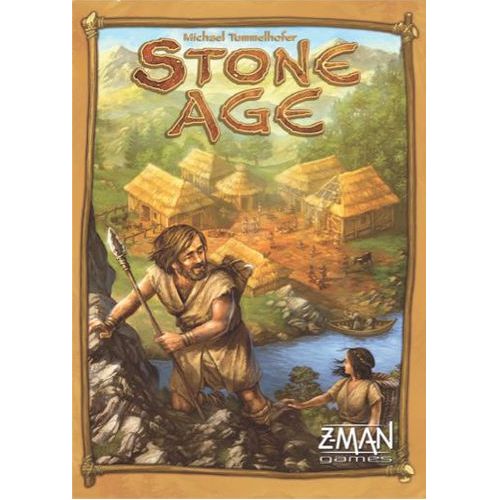
Reglas de Stone Age
Resumen
Cavemen is a worker-placement game in which players develop a village over several rounds by sending figures to locations to gather resources and food, acquire Civilization cards and buildings, and score points. The player with the highest total score at the end wins.
Preparación
Place the board in the middle of the table and sort the Food tokens by value, placing each stack on the hunting grounds. Each player chooses a color, places their small marker on space 0 of the agriculture track and their big marker on space 0 of the scoring track, and takes a player board with 5 figures of their color and Food worth a total of 12. The remaining figures form a general supply beside the board, and the dice and dice cup are placed nearby.
Put the 28 wood on the forest, 18 clay on the clay mound, 12 stone on the quarry, and 10 gold on the river. Sort the Tool tiles by value (1/2 and 3/4) onto their spaces in the village. Shuffle the Building tiles and stack them in piles of 7, using 4 piles with 4 players, 3 with 3 players, or 2 with 2 players; return leftover piles to the box unseen, then reveal the top tile of each pile. Shuffle the Civilization cards, place them face-down beside the board, and reveal the first 4 onto the indicated spaces, starting from the rightmost. The youngest player takes the First player token.
Un turno
Each round has three phases, played in order.
- Placing figures: Starting with the first player and going clockwise, players place one or more figures on locations, until everyone has placed all their figures. Each location has a limit: the tool maker and field take one figure per round; the hut takes exactly 2 figures of one player placed together; civilization cards and buildings take one figure per space shown; the forest, clay mound, quarry and river take up to 7 figures; the hunting grounds take any number. A player may not pass while holding unplaced figures, and may not add figures to a location where they already have figures this round.
2. Taking actions: Starting with the first player, each player takes the actions of their figures in any order they choose, returning each figure to their board after its action.
- Tool maker: gain a new Tool tile (a value 1 tile if you have none yet). Later tools follow the rules shown on the board, such as upgrading values at the 7th and 10th tools. Each Tool tile may be used once per round in a dice roll, used fully, then turned 90 degrees.
- Hut: take an extra figure from the supply onto your board.
- Field: move your marker up 1 space on the agriculture track.
- Hunting grounds: roll one die per figure, add the total, optionally add Tool values, then divide by 2 (rounded down) to get Food.
- Forest, clay mound, quarry, river: roll one die per figure, add the total, optionally add Tool values, then divide by 3 (wood), 4 (clay), 5 (stone) or 6 (gold) to get resources.
- Civilization card: pay the resources shown (not Food) and take the card to your board; if you cannot or will not pay, the figure returns and the card stays.
- Building: pay the required resources, return them to supply, take the building, and immediately move your scoring marker by the points shown; flip the next tile in that pile. Some buildings let you choose resource types or amounts, and then you count the points yourself.
- Feeding the tribe: Gain 1 Food for each level on the agriculture track, then pay 1 Food per figure on your board. Missing Food may be covered by resources at 1 resource per Food. A player who cannot or will not feed the tribe loses 10 points, regardless of how many figures are unfed. Leftover Food is kept.
At the end of the round, pass the First player token clockwise. At the start of a new round, slide the remaining Civilization cards right, reveal new cards to fill the empty spaces from the right, and turn Tool tiles back so they can be used again.
Fin de la partida
The game ends when either there are not enough Civilization cards in the pile to fill the 4 spaces at the start of a round, in which case it ends immediately without starting that round; or at least one Building pile is empty, in which case the current round is completed, including feeding the tribe. Then the final scoring is carried out.
Puntuación
Each player scores their Civilization cards and remaining resources:
- Each set of different green-backed cards scores the number of different cards in the set, multiplied by itself.
- Sand-backed cards score as follows: farmers times the agriculture track position; tool makers times the total value of your Tool tiles; builders times your number of Building tiles; shamans times the number of figures on your board.
- Each remaining resource other than Food is worth 1 point.
Points are recorded on the scoring track. The highest total wins. In a tie, the tied players compare the sum of their agriculture level, total Tool value and acquired figures, and the highest sum wins.
Variantes
With 2 or 3 players, only 2 of the tool maker, hut and field may be occupied in a round, leaving one vacant; the vacant location may change each round. With 3 players, only 2 players' figures may occupy each of the forest, clay mound, quarry and river. With 2 players, only 1 player's figures may occupy each of those four locations. All other rules stay the same.
Cambios
- Variantes, por el borrador del reglamento, 23 de noviembre de 2026 (se muestra ahora)
- Puntuación, por el borrador del reglamento, 23 de noviembre de 2026 (se muestra ahora)
- Fin de la partida, por el borrador del reglamento, 23 de noviembre de 2026 (se muestra ahora)
- Un turno, por el borrador del reglamento, 23 de noviembre de 2026 (se muestra ahora)
- Preparación, por el borrador del reglamento, 23 de noviembre de 2026 (se muestra ahora)
- Resumen, por el borrador del reglamento, 23 de noviembre de 2026 (se muestra ahora)