Reglas de Taluva
Resumen
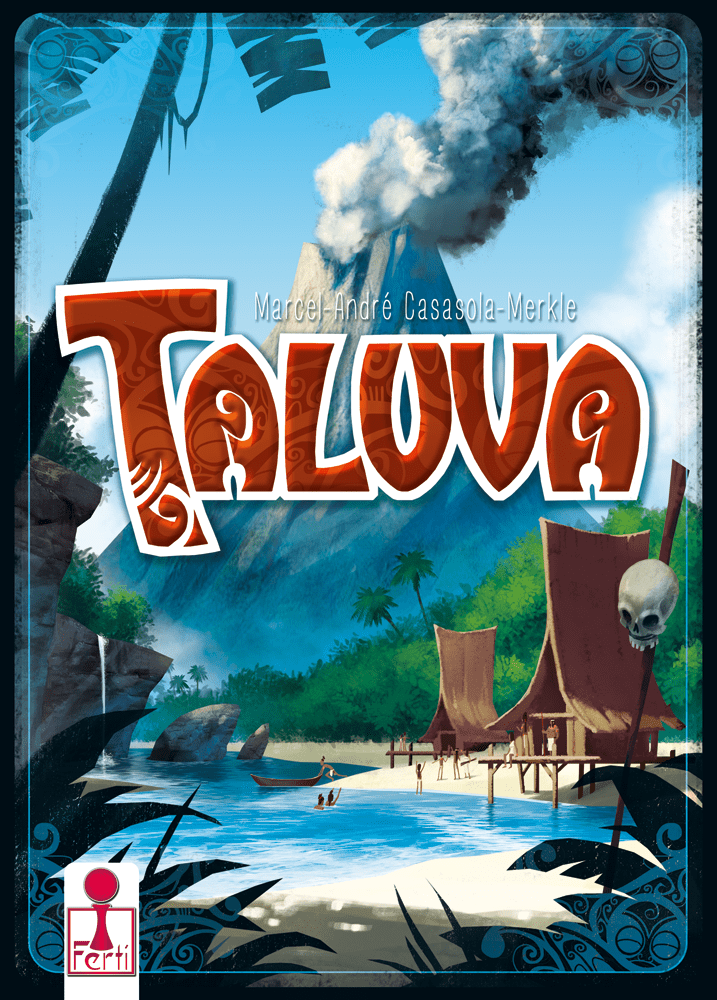
A tile-laying game in which players grow Settlements of their own colour on a landscape built from Volcano tiles. A player wins immediately by placing all pieces of two of the three types (Temples, Towers, Huts). If the tiles run out first, the player with the most Temples wins, with Towers and then Huts as tiebreakers.
Preparación
Shuffle the 48 Volcano tiles and place them as a face-down stack beside the table.
Each player chooses a colour and takes all the Temples, Towers and Huts in that colour.
Tile count depends on the number of players: 24 randomly drawn tiles for 2 players, 36 randomly drawn tiles for 3 players, and all 48 for 4 players.
Un turno
The youngest player starts, and turns go clockwise. Each turn has two steps.
Step 1: Place a Volcano tile. Draw a tile from the stack and look at it. On the first turn, put it in the middle of the table. On later turns, choose one of two options:
- Expand the landscape: Place the tile on the table so at least one side touches an existing tile. Gaps may remain.
- Volcanic eruption: Place the tile on top of existing tiles. The Volcano field must sit on an existing Volcano field, facing a different direction from the Volcano it covers, and no empty space may be left under the tile. You may cover Huts (your own or others'), which are returned to the box, and up to two or three Volcanoes. You may not cover Towers or Temples, and you may not cover a whole Settlement, so at least one piece of each covered Settlement must remain.
Step 2: Place one or more building pieces. You may not build on a Volcano. Choose from these options, provided you have the pieces and all conditions are met before building:
- Build a Hut: Place one Hut on an empty level 1 field that is not next to a Settlement of your colour. This is the only way to start a new Settlement.
- Build a Tower: Place one Tower on an empty level 3 or higher field next to one of your Settlements. Each Settlement may hold only one Tower.
- Build a Temple: Place one Temple on an empty field of any level next to one of your Settlements that has at least three fields. Each Settlement may hold only one Temple.
- Expand a Settlement: Pick one of your Settlements and one terrain type (Jungle, Clearing, Sand, Rock or Lake). Fill every empty field of that type adjacent to the Settlement, placing Huts equal to each field's level (level 1 gets one Hut, level 2 gets two, level 3 gets three, and so on). This is the only way to place several Huts in one turn.
You may join two of your own Settlements by building between them. If you cannot place at least one piece on your turn, you are eliminated.
Fin de la partida
The game ends in one of two ways.
Regular ending: As soon as a player has placed all pieces of two of the three types (Temples and Towers, Temples and Huts, or Towers and Huts), that player wins immediately.
Alternate ending: When no Volcano tiles remain to be played, the game ends at once and the scoring below decides the winner.
Elimination: A player who cannot place any building piece on a turn is eliminated and loses. Their turns are skipped for the rest of the game, and their placed pieces stay on the table.
Puntuación
Used only at the alternate ending. Eliminated players are not counted.
1. The player with the most Temples wins.
2. If tied, the player with more Towers wins.
3. If still tied, the player who has built more Huts wins. Huts returned to the box still count.
The rulebook does not describe any further tiebreak.
Variantes
Two, three and four players: The tile counts for each player count are listed under setup.
Four-player teams: Form two teams of two, with turns alternating between teams. Only the early ending changes: a team wins as soon as one teammate has placed all pieces for two building types and the other teammate has placed all pieces for one building type. The regular ending stays the same, but the buildings of both teammates are added together.
Ranking order: If you want to rank all players, a player who completes two building types does not end the game. That player takes first place and the others keep playing. Each later player to finish takes the next place. The first player eliminated for being unable to build finishes last, and each later eliminated player takes the place just above the last. If the tiles run out, the remaining places are ordered by Towers, Temples and Huts as in a regular ending.
Cambios
- Variantes, por el borrador del reglamento, 23 de noviembre de 2026 (se muestra ahora)
- Puntuación, por el borrador del reglamento, 23 de noviembre de 2026 (se muestra ahora)
- Fin de la partida, por el borrador del reglamento, 23 de noviembre de 2026 (se muestra ahora)
- Un turno, por el borrador del reglamento, 23 de noviembre de 2026 (se muestra ahora)
- Preparación, por el borrador del reglamento, 23 de noviembre de 2026 (se muestra ahora)
- Resumen, por el borrador del reglamento, 23 de noviembre de 2026 (se muestra ahora)