Reglas de Terra Mystica
Resumen
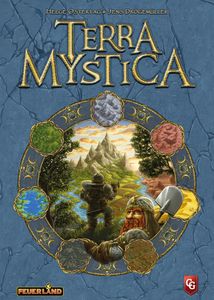
Terra Mystica is a game in which each player leads one of fourteen factions that expand across a map, transform terrain into their home type, build and upgrade Structures, and develop four Cults. The game lasts six rounds. The player who develops their faction best, with the most Victory points at the end, wins.
Preparación
Place the Game board in the middle of the table and the Cult board beside it. For a first game, use the predefined factions for your player count: 2 players Witches and Nomads; 3 players add Alchemists; 4 players Witches, Nomads, Halflings and Mermaids; 5 players add Giants. Each player takes the Faction board and tokens in their color. Put the 7 Priests and 3 Bridges beside your board as your supply and place your Structures on their spaces. Take the starting Workers and Coins shown on your board. Place your Markers: one on the leftmost Shipping space (value 0, except Mermaids at 1), one on the bottom space of the Exchange track, one on space 20 of the Victory point track, and the other four on space 0 of each Cult track. For each Cult symbol beside your starting resources, move your Marker on the Cult board up one space. Split your 12 Power between Bowls I and II as your board shows. Place the Bonus cards face up: 5 for 2 players, 6 for 3, 7 for 4, 8 for 5. Place the Scoring tiles on round spaces 1 to 6 in order, then cover the right half of the round 6 tile with the Game end token. Lay the Favor tiles in a 3 by 4 grid, turn the 10 Town tiles face up, and place an Action token on each of the six Power action spaces on the Game board. Keep the remaining Action tokens, Workers, Coins and Town tiles nearby. The player who most recently gardened takes the orange Starting player token. Placing first Dwellings: starting with the Starting player and going clockwise, each player places one Dwelling on an empty space of their Home terrain. Then, starting with the last player and going counterclockwise, each places a second Dwelling the same way. The Nomads then place a third Dwelling, and the Chaos Magicians place their single Dwelling last. Terrain cannot be transformed at this stage. Finally, beginning with the last player and going counterclockwise, each player chooses one Bonus card, and 1 Coin from the supply goes on each leftover card.
Un turno
Each round has three phases. Phase I, Income: collect Workers, Coins, Priests and Power from your Structures, your Bonus card and your Favor tiles. The first round also includes your faction's starting income. Phase II, Actions: starting with the Starting player and going clockwise, each player takes exactly one Action per turn, and turns continue until no one wants to act. Each Action except passing can be repeated. The options are: transform a terrain space and/or build a Dwelling; advance on the Shipping track; lower the Spade exchange rate; upgrade a Structure; send a Priest to a Cult order space; take a Power action from the Game board; use a Special action; or pass. Conversions may be made any time during your turn, before or after your Action: 5 Power for 1 Priest, 3 Power for 1 Worker, 1 Power for 1 Coin, Priest to Worker, Worker to Coin. Power is gained by moving tokens from Bowl I to Bowl II to Bowl III, and spent by moving tokens from Bowl III back to Bowl I. When an opponent builds or upgrades next to you, you may gain Power by losing one fewer Victory point than the Power gained. Phase III, Cult bonuses and clean-up: award the Cult bonuses on the round's Scoring tile, remove leftover Action tokens from the board and Favor and Bonus cards, and add 1 Coin to each leftover Bonus card. Turn the round's Scoring tile face down. Passing: when you pass, you stop taking Actions for the rest of the round. Return your Bonus card, collect any Victory points it gives, then take one of the three available cards. The first player to pass becomes the Starting player for the next round. In round 6, no new Bonus card is taken.
Puntuación
Cult scoring: on each of the four Cult tracks, the highest player gets 8 Victory points, the second highest 4, and the third highest 2. Nobody scores on space 0. If players tie, they share the points for the tied tiers and round down. Area scoring: count your largest group of connected Structures, where connection includes direct and indirect adjacency through Shipping, Bridges, and the special Tunneling or Carpet Flight of Dwarves and Fakirs. The highest group scores 18 Victory points, the second 12 and the third 6. Ties share the points and round down. Resource scoring: each leftover 3 Coins gives 1 Victory point, after converting other leftover resources to Coins. Alchemists score 1 point per 2 Coins. Winner: the player with the most Victory points wins. If there is a tie, all tied players win.
Variantes
The rulebook describes one variant, the main game, which is played after the introductory game. Randomly select the Bonus cards to use and draw the Scoring tiles randomly, but do not use a Scoring tile with a Spade on its left side for round 5 or 6; put it aside and draw another. Then choose factions freely, or assign them randomly by giving each player one Dwelling of a random color. Each player chooses which side of their Faction board to use. Place the first Dwellings freely rather than on preset spaces. Make sure everyone knows the special abilities of the factions in play before starting.
Cambios
- Variantes, por el borrador del reglamento, 22 de noviembre de 2026 (se muestra ahora)
- Puntuación, por el borrador del reglamento, 22 de noviembre de 2026 (se muestra ahora)
- Un turno, por el borrador del reglamento, 22 de noviembre de 2026 (se muestra ahora)
- Preparación, por el borrador del reglamento, 22 de noviembre de 2026 (se muestra ahora)
- Resumen, por el borrador del reglamento, 22 de noviembre de 2026 (se muestra ahora)