Reglas de The Duke
Resumen
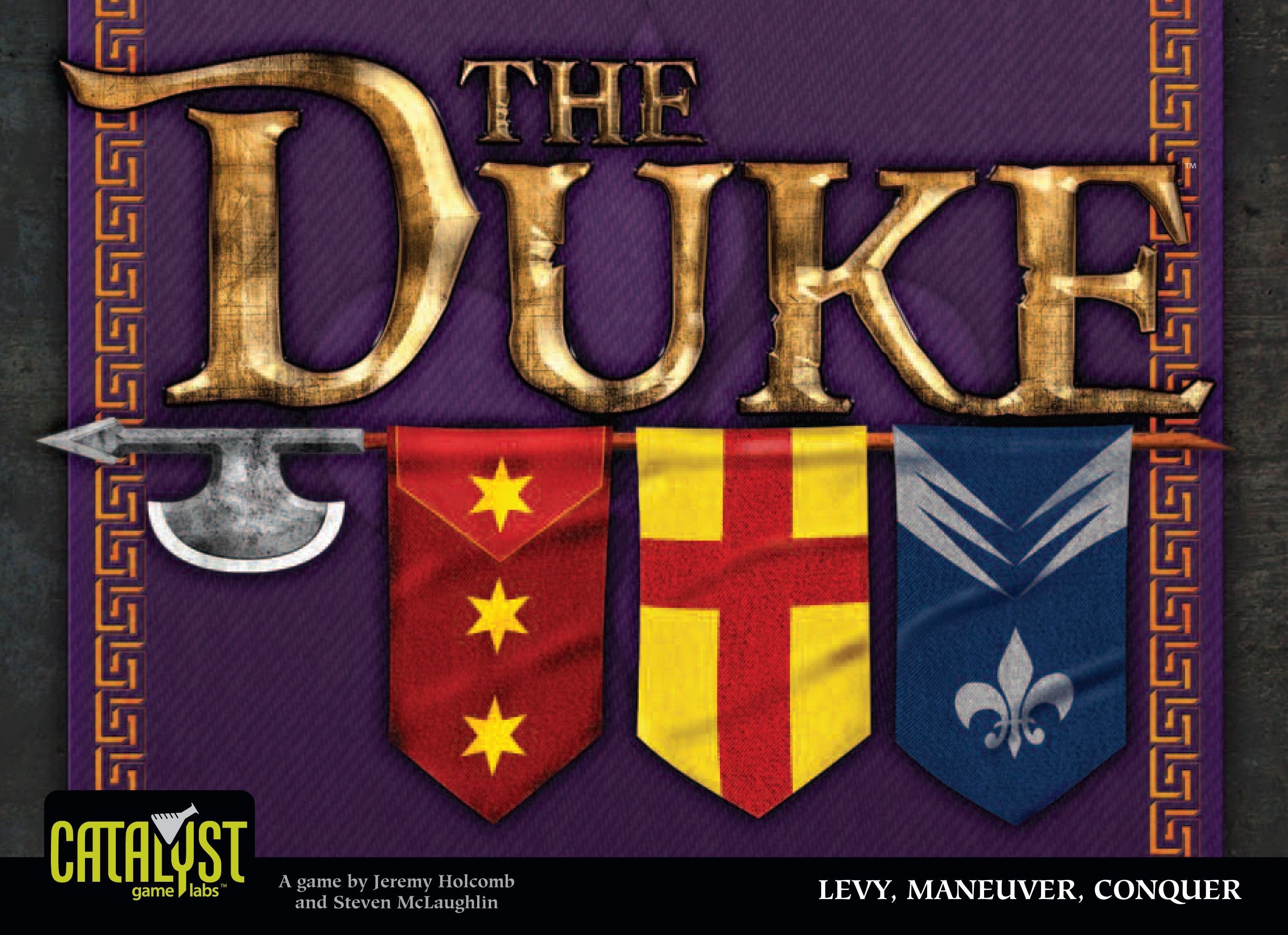
The Duke is a two-player strategy game in which each side moves and places troop tiles on a gameboard, flipping each tile after it moves. Capturing an opponent's troop tile removes it, and a player wins by capturing the opponent's Duke.
Preparación
Place the gameboard in the center of the playing area. Each player takes a bag of Troop Tiles and sets aside their Duke and two Footmen, putting the rest of their tiles into the bag. The player who sets up first places their Duke on one of the two center squares of their home edge, then places both Footmen on squares sharing a side with the Duke (corner-only contact is not allowed). The second player does the same on the opposite edge, without needing to mirror the first player's position. Every tile is placed with its name facing its controlling player, and new tiles always enter on their starting side.
Un turno
Players alternate turns, and each turn a player must do exactly one of the following:
- Move a Troop Tile: Move one of your tiles using a legal movement icon, then flip it to its other side.
- Place a New Troop Tile: Draw a random tile from your bag and place it, starting side up, on an empty square sharing a side with your Duke. If your Duke is fully surrounded, you cannot place a tile and must move instead.
- Use an Enhanced Ability (optional): Only if the players agreed to use Enhanced Tiles.
A player may never pass. Movement icons work as follows: Move goes in a clear straight path to an empty or enemy square; Jump lands on a square past any piece; Slide moves any distance along a clear path; Jump Slide works like Slide but ignores the adjacent tile in that direction; Strike captures an enemy from a distance without moving the tile; Command lets you relocate one of your tiles between Command-marked squares without moving the commanding tile; Dread freezes any tile covered by it, except tiles inside a Fort or Camelot, the Duke, and tiles with a Dread icon. Defense icons block straight-line captures through their square, while a non-straight path may be used if no straight path exists. Capturing removes the enemy tile to the side of the board. A player must say "Guard" when a move lets them capture the enemy Duke next turn, and no player may make a move that would let the opponent capture their Duke on the next turn.
Fin de la partida
The game ends as soon as one player captures the opponent's Duke Tile, and that player wins.
Variantes
Enhanced Tiles: Duchess and Oracle, or any tile with a double border and a Roman numeral, use extra abilities. Summon lets you call a tile next to your Duke in place of a normal turn. Divination lets you flip a tile back to its starting side and pick one of three random tiles from the bag. Escape lets a tile sacrifice an adjacent friendly tile to return to a starting square, capturing an enemy there if present. Ransom lets a player trade or return captured Ransom tiles in exchange for captured opponent tiles.
Terrain Tiles: Mountain blocks movement and strikes through its square and cannot receive new tiles. Fort allows entry with Move, Slide or Jump Slide, allows only one tile per turn, and cannot receive new tiles. Dragon starts in a middle square, captures tiles between turns, and can be enraged by a Slide or Jump Slide that pushes it.
Alternate Objectives: Counting Coup uses Flag Tiles and awards points for ending a move beside the opponent's Flag, with the first player to 3 points winning. Trophy Hunters wins by moving the opponent's Flag to your home edge. Dark Rider is an asymmetric scenario where Pikemen try to capture the Knight or reach the far edge with three tiles, while the Knight wins by capturing three Pikemen. Dynastic Dispute has players draft their tile types alternately into their bags before setup.
Customization Tiles: players may design their own tiles with the stickers, as a balance guide to the standard tiles.
Cambios
- Variantes, por el borrador del reglamento, 23 de noviembre de 2026 (se muestra ahora)
- Fin de la partida, por el borrador del reglamento, 23 de noviembre de 2026 (se muestra ahora)
- Un turno, por el borrador del reglamento, 23 de noviembre de 2026 (se muestra ahora)
- Preparación, por el borrador del reglamento, 23 de noviembre de 2026 (se muestra ahora)
- Resumen, por el borrador del reglamento, 23 de noviembre de 2026 (se muestra ahora)