Reglas de Las Edades de Oro
Resumen
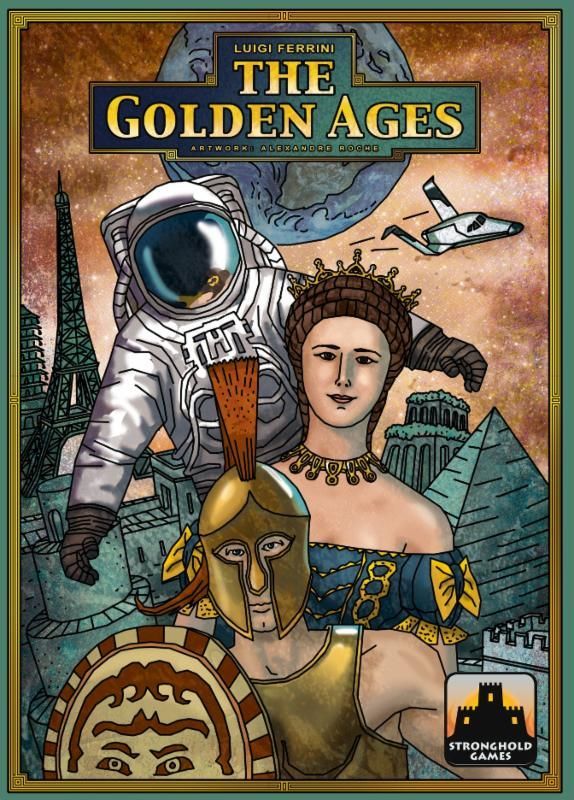
A civilisation-building game over four Eras in which players expand a shared map, found cities, claim resources, and build buildings, wonders, and technologies. The player with the most victory points (VP) at the end wins.
Preparación
- Place the game board and the agora in the middle. Sort the continent tiles by size and place them face down beside the board. Put the square continent tile in the middle of the board, oriented as you like.
- Sort the building cards by Era into four face-down decks. With 3 players, remove all cards marked 4+. With 2 players, remove all cards marked 3+ and 4+.
- Sort the wonder and civilisation cards by Era into four face-down decks each.
- Shuffle the History's Judgement cards, draw five face up beside the board, and return the rest to the box.
- Shuffle the future technology cards into a face-down deck. Shuffle the glory tiles face down beside the board. Place all gold as a general reserve.
- Each player takes a colour set: player board, technology tiles, capital, 3 colonists, 12 cubes, and score marker. Put the score marker on 0. Place the technology tiles on their spaces and put 7 cubes on their cube spaces; the other 5 go to the player board reserve.
- Each player takes 3 gold for the player board.
- Each player takes one civilisation card of each Era (4 total) and one future technology card, keeps them face down and hidden, and returns any unused ones to the box unseen.
Un turno
Each Era has five phases: A) Era setup, B) Expand the map, C) Player actions, D) End of the Era, E) Prepare for the next Era.
A) Era setup: Reveal the wonder cards of the current Era face up, and reveal building cards of the current Era equal to the number of players. Then each player reveals his civilisation card for this Era and keeps either it or his previous one, discarding the other. Skip the choice in the first Era. The player with the lowest number in the upper right corner of his civilisation card becomes the start player.
B) Expand the map: Starting with the start player and going clockwise, each player places one continent tile, with 3 squares in the first Era and 2 squares afterwards. Each new tile must touch an existing tile, stay within the grid, and match land to land and sea to sea; map edges do not count as connections. Tiles cannot overlap other tiles, but they can cover printed islands, and any colonists on covered spaces return to their owners' capitals. Then place your capital on the new tile (first Era) or move it to a square on your most recently placed tile (later Eras), moving any colonists from the old capital square to the new one. A capital covers the resource symbol beneath it.
C) Player actions: Starting with the start player and going clockwise, each player takes one action per turn until all players have started a Golden Age. Actions are:
1. Explorer (uses a colonist): move a colonist and/or found a city, in that order.
2. Builder (uses a colonist): take a colonist to the agora and erect a face-up building card on a free building space. Gain gold based on developed technologies and cards.
3. Artist (uses a colonist): move a colonist to the agora and score 3 VP.
4. Soldier (uses a colonist): attack an opponent's colonists or city (not capitals), paying the gold shown on the leftmost free invasion space, then take a random glory tile. Limited to four uses per game.
5. Build a wonder: pay the gold cost and place the card by your board. Apply any instant effect.
6. Activate a building or wonder: use its ability once per Era, then flip the card.
7. Develop a technology: pay its cost, place it face down, return cubes on it to your reserve, and apply its benefit. Each technology needs the previous one in its row to be developed first; some make older ones obsolete.
8. Start a Golden Age (only if you have no standing colonists): pass for the rest of your turn, flip your capital to its Golden Age side, and gain 2 gold from the reserve each time you would take a turn afterwards. The first player to start a Golden Age this Era takes a History's Judgement card to the agora.
D) End of the Era: Happens when all players have started a Golden Age. Each player scores VP according to the History's Judgement card on the agora. Skip this at the end of the fourth Era.
E) Prepare for the next Era: Discard unbuilt building and wonder cards from this Era and the History's Judgement card on the agora, returning them to the box. Flip capitals to their active side. Stand all colonists up, and move colonists from the agora back to their owners' capitals.
Fin de la partida
The game ends after the fourth Era when a player starts a Golden Age. Every other player then gets one last action, and the game ends after the turn of the player to the right of the player who triggered it. The chosen History's Judgement card is resolved before the final scoring.
Puntuación
At the end of the game, each player scores VP for:
- Gold: 1 VP for every 3 gold.
- Developed technologies: the VP printed on the back of each technology tile beside the player board.
- Glory tiles: the VP on the glory tiles on the invasion track.
- Future technology card: scored if its prerequisite has been achieved.
The player with the most VP wins. If players tie, the tied player with the most cities on the map wins. If still tied, the victory is shared.
Cambios
- Puntuación, por el borrador del reglamento, 23 de noviembre de 2026 (se muestra ahora)
- Fin de la partida, por el borrador del reglamento, 23 de noviembre de 2026 (se muestra ahora)
- Un turno, por el borrador del reglamento, 23 de noviembre de 2026 (se muestra ahora)
- Preparación, por el borrador del reglamento, 23 de noviembre de 2026 (se muestra ahora)
- Resumen, por el borrador del reglamento, 23 de noviembre de 2026 (se muestra ahora)