Reglas de Three Kingdoms Redux
Resumen
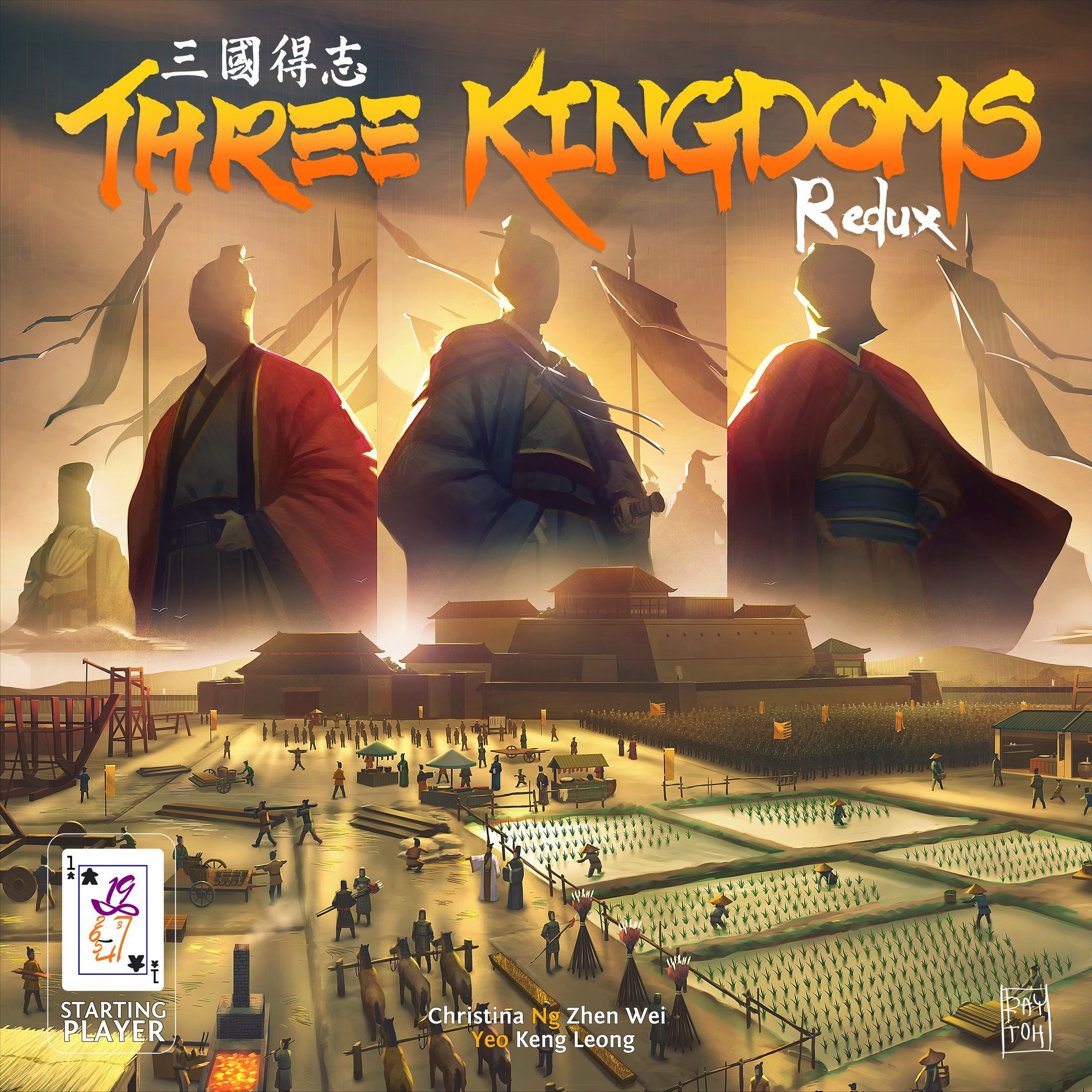
Three Kingdoms Redux is a game for three players, each leading one of the states Wei, Wu, or Shu during the Three Kingdoms period. Over up to 12 rounds, players bid their generals on action spaces to develop their state, build armies, expand their borders, and earn victory points (VPs). The player with the most VPs at the end of the game wins.
Preparación
- Place the game board, round marker on space 1, and the state markers on the bid order track in the order Wei, Wu, Shu. Leave the action order track empty for now.
- Place one criterion marker on the control Han emperor space and the other on the win popular support space, with opposite criteria showing (one administration, one combat).
- Place all 15 border location tokens on their 0 VP side. Put the state markers on 0 on the military VP track and on Governor on the rank track.
- Each player places 5 farm tokens and 5 marketplace tokens on their development spaces, undeveloped side up. Set the rest of the tokens aside as a supply.
- Place each state's tribe marker on its tribal relations track: Wei at 5, Wu at 6, Shu at 7.
- Shu takes the alliance token. Set the Han emperor token aside.
- Each player takes starting resources: Wei 3 gold and 3 rice; Wu 4 gold, 4 rice and 1 popular support; Shu 5 gold, 5 rice and 2 popular support.
- Shuffle the Separation and Unification enhancement decks separately. Deal each player Wei 1 Separation and 3 Unification, Wu 2 Separation and 3 Unification, Shu 3 Separation and 3 Unification. Keep these hidden from others.
- Each lord starts on their own general card and token. Shuffle each state's other general cards and draw 6. Wei keeps 4 of them, Wu keeps 3, and Shu keeps 2. Return the rest to the state's remaining generals.
- Each player takes their bid tokens and keeps the remaining tokens in a shared supply.
Un turno
Each round has two phases, played in order.
Conflict Phase:
1. Recruit generals (rounds 3, 5 and 9 only). Each player draws a set number of general cards, two more than the number they keep, and selects which to recruit. Unselected cards are returned. New generals can bid from that round on.
2. Select alliance action space. The third player in bid order chooses one of the common bidding spaces, other than the control Han emperor and win popular support spaces, and places the alliance token there. The same space cannot be the alliance space in two consecutive rounds.
3. Bid for action spaces. Following bid order, each player places one general face up on an action space per turn. Generals can be paired with army units (limited by leadership), gold for improve tribal relations, bid tokens, popular support tokens or the Han emperor token to raise the bid. A player who runs out of generals is skipped. A player may pass, which ends their bidding for the round.
Resolution Phase:
1. Remove tokens. Determine the winner of each action space by highest bid under its criterion. Ties go to whoever reached the total first. Losing players return their general tokens and attached items. Winners leave theirs in place. Arrange the state action markers on the action order track to match the bid order.
2. Determine turn order for next round. Rank players by number of successful bids (highest is first, lowest is third). Ties are broken by military VPs (more is earlier), then by the order Wei, Wu, Shu. The player who goes first leaves the alliance next round, and the players going second and third form the new alliance, with the third player choosing its space.
3. Take actions in the action order. A player who won several spaces chooses their order and may skip any. After each action, return the used tokens to supply as the action requires.
4. Reduce tribal relations level by 1 if the player did not take the improve tribal relations action this round. Reaching or staying at level 1 gives a deficit token.
5. Receive or activate benefits from recruited generals and state enhancements that trigger at the end of a round.
Update and Maintenance (only if no game end condition was met):
1. Flip the two criterion markers.
2. Pass the Han emperor token to the winner of control Han emperor this round, or return it to supply if nobody bid for that space.
3. Pay upkeep: 1 rice per 2 popular support tokens, plus 1 gold and 1 rice per stationed army unit, each reduced by the matching treasury, granary, and border location tokens. Missing payments give deficit tokens.
4. Award 1 military VP per stationed army unit, including units from earlier rounds.
5. Advance the round marker.
Fin de la partida
The game ends immediately after the Resolution Phase of a round when any of these occurs:
- Round 12 is completed.
- A player has reached level 5 on both their farm and marketplace development.
- A player is promoted to Emperor, which removes the Han emperor.
- A player stations their 5th general at a border location.
When the game ends this way, the Update and Maintenance after that Resolution Phase is skipped, and final scoring follows.
Puntuación
Sum each player's VPs across these categories:
- Military VPs: read from the military VP track.
- Border VPs: at each border, the player occupying more border locations wins it. Totals per player are 5 for winning both borders, 3 for winning one and tying one, 2 for winning one and losing one or tying both, 1 for tying one and losing one, and 0 for losing both.
- Border location VPs: 1 VP for each border location token on the 1 VP side, on the player's granary and treasury.
- Domestic development VPs: compare the sum of farm and marketplace development levels. Highest gets 5, second 3 if tied... see ranking table: individual first 5, joint first 3, individual second 2, joint second 1, individual third 0.
- Civil harmony VPs: compare the sum of tribal relations level and popular support tokens with the same 5/3/2/1/0 ranking. Also add 1, 2, 3 or 4 VPs for tribal relations levels 9, 10, 11 or 12.
- Rank VPs: compare ranks with the same 5/3/2/1/0 ranking. Add 1 VP for each rank step above the lowest rank.
- Han emperor token: the holder gets 2 VPs.
- State enhancement VPs: as printed on the cards constructed.
- Deficit tokens: each gives -3 VPs.
If all three players are tied in a comparative category, each gets 3 VPs. The highest total wins. If tied, the player with more gold and rice tokens in supply wins. If still tied, the order Shu, Wu, Wei decides among the tied players.
Variantes
- Beginners' Tutorial: the rulebook offers a simpler version of the game for first plays. Players use a fixed set of generals for recruitment in rounds 3, 5 and 9 instead of drawing generals, and they ignore all general skills during play. All other rules stay the same.
Cambios
- Variantes, por el borrador del reglamento, 23 de noviembre de 2026 (se muestra ahora)
- Puntuación, por el borrador del reglamento, 23 de noviembre de 2026 (se muestra ahora)
- Fin de la partida, por el borrador del reglamento, 23 de noviembre de 2026 (se muestra ahora)
- Un turno, por el borrador del reglamento, 23 de noviembre de 2026 (se muestra ahora)
- Preparación, por el borrador del reglamento, 23 de noviembre de 2026 (se muestra ahora)
- Resumen, por el borrador del reglamento, 23 de noviembre de 2026 (se muestra ahora)