Reglas de Thurn and Taxis
Resumen
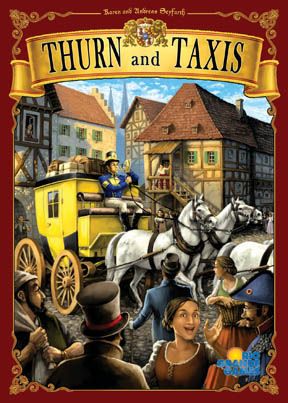
Each player builds a postal system by laying city cards in a single row called a route, then closing the route to place houses in cities, collect bonus tiles and take carriage cards. The player with the most victory points at the end of the game wins.
Preparación
- Place the board in the middle of the table and put the bonus tiles face up on their spaces, each stack ordered with the highest number on top.
- Shuffle the city cards face down, place 6 face up on the board's city spaces and set the rest face down beside the board as the supply.
- Sort the carriage cards by value and place them on their spaces on the board.
- Each player takes 20 houses of one color, a summary card and a principal firm card and places them in front of him as his play area.
- Choose a starting player by any method.
Un turno
Starting with the starting player and continuing clockwise, each player takes these steps in order:
1. Add a city card: Take one of the 6 face-up cards or the top card of the supply, then refill the display from the supply. When the supply runs out, shuffle the discard stack to make a new supply. Postmaster: take a second card from the display or supply. A player with no cards in hand must use the Postmaster, and everyone must use it on the first turn. Administrator: before taking a card, discard the whole display and draw replacements.
2. Play a city card: Start a new route or add the card to one end of your current route. Routes are a single row with no branches. A card must show a city directly adjacent on the board to the city at the end it touches, and it cannot already be in the route. Routes cannot be rearranged or have cards inserted. If you have no suitable card, or choose not to add one, discard the current route without scoring it and start a new one. Postal carrier: add a second card to the route under the same rules.
3. Close and score the route (optional): Allowed only if the route has at least 3 cities. Then:
- a. Place houses: either place one house in one city of each province on the route, or place one house in every route city within a single province. A player may hold only one house per city, and may place in cities where others have houses.
- b. Collect bonus tiles: a route of 5, 6 or 7 or more cities earns the matching length tile (7 if longer, or the next lower one if that tile is gone). Completing all cities of a province or grouped province pair earns that stack's top tile. 'All provinces' needs at least one house in every province. Houses must actually be placed to earn tiles.
- c. Acquire carriage: if the route length is at least the value of the next carriage, take it. Carriages cannot be skipped. Cartwright: take the next carriage even if the route is one or two cities short, but not three.
- d. Discard: place the route's city cards on the discard stack, then discard extra cards from hand until you hold 3 cards.
Fin de la partida
The game ends in the final round once a player has acquired a value 7 carriage or has placed his last house. That player gains the 'Game end' bonus tile. The round is completed, ending with the turn of the player to the right of the starting player.
Puntuación
Each player's score is the value of his highest carriage plus the points on his bonus tiles, minus the number of houses he has not placed. The highest score wins. If players tie, the player holding the 'Game end' tile wins if he is among them. Otherwise, the tied player closest clockwise from the 'Game end' holder wins.
Cambios
- Puntuación, por el borrador del reglamento, 23 de noviembre de 2026 (se muestra ahora)
- Fin de la partida, por el borrador del reglamento, 23 de noviembre de 2026 (se muestra ahora)
- Un turno, por el borrador del reglamento, 23 de noviembre de 2026 (se muestra ahora)
- Preparación, por el borrador del reglamento, 23 de noviembre de 2026 (se muestra ahora)
- Resumen, por el borrador del reglamento, 23 de noviembre de 2026 (se muestra ahora)