Reglas de Tokaido
Resumen
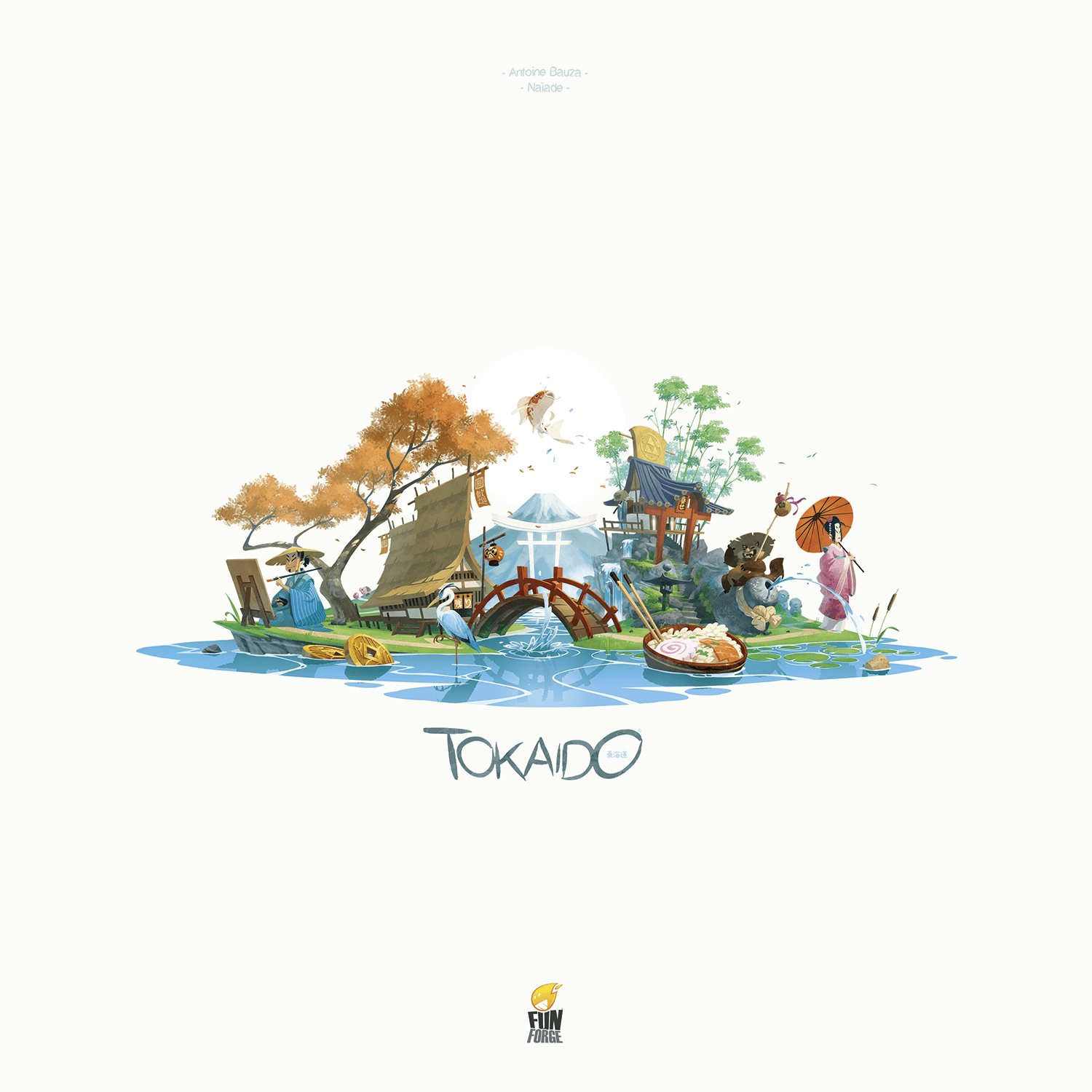
Tokaido is a journey game where players are travelers moving along the historic road from Kyoto to Edo. Along the way they collect souvenirs, meals, panoramas, hot springs and encounters, and they can donate coins at temples. The player with the most points at the end wins.
Preparación
Place the board on a flat surface and put the achievement cards face up beside it. Shuffle the Meal, Souvenir, Encounter and Hot Spring cards into four face-down piles. Sort the Panorama cards by type (Sea, Mountain, Paddy) and value, with 1 on top, and make three piles. Place the seven resulting piles on their spaces on the board. Put the coins beside the board as a reserve.
Each player takes a Traveler piece, the matching marker and a bag token. Place each marker on square 0 of the journey track. Each player draws 2 Traveler tiles at random, keeps one face up and puts their bag token in its hole. Return unused tiles to the box. Each player takes coins equal to the number in the upper right corner of their tile as their starting bank. Each tile has a special ability for its traveler. Finally, place all Traveler pieces in a line at the first Inn, Kyoto, in random order.
Un turno
The player whose traveler is farthest behind on the road takes the next turn. They move their traveler toward Edo to any open space, and may pass over open spaces. Then they receive the benefit of that space. If the traveler is still last after moving, that player goes again.
Double spaces are used only with 4 or 5 players. The first traveler to land on a double space takes the space on the road. A later arrival takes the side space. With 2 or 3 players, the side space cannot be used.
Space effects:
- Village: Draw 3 Souvenir cards face up and buy any number of them by paying their prices. Put unbought cards face down on the bottom of the pile. You need at least 1 coin to stop here. Souvenirs cost 1, 2 or 3 coins. Each set holds one Souvenir of each of four types (small objects, clothing, art, food and drinks). The first Souvenir in a set is worth 1 point, the second 3, the third 5 and the fourth 7. Points are scored when the card is added to your collection.
- Farm: Take 3 coins from the reserve.
- Panorama: Take the next card of that type in ascending order, starting at value 1, and score its value. Each traveler can complete only one panorama of each type.
- Hot Spring: Take a Hot Spring card, worth 2 or 3 points.
- Temple: Donate 1, 2 or 3 coins to the temple in your color and score 1 point per coin donated. You must donate at least 1 coin.
- Encounter: Reveal the top Encounter card, apply its effect, then add it to your collection. Effects: Shokunin (draw a Souvenir and score it), Annaibito (take a panorama card of the depicted type), Samurai (score 3 points), Kuge (take 3 coins from the reserve), Miko (move 1 coin from your bank to the temple and score 1 point).
Fin de la partida
All travelers are at Inns on the way and must stop at each of the four Inns. Arrival at an Inn works as follows. The first traveler to arrive draws one more Meal card than there are players, looks at them secretly and may buy one. Bought Meals cost 1, 2 or 3 coins and are worth 6 points each. Remaining cards are set aside. Each later arrival may buy one of the remaining Meals. Rules at Inns:
- A traveler cannot taste the same Meal twice during the journey.
- A traveler can buy at most one Meal per Inn.
- A traveler is never required to buy a Meal.
After all travelers have arrived at an Inn, unbought Meal cards go to the bottom of their pile. The traveler farthest from the Inn moves next.
The game ends when all travelers have reached Edo at the last Inn. Then the end-of-game achievements and temple rankings are resolved.
Puntuación
Journey points are scored throughout the game.
Panorama achievements (3 points each) are given during the journey. The first traveler to complete a panorama of a given type receives that type's achievement card and scores 3 points immediately.
At the end, four achievements are awarded, each worth 3 points:
- Gourmet: highest total coins on Meal cards.
- Bather: most Hot Spring cards.
- Chatterbox: most Encounter cards.
- Collector: most Souvenir cards.
If travelers are tied for an achievement, they all score 3 points.
Temple donors are ranked by total coins donated. The top donor scores 10 points, second scores 7, third scores 4, and all other donors score 2. Travelers who donated nothing score nothing. Tied players all score the points for their shared rank. For example, two players tied for first each score 10.
The player with the most points wins. If players are tied, the tied player with the most achievement cards wins. You may recount your points at the end using your collection if you suspect an error.
Variantes
Journey of Initiation: Leave the Traveler tiles in the box and give each player 7 coins at the start. This is a simpler way to learn the game.
Return Trip: Travel from Edo to Kyoto instead of the usual direction. Otherwise the rules are the same.
Gastronomy: When the first traveler arrives at an Inn, they draw only as many Meal cards as there are players, instead of one more. This gives each traveler less choice and makes arrival order more tactical.
Preparations: To offset the order of departure from the first Inn, adjust starting banks at the start only. The last player to leave Kyoto gets 2 extra coins, the third player gets 1 extra, the second gets none, and the first removes 1 coin from their bank. Choose Traveler tiles before the departure order is randomly determined.
Two players: Add a Neutral traveler to the starting Inn, with its order set at random. The leading player moves the Neutral traveler whenever it is last on the road. When it stops at a Temple, take a coin from the bank and place it in the temple area of its color. When it stops at an Inn, the moving player draws four Meal cards, discards one at random face down to the bottom of the pile, and the rest are used as normal. The rest of the rules are unchanged.
These variants can be mixed, and they can also be used in the two-player game.
Cambios
- Variantes, por el borrador del reglamento, 23 de noviembre de 2026 (se muestra ahora)
- Puntuación, por el borrador del reglamento, 23 de noviembre de 2026 (se muestra ahora)
- Fin de la partida, por el borrador del reglamento, 23 de noviembre de 2026 (se muestra ahora)
- Un turno, por el borrador del reglamento, 23 de noviembre de 2026 (se muestra ahora)
- Preparación, por el borrador del reglamento, 23 de noviembre de 2026 (se muestra ahora)
- Resumen, por el borrador del reglamento, 23 de noviembre de 2026 (se muestra ahora)