Reglas de Tournay
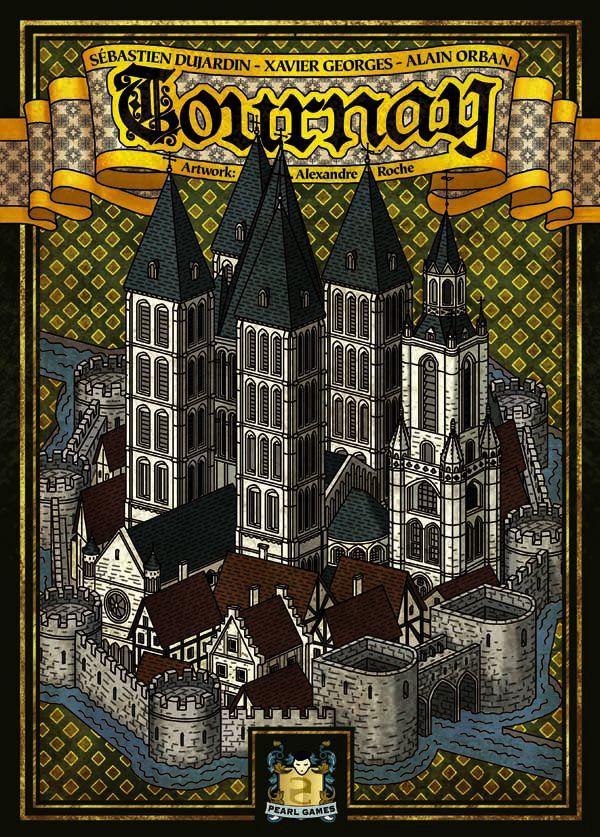
Resumen
Tournay is a card game in which you run a wealthy Tournaisian family's district as the city is rebuilt after the Norman invasion. You manage citizens of three classes: military (red), religious (white) and civilian (yellow). Build buildings and prestige buildings to earn prestige points (PPs), and the player with the most prestige after the final scoring wins.
Preparación
Sort the activity cards by color and level into 9 decks of 10 cards. For an introductory game, use only the basic cards. Shuffle each deck and place it in descending level order under the slot of matching color on the gameboard, with the Supply side face up.
Make a 15-card Event deck and place it above the board. Reveal its top 3 cards to form the event queue above the other three black slots.
Place 3 citizens of each color on the designated spots on the board. Each player takes 6 deniers, a Plaza card and the scoring token of their color. Each player stands 2 citizens of each class (yellow, red, white) on their Plaza card; these are their available citizens. Put the remaining deniers and the damage / gray citizen tokens in a general supply.
Choose a starting player, who takes the start player marker. The marker is only used to determine exactly when the game ends.
Un turno
Players take turns in clockwise order. A turn has two phases, in this order:
- Play a card (optional): You may play one card from your hand into your district. Pay the construction cost shown in the upper-left corner. The card must be orthogonally adjacent to a card already in your district, except for your first card. A district may not extend beyond 3 rows or 3 columns. You may stack a card on a card of the same color. A card placed on a card of a different color replaces it, and the old card is discarded face down under its deck.
2. Perform one action with citizens (mandatory): Choose one of these:
- Draw a card: One citizen of a color lets you draw a Level I card of that color, two let you draw Level II, three let you draw Level III.
- Activate a building: Put a citizen of the same color on an unoccupied building in your district to use its effect.
- Combat an event: See the rules for combat below.
- Earn deniers: Use your own citizens of one color to earn 2 deniers each.
- Gather your citizens: Move all your citizens back onto your Plaza card and return damage and gray tokens in your district to the supply.
You may use your own available citizens for free, or citizens from an opponent's Plaza, which costs 2 deniers per citizen paid to the owner. Used citizens are laid down beside the Plaza card they came from. Character cards never take citizens.
Drawing: Take the top face-up card, or look at the top two face-down cards and keep one, putting the other face up on top of the deck. If one of the drawn cards is a Town Crier, draw an extra card first, then resolve the Town Crier (see below).
Town Crier: Turn the Town Crier 90 degrees under its deck, so that deck has no more Town Criers for the rest of the game. Place one coin from the supply on each event card in the queue that has an empty circle. Then every player is affected by each event card, once for each coin on it.
Ramparts: In response to a Town Crier, a player may play a Rampart card from hand to avoid one entire event card. Rampart cards are kept face down in one pile beside the district.
Combat: You may combat an event in the queue that has at least one coin on it. To combat an event that makes players lose deniers, use 2 citizens of the color shown on the card. For other events, use 1 citizen of that color and pay the coins on the card plus 1 denier. Return the coins to the supply, take the event card into your hand (it can later be built as a Rampart), and replace it with the top card of the event deck.
At the end of your turn you may hold at most 4 cards. Discard any extras face down under their decks. Rampart cards count toward this limit.
Fin de la partida
The game ends at the start of the start player's turn if either of these is true:
- Condition 1 is met by at least 2 players. Condition 1 is having a 9-space district with at least 2 visible prestige buildings.
- Condition 1 and Condition 2 are met at the same time. Condition 2 is having revealed one more Town Crier than there are players: 5 with 4 players, 4 with 3 players, 3 with 2 players.
Each player then takes one final turn. After that, all players simultaneously and secretly choose one card from their hand and place it face down in their district. They reveal the cards together, pay their costs and gain any benefits from character cards in the same row or column. Finally, players may move all their Rampart cards from hand into their ramparts pile.
Puntuación
Flip the gameboard to its score track and place the players' markers beside it.
Score each visible prestige building for all players. The player who built it earns the left PP value, and every other player earns the right PP value. Score buildings one at a time, starting with the start player, and place a damage marker on each building once it is scored so you can track what is done. Buildings with the same name score only once.
Then each player earns the PPs printed below the costs of every card in their district, including covered cards, plus 1 PP for each card in their ramparts pile. No single prestige building can give more than 12 PPs to the same player.
The player with the most prestige points wins. The rulebook does not state a separate tie-break for the final prestige count.
Variantes
Advanced rules: For longer, more strategic games, change these rules:
- Setup: each player starts with one citizen of each class on their Plaza and 9 deniers. Each general supply starts with players plus 3 citizens of each color (7 with 4 players, 6 with 3, 5 with 2).
- Add a sixth action, Recruit a citizen: use one of your citizens and pay 5 deniers to take a citizen of the same color from the general supply. Lay your used citizen beside your Plaza and stand the recruited one on your Plaza, where it is available.
Expansion: Use the expansion cards in place of some basic cards. Replace the cards marked with the expansion symbol by the same-color, same-level cards with the other symbol. Shuffle together the cards of the same color and level that carry either symbol, then draw 3 cards at random for each deck. Expansion character cards have no arrows. They do not affect cards in their row or column but give a permanent effect to their owner. Examples:
- Bakery (II): 2 deniers per military or religious citizen on your Plaza.
- Brewery (I): 1 denier per citizen on your Plaza; Brewery (II): 2 deniers per citizen beside your Plaza.
- Inn (I): 4 deniers per civilian and military citizen pair on your Plaza.
- Senator (I/II): 2 or 3 deniers when you use the Gather action.
- Abbey (I/II): reveal the top cards of the Level I or II decks and add 2 of the 3 to your hand.
- Monk and Templar (I/II): let you activate a second yellow card (Monk) or red card (Templar) in the same row or column with an extra citizen.
- Catapult (I): place a damage token on an unoccupied card in each opponent's district; a citizen here can protect you from one event.
- Courthouse (II): the richest player gives 4 deniers to the active player; ties for richest pay 3 each.
- Knight (I/II): a second red or gray citizen in the same row or column lets you combat an event.
- Lordship (I): choose a color; each player pays you 1 denier per building of that color in their district.
- Mercenary (II): earn 3 deniers per military citizen instead of 2 with the Earn action.
Cambios
- Variantes, por el borrador del reglamento, 23 de noviembre de 2026 (se muestra ahora)
- Puntuación, por el borrador del reglamento, 23 de noviembre de 2026 (se muestra ahora)
- Fin de la partida, por el borrador del reglamento, 23 de noviembre de 2026 (se muestra ahora)
- Un turno, por el borrador del reglamento, 23 de noviembre de 2026 (se muestra ahora)
- Preparación, por el borrador del reglamento, 23 de noviembre de 2026 (se muestra ahora)
- Resumen, por el borrador del reglamento, 23 de noviembre de 2026 (se muestra ahora)