Reglas de Wir sind das Volk!
Resumen
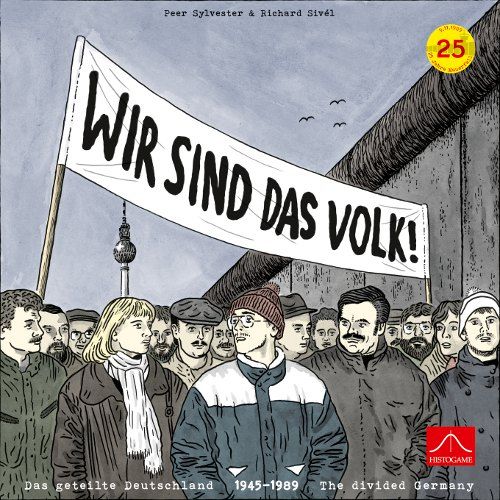
Wir sind das Volk! is a two-player game about divided Germany from 1945 to 1989, with one player running East Germany and the other West Germany. Players use action cards to build their economies and raise living standards while keeping unrest low, because too much unrest sparks mass protests. A state that reaches 4 mass protest markers collapses and loses the game.
Preparación
Place 2 unrest counters in each of the 3 West German supplier provinces and 3 in each of the other 11 provinces. Put 1 socialist counter in the socialist holding box. West places a yellow factory on Hamburg and on Dortmund; East places a red factory on Berlin and on Bitterfeld. Rotate each factory so its number 1 points north. Set aside all other factories and infrastructure. Place the prestige, Western currency, socialist and End of Decade markers on their tracks, and put the flight marker on 0. The player with the prestige advantage starts: East has it when the prestige marker is in the red part of the track, otherwise West does.
Un turno
The game has 4 decades, each with two half decades followed by an End of Decade stage.
At the start of the first half decade of a decade, put that decade's special card in the card display, shuffle the decade's normal cards into a draw deck, and fill each hand to 2 cards. From decade II, players may first discard leftover cards from earlier decades; a player holding 3 cards must discard at least 1. Then reveal the top 7 cards of the deck into the display.
Players alternate turns, starting with the prestige advantage holder. On a turn, take one card from the display or your hand and perform one action with it. Only East may take the special card. If East takes it, East either discards a hand card or lets West draw the top deck card into its hand.
The half decade ends when the last normal card in the display has been played. For the second half decade, skip the refill and reveal, leave any special card in the display, and let the player who did not make the last action of the first half start. Played cards line up at the bottom edge with their flight icons visible, unless a police power icon sends the card to East's side.
The possible actions with a normal card are:
- Remove an unrest counter: free if the card is your colour (East with red, West with yellow). A dual card, or a card of the opponent's colour, requires dismantling one build point, and you cannot take this action if you have nothing to dismantle.
- Build up the economy: gain build points equal to the card value and spend them on factories (empty cities) or infrastructure (empty blue lines touching a factory). You cannot build in a province with a mass protest marker. A connection between two factories that is fully built becomes a working connection, and each factory's value equals 1 plus its working connections.
- Increase living standard: place up to 3 living standard (LS) counters in different provinces. A province's first LS needs an economy of 3, the second 6, the third 9, and so on. Card value can temporarily cover a shortfall, but never more than 2 points per province. Each placed LS removes one unrest counter from that province.
- Trigger the card event: East may trigger red and dual card events; West may trigger yellow and dual card events. Execute all icons on a red or yellow card. On a dual card you may ignore one arrow or one icon without arrows.
Mass protests: a province with 4 unrest counters gets a mass protest marker, with another at 8, 12, and so on. Markers are removed as counts drop below those thresholds.
Fin de la partida
After the second half decade, resolve the End of Decade stage. Victory is checked only at this point, in the collapse check. If no state has collapsed, discard the draw deck and any special card left in the display, then start the next decade. The game ends after 4 decades.
The End of Decade stage has 10 phases, resolved in order:
1. Flight from the Republic, or the Wall costs, depending on which side of the End of Decade marker is face-up.
2. Prestige effects, decided by the prestige advantage holder.
3. Western currency income and factories turning rundown.
4. Payment for police power cards collected by East.
5. Holding living standards, where surplus LS are removed.
6. Internal comparison, where a province with fewer LS than the highest developed province in the same state gains unrest.
7. East-West comparison, where provinces attack adjacent opposing provinces with unrest.
8. Use of police power cards to remove unrest.
9. Socialists phase, where East gains or loses socialists according to the track.
10. Collapse check.
Some results end the game immediately. East loses if it must dismantle more than it has during the End of Decade, or if it must remove a socialist that is not on the board (socialism fails). East wins immediately if it should receive a socialist but all 12 are already on the board (triumph of socialism). A state with 4 or more mass protest markers collapses and loses. If both collapse at the same time, East wins.
Puntuación
The game does not award points. A player wins by making the opposing state collapse, meaning it has 4 or more mass protest markers at the collapse check. If both states collapse simultaneously, East wins. If the game reaches the end of the fourth decade with no winner, East wins.
Cambios
- Puntuación, por el borrador del reglamento, 23 de noviembre de 2026 (se muestra ahora)
- Fin de la partida, por el borrador del reglamento, 23 de noviembre de 2026 (se muestra ahora)
- Un turno, por el borrador del reglamento, 23 de noviembre de 2026 (se muestra ahora)
- Preparación, por el borrador del reglamento, 23 de noviembre de 2026 (se muestra ahora)
- Resumen, por el borrador del reglamento, 23 de noviembre de 2026 (se muestra ahora)