Règles de Amyitis
Résumé
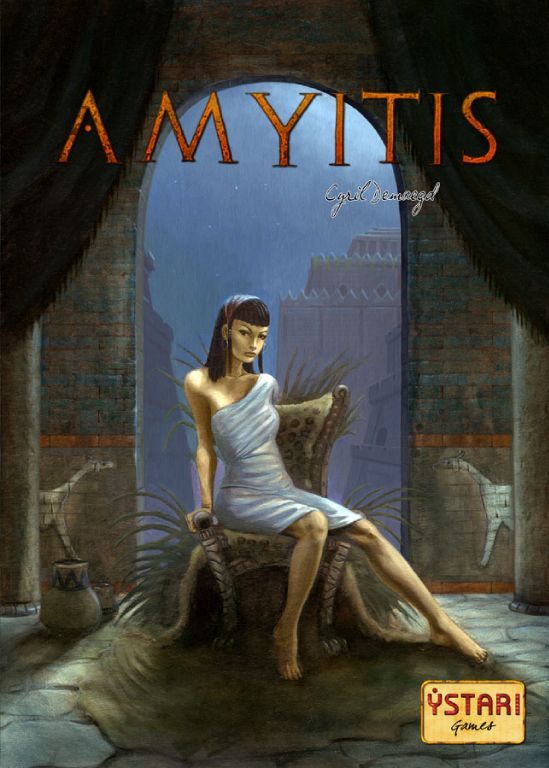
Players are noble Babylonians competing for prestige by building the hanging gardens, irrigating them, trading with Mesopotamian cities and recruiting characters. The player with the most prestige points at the end of the game wins.
Mise en place
Remove the Craft and Court cards marked for unused player counts: in 3-player games, the cards with a '4 players' sign; in 2-player games, those with a '3 players' or '4 players' sign. Place the boards, put a camel token on the Babylon square of the Mesopotamia board, and place the Amyitis card matching the player count beside the boards. Keep talents, camels, neutral cubes and resource tokens together as the general stock. Put the quality 2 Plant card on Khorsabad (either face), then put the other three Plant cards on Eshnunna, Ur and Mari with the quality 1 face showing. Shuffle the Craft cards into a face-down pile beside the board, and place the Court cards face up beside the board. Put one Wine token on each level 2 Caravaneer card. Sort the Garden tiles by type and shuffle each type: place 7 quality 1 tiles at random on the first floor, 5 quality 2 tiles at random on the second floor, the quality 3 tile worth 10 on the top floor, and 3 quality 3 tiles at random on the third floor. Return unused tiles to the box. In 2-player games, leave the three starred squares empty. Each player chooses a color and takes its cubes, 4 talents, one camel and a level 0 Caravaneer card, and places their score marker on 0. Draw lots for the first player, who takes the First player card.
Un tour de jeu
Each turn has three phases: setup, player actions, and end of turn. In the setup phase, the first player shuffles the Craft cards and lays them face up in groups of three, with the number of groups equal to the number of players. Each player then receives talents, and possibly prestige points, matching the figure on their Banker card; players without a Banker get nothing. In the actions phase, players act clockwise, one action at a time, until everyone has passed. Each action is one of: pass, recruit, or move the Caravan.
Passing places a marker on the Pass square, and the player takes no further actions this turn. Each later turn a passed player takes one talent from the stock.
Recruiting means choosing a Craft card. The first card in a group is free, the second costs one talent and the third costs two talents, paid to the stock. The chosen card is flipped to its talent side and its action is performed. The actions are: peasant, which places a cube on the leftmost empty field of a line and takes the matching resource token; priest, which places a cube in the leftmost square of a temple and pushes other cubes right, expelling the rightmost cube if the temple is full; engineer, which places a cube on an available irrigation area connected to the river through irrigated areas and scores 2 prestige points; and merchant, which takes a camel from the general stock.
Moving the Caravan means spending at least one camel and moving it clockwise at least one square. The distance is the number of camels spent plus any bonus from the Caravaneer level. The player then acts on the city where it stops: selling resources for prestige points and a free irrigation; buying a Court card by paying the resource that city asks for; or buying a plant by paying the required tokens, then planting it.
Planting requires a garden square with at least one fully irrigated side and a plant quality at least equal to the floor's quality. Each Gardener card spent raises plant quality by one. The player takes the Garden tile and gains its points and bonuses. The player with the most cubes around the new plant scores points equal to its quality, with no points on a tie. Any neutral irrigation needed between the new plant and existing plants is then placed.
In the end-of-turn phase, the procession, temples, stock limits and First player card are resolved in that order.
Fin de la partie
The game ends at the end of a turn once few enough Garden tiles remain to be planted. In 2-player games, this happens when 3 or fewer tiles are left. In 3- and 4-player games, it happens when 4 or fewer tiles are left. The final scoring then takes place.
Décompte des points
During the end-of-turn phase, the last player in turn order places a cube from their personal stock in a temple of their choice, and a neutral cube goes into each of the other two temples. Neutral cubes do not count toward majorities. A player alone in a temple gets only the first-place reward. Ties are won by the player whose rightmost cube is farthest right. Temple rewards are: Ishtar gives one camel or one talent for first place and the other item for second; Marduk gives 2 points for first and 1 point for second; Tammouz gives the first-place player a resource token from the stock, and the second-place player may swap one resource token for one from the general stock, but not Wine. In 2-player games, only the first-place player in a temple is rewarded.
Stock limits apply after the temples: players at Caravaneer level 0 or 1 keep at most 2 resource tokens, and players at level 2 keep at most 4. Excess tokens return to the general stock.
Amyitis' favor is awarded according to the number of Garden tiles each player has. In 2-player games, 5 or 6 tiles earn 5 points and 7 or more earn 10 points. In 3-player games, 4 or 5 tiles earn 5 points and 6 or more earn 10 points. In 4-player games, 3 or 4 tiles earn 5 points and 5 or more earn 10 points. These bonuses do not stack.
Finally, each player scores 1 point for each resource token left in their stock. Camels and talents score nothing. The player with the most prestige points wins, and if players are tied for first, all of them win.
Variantes
The rulebook gives no solo, team or short-game variant. It does include player-count adjustments: in 2-player games, three squares are left empty, the Craft and Court cards for 3 and 4 players are removed, only first place is rewarded in temples, and the Amyitis thresholds and game-end trigger change. In 3-player games, the 4-player Craft and Court cards are removed and the Amyitis thresholds and game-end trigger change.
Modifications
- Variantes, par le brouillon tiré du livret de règles, le 23 novembre 2026 (affichée maintenant)
- Décompte des points, par le brouillon tiré du livret de règles, le 23 novembre 2026 (affichée maintenant)
- Fin de la partie, par le brouillon tiré du livret de règles, le 23 novembre 2026 (affichée maintenant)
- Un tour de jeu, par le brouillon tiré du livret de règles, le 23 novembre 2026 (affichée maintenant)
- Mise en place, par le brouillon tiré du livret de règles, le 23 novembre 2026 (affichée maintenant)
- Résumé, par le brouillon tiré du livret de règles, le 23 novembre 2026 (affichée maintenant)