Règles de Barrage
Résumé
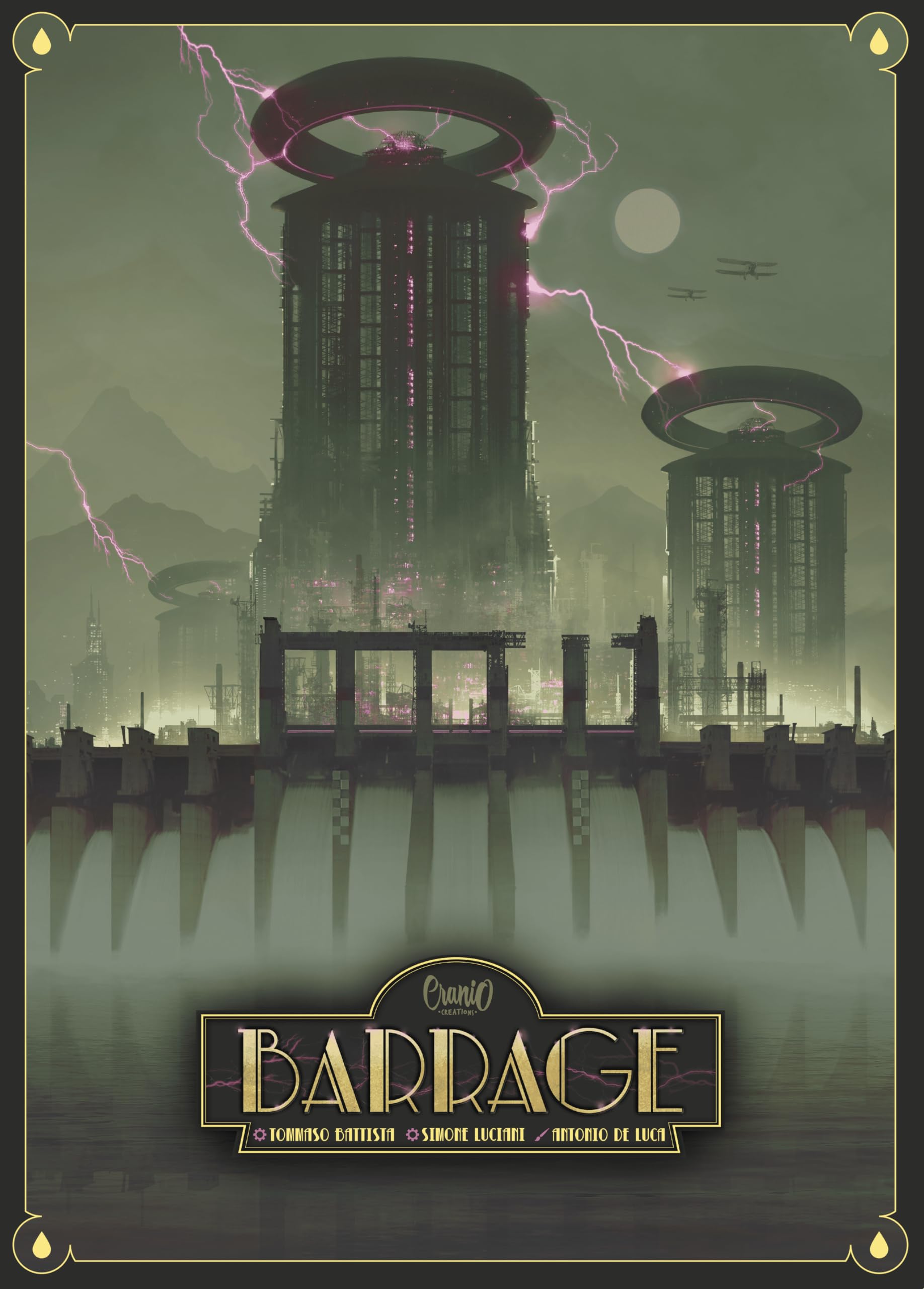
Barrage is a race to produce energy. Each player runs one of four national energy companies, buying technologies to build dams, powerhouses and conduits that move water and turn it into energy, which in turn fulfils contracts. The game lasts five rounds, and the player with the most Victory Points (VP) at the end wins.
Mise en place
- Place the double-sided map in the centre, with the side without icons recommended for first games.
- Place the energy track and the management board next to the map.
- Put the excavators and concrete mixers (machineries), credits sorted by value, and water drops in a general supply.
- Shuffle the headstream tiles and place 4 face up on the map. Return the rest to the box.
- Shuffle the bonus tiles, remove the one shown in the setup image, and place 5 face up on the energy track.
- Shuffle the objective tiles and place 1 at the end of the energy track.
- Shuffle the national contracts and place a number equal to players minus one face up on the management board.
- Sort the private contracts by back, shuffle each pile, and place them face down on the management board, turning the top two of each pile face up.
- Build the neutral dams from the setup tiles drawn at random: a level 1 dam in the mountains, a level 2 dam in the hills and a level 3 dam in the plains, each with 1 water drop.
- Set the patent office board beside the map, sort the advanced technology tiles by back, shuffle the piles, and place the top three tiles of pile I face up.
- Return the basic wild technology tiles (marked with a question mark) to the box for the introductory game, along with the advanced tiles.
For the introductory game, each player takes the components of one company: a company board, an executive officer tile placed to the left of the board, a construction wheel, and all pieces of that colour. Each player also receives 6 credits, 6 excavators and 4 concrete mixers, plus the starting contract matching their company. Players pick company boards and starting contracts in turn, with the first player chosen at random and the others choosing clockwise. Turn order markers are placed opposite to the selection order, so the last to choose goes first. Place the energy markers on the starting space of the energy track, and place the VP markers on space 10 of the scoring track.
Un tour de jeu
The game is played over five rounds. Each round has five phases in this order: income and headstreams, actions, water flow, scoring, and end of round.
Income and headstreams: Every player collects the active income shown on their company board for each structure they have built. Water drops are then placed on the headstream tiles according to the round number shown on them, except in the fifth round.
Actions: Players take turns in turn order. On your turn you must place engineers on one free action space and perform its action. Each action space needs one to three engineers, and some spaces with a red outline also cost 3 credits. You cannot use a space that is already occupied by another player's engineers on your company board, though shared management spaces can be taken by anyone first. You may not place engineers you do not have. Once you have no engineers left, you must pass. The phase ends when all players have passed.
Actions include:
- Construction: pay the engineers, place the technology tile matching the structure in the open segment of your wheel, add the required machineries, rotate the wheel one segment, and place the structure on the map.
- Management actions: the turbine station (production), the bank (credits), the workshop (rotate your wheel), the machinery shop (buy machineries), the contract office (take contracts), and the patent office (buy advanced technology tiles for 5 credits).
- Water management: add water drops to headstreams.
Water flow: All water drops on headstream tiles flow along the rivers and basins. Drops are moved one at a time. A dam fills up to its level, and any extra water passes on towards lower basins. Water that reaches the bottom of the map is lost.
Scoring: See the scoring section.
End of round: See the end section.
Fin de la partie
The game ends after the scoring phase of the fifth round, and the final scoring then takes place. The end-of-round phase is not played in the last round. If a player's energy marker passes the 30 space, they flip it and keep counting from the start of the track.
Décompte des points
During each round, the first player on the energy track scores 6 VP and the second scores 2 VP. If two or more players tie for first place, they split the 8 VP evenly, rounding up, and nobody gets the second-place bonus. Any tie for second place gives 1 VP to each tied player. Only players who produced at least 1 energy unit can score this.
Credits are gained according to your position on the energy track. If your marker is on the 0 space, you gain 3 credits but lose 3 VP.
The current round's bonus tile (the leftmost one) is scored by players who produced at least 6 energy units. If your marker is in the current section or further, you get the full reward. If it is in an earlier section, you get a reduced reward, which is reduced by 4 VP for each section you are behind. If your marker is before space 6, you score nothing from that tile. Then the leftmost bonus tile is discarded, and the game ends if the last tile is removed.
At the end of the game, each objective tile ranks players by a condition. The first player scores 15 VP, the second 10 VP and the third 5 VP. Ties split the points for the tied places, rounded up.
Leftover resources (excavators, concrete mixers and credits) in your personal supply score 1 VP per set of 5 items. Each water drop held in your personal dams scores 1 VP.
The player with the most VP wins. If players tie, the one who produced the most energy in the last round wins.
Variantes
- Introductory game: the rulebook recommends this first. It uses the simplified setup and rules, leaves out the advanced rules in the boxes marked for later reading, and omits the basic wild technology tiles and the advanced technology tiles.
- Two- and three-player games: the setup changes. Components of unused companies are returned to the box, unused turn order spaces are left empty, and engineers of unused companies are placed on the action spaces marked with a 3 or 4 symbol, as shown in the setup notes. In a two-player game, the national contracts and private contract piles are set up as described for the player count.
- Automa (solo or against automa players): the rulebook says the Automa rules are in a separate Automa rulebook, with 20 automa tiles.
Modifications
- Variantes, par le brouillon tiré du livret de règles, le 22 novembre 2026 (affichée maintenant)
- Décompte des points, par le brouillon tiré du livret de règles, le 22 novembre 2026 (affichée maintenant)
- Fin de la partie, par le brouillon tiré du livret de règles, le 22 novembre 2026 (affichée maintenant)
- Un tour de jeu, par le brouillon tiré du livret de règles, le 22 novembre 2026 (affichée maintenant)
- Mise en place, par le brouillon tiré du livret de règles, le 22 novembre 2026 (affichée maintenant)
- Résumé, par le brouillon tiré du livret de règles, le 22 novembre 2026 (affichée maintenant)