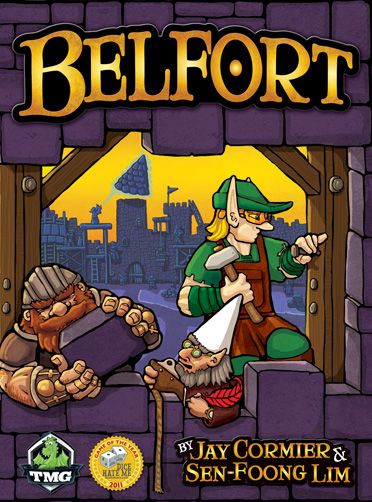
Règles de Belfort
Résumé
Belfort is a worker-placement game where players use Elves and Dwarves to gather resources and build Properties, Walls and Guilds across the five districts of a castle city, and can hire Gnomes to unlock extra abilities. Points come from district majorities and worker majorities, scored three times in the game. The player with the most points after seven rounds wins.
Mise en place
- Arrange the five districts into a pentagon board in numbered order, with the Collection board and Calendar board beside it.
- Make supply piles of Wood, Stone, Metal and Gold next to the Collection board.
- Each player takes a color set, keeps 3 Elves and 3 Dwarves (Master side down) and puts the rest in a shared worker supply. Each player also gets starting resources (1 Wood, 1 Stone, 1 Metal, 5 Gold), 12 Property markers and a Scoring marker placed at the start of the track.
- Give each player a random Turn Order Crest matching the player count.
- Put Gnomes for hire on the board: 9, 14, 18 or 22 for 2, 3, 4 or 5 players. Return extras to the box.
- Set the Recruiter's Desk planks according to player count.
- Choose 5 Guild tiles and place them on the board in Guild locations (see variants for selection).
- Place the Calendar marker on the first month of Spring.
- Shuffle the Property deck, reveal 3 cards as the draw pool, and deal each player 5 cards. Each player keeps 3 and discards 2 to a face-up pile.
Un tour de jeu
Each round has five phases.
- Calendar: Move the Calendar marker to the next month. In the first round, place it on the first month of Spring.
- Placement: Starting with the holder of Crest 1 and going in turn order, each player places one Worker on an open plank or passes. Workers cannot go on occupied planks. Some planks cost Gold, and some Property planks need a Gnome unlocked first. Once a player passes, all remaining Workers go into the Resource Areas.
3. Collection: Resolve the Collection board left to right, top row then bottom row.
- Resource Areas: each Worker collects resources. Masters count as two Workers here. The player with the most Workers in an area gets a bonus, and a tie gives no bonus.
- King's Camp: players swap Turn Order Crests in placement order.
- Recruiter's Desk: each Worker there is returned and a new Worker of the same type is taken from supply.
- Income and taxes: collect Gold for each Income Coin shown on built Properties, then pay tax based on the Scoring marker's tax level. Unpaid tax moves the Scoring marker back.
- Actions: In Crest order, each player takes any actions they want, in any order. Each placed Worker must be activated and returned during this turn. Options include building Properties (by playing a card from hand and placing a marker on a matching symbol), Walls (3 Wood and 3 Stone), and Guilds (paying the tile cost). Also possible are visiting the Trading Post and hiring a Gnome, each once per turn. Hiring a Gnome costs 3 Gold and needs an open Gnome Lock. At the end of the turn, buy one Property card for 1 Gold as the last action, then discard down to 5 cards.
- Scoring: Happens only when the Calendar marker is on a red X, at the end of each season. Otherwise skip to the next round.
Fin de la partie
The game ends after the seventh round, once the final scoring phase is complete.
Décompte des points
Scoring happens at the end of each season, when the Calendar marker is on a red X.
- District Majority: For each district, the player with the most Property markers there (including Property, Wall and Guild symbols) gets 5 points, second place gets 3 points, and in 4- or 5-player games third place gets 1 point.
- Worker Majority: For Elves, Dwarves and Gnomes separately, the player with the most gets 3 points and second place gets 1 point. Gnomes count only those on built Properties. Masters count as one worker.
- Ties: Tied players all receive the points for the next rank down, and lower ranks shift down one step as well.
- Update each player's points on the Scoring track.
Tiebreak for the winner: the tied player with the most resources wins, where Metal counts as 2. If still tied, the tied players share the victory.
Variantes
- Beginner game: 3 Resource Guilds and 2 Basic Guilds.
- Normal game: 1 Resource Guild, 2 Basic Guilds and 2 Interactive Guilds.
- Advanced game: Guilds are chosen at random or picked by agreement among players.
- 2-player game: Each player controls a non-player (NP) with its own Property markers, Workers and Turn Order Crest 3 or 4. The player with Crest 1 controls NP3, and the player with Crest 2 controls NP4. Use the Wizards' Guild as the only Interactive Guild, and place one NP Dwarf on a Guild of choice to block it. NPs take a Property card from the draw pool or deck each round and place a marker. Score each district as a 4-player game, counting each NP as having 4 Elves and 4 Dwarves. After each NP turn, move its Dwarves one Guild clockwise.
Modifications
- Variantes, par le brouillon tiré du livret de règles, le 23 novembre 2026 (affichée maintenant)
- Décompte des points, par le brouillon tiré du livret de règles, le 23 novembre 2026 (affichée maintenant)
- Fin de la partie, par le brouillon tiré du livret de règles, le 23 novembre 2026 (affichée maintenant)
- Un tour de jeu, par le brouillon tiré du livret de règles, le 23 novembre 2026 (affichée maintenant)
- Mise en place, par le brouillon tiré du livret de règles, le 23 novembre 2026 (affichée maintenant)
- Résumé, par le brouillon tiré du livret de règles, le 23 novembre 2026 (affichée maintenant)