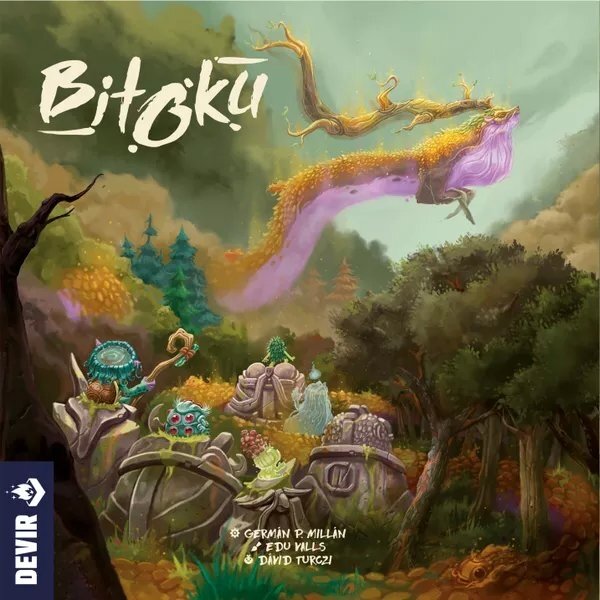
Règles de Bitoku
Résumé
Bitoku is a game over four rounds, each split into four seasonal phases, in which players earn Virtue Points (VP) by playing Yōkai cards, using dice in the Forest, and advancing along the Spirit Path. The player with the most VP at the end, after the Ascension scoring, becomes the new Great Spirit and wins.
Mise en place
Place the game board in the middle of the table, using the side without gaps for solitaire and two-player games and adding the die-cut pieces for three or four players. Place the Great Spirit counter on the first Round Track space and the Pagoda counter on Spring. Randomly place Torii Gate tiles, Ancient Buildings, Forest Treasure tiles, Kodama counters (a neutral one on the fourth space of each track in a two-player game), and the stacks of Building, Crystal, Mitama Spirit and Dragonfly tiles, filling the spaces next to each stack. Give each player an Iwakura Rock face down, fill the Rock Garden face up, and set up the Vision, Bitoku and Yōkai decks, with one of each face up in the Hills. Create a common supply of Resources, x3 Resource tiles, Hikaru markers and Amulets.
Each player takes a player board and flag, 3 dice (set to 3, 2, 1 on the red spaces), 5 Kodama counters on the first space of each Kodama Track, 11 Pilgrim counters (3 awakened in the upper right area, 8 asleep on the Crystal areas), 3 Player counters (one on the Bitoku Path, one on the start of the Ascension VP track, one on the Turn Order Track, which is shuffled randomly), 6 Building counters, one random Dragonfly, one random Vision card, their 5 Starting Yōkai cards (shuffled into a face-down deck), 1 wood, 1 jade and a +1 Amulet, and their Iwakura Rock in the leftmost Rock Path space.
Un tour de jeu
Each round has four phases. In Spring, each player draws Yōkai cards up to 4 in hand, then discards down to 3, and collects the rewards on their Dream Crystals. In Summer, players take turns in Turn Order and choose one basic action: play a Yōkai card from hand onto an empty card space (unlocking the die beside it, then optionally activating the card and any attached Crystal), use an unlocked die by placing it in a Forest region and optionally using one Forest Action and one Building Action (die values must meet the requirements), cross the river with a die in the Forest by lowering its value (1 for most dice, 3 for a 6) and taking a Favor in the Hills, or pass. Once a player passes they are out for the phase. In Autumn, the player whose die is highest in the Home of the Great Spirit moves to the first Turn Order position, and so on down. In Winter, players return dice, may remove one Yōkai card to score VP, discard the rest of their board Yōkai, advance the Great Spirit, and refresh the board for the next round.
Fin de la partie
After the Winter Phase of the fourth round, when the Great Spirit reaches the Ascension space, the game ends and the Ascension begins, skipping the usual Winter steps.
Décompte des points
During the Ascension, players finish scoring: collect Dream Crystal rewards; 3 VP to the player first on the Turn Order Track; VP for the number of different Bitoku types on the Bitoku Path (1 to 7 types score 1, 2, 4, 7, 11, 16, 22); VP for Kodama positions in each Forest region (highest, middle and lowest rewards, with ties splitting rewards rounded down); VP from Iwakura Rocks paired with Pilgrims; a score from the total value of dice plus remaining Resources divided by 4, rounded down; VP for completed Visions, minus 1 or 2 for each uncompleted one (each item can serve only one Vision); and finally the end-of-game VP printed on player boards. The player with the most VP wins. A tie is broken by the player who completed the most Visions, then by the player furthest ahead on the Turn Order Track.
Variantes
Solitaire play (Rise of the Tengu): the player faces an automated opponent, the Tengu, set up as a second player with its own board, Tengu Action cards, and Tengu Attitude tile. The Tengu takes turns alternately with the player, acting by rolling its two Will of the Tengu dice to choose an Active Tengu card and following the Tengu Activation Cycle. At the end, the player scores normally and the Tengu is scored by its own rules; the player wins with more VP. Optional difficulty adjustments are given to make the solo game easier or harder. A harder option for the standard multiplayer game raises the Forest Action requirement: a die must be higher than all others in its region, and any 6 can be spent Amulet-boosted above 6 for that action only.
Modifications
- Variantes, par le brouillon tiré du livret de règles, le 22 novembre 2026 (affichée maintenant)
- Décompte des points, par le brouillon tiré du livret de règles, le 22 novembre 2026 (affichée maintenant)
- Fin de la partie, par le brouillon tiré du livret de règles, le 22 novembre 2026 (affichée maintenant)
- Un tour de jeu, par le brouillon tiré du livret de règles, le 22 novembre 2026 (affichée maintenant)
- Mise en place, par le brouillon tiré du livret de règles, le 22 novembre 2026 (affichée maintenant)
- Résumé, par le brouillon tiré du livret de règles, le 22 novembre 2026 (affichée maintenant)