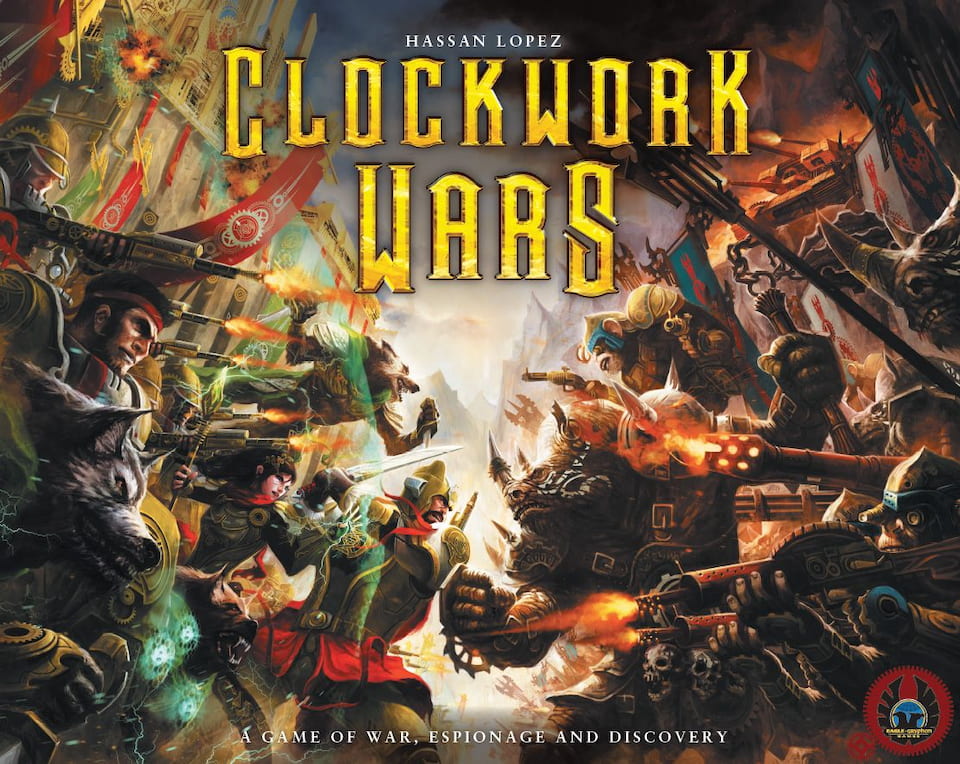
Règles de Clockwork Wars
Résumé
Clockwork Wars is a war game for 2 to 4 players set in a fantasy-steampunk world, where each player leads one hybrid race over seven turns. Players fight for resource territories, build up manpower, and buy Discoveries and Generals through three research disciplines. The player with the most Victory Points (VPs) at the end of the final Scoring Phase wins.
Mise en place
- Each player takes or randomly gets a race, then takes its screen, 30 colored discs (the reserve), and Unique Unit tokens. Each player also takes a deployment-orders sheet and places 1 IP from each discipline behind the screen.
- Build the map for your player count using one of the suggested layouts, a random draw, or your own design.
- Sort the Discovery cards into 9 stacks by discipline and age (early, middle, late), shuffle each, and reveal one card from each stack in a 3x3 grid, with early cards on top. Place the matching Discovery tokens on them. Return the other cards to the box.
- Put the General cards and miniatures near the map. Sort the IP tokens by discipline beside the map.
- Place the game-board with the basic or epic side up. Place the Spymaster tiles on the Espionage spaces, the turn marker on the first turn space, and each score marker by the score track.
- Shuffle the Espionage cards, deal one to each player, and put the rest face-down beside the board.
- Choose one Court and place it beside the map. Each player places 1 worker from their reserve into that Court.
- The oldest player takes the first-player token.
Un tour de jeu
A game lasts 7 turns, split into Early (turns 1-2), Middle (turns 3-4), and Late (turns 5-7) ages. Each turn has five phases, plus a Scoring Phase at the end of turns 2, 4, and 7.
- Spymaster Phase: Starting with the first player and going clockwise, each player picks one Spymaster action (Conscription, Gambit, R & D, Counter-Intel, Technophilia, or Tactical Ops). Each action can be chosen only once per turn and lasts only that turn.
- Recruitment Phase: Your Capital gives 4 workers, each controlled Village gives 1, and each City gives 2. A Village becomes a City with 3 or more of your units, and reverts when it falls below 3. Your population is capped at 30.
- Deployment Phase: Write secret orders on your sheet using territory ID tags. Units already on the map cannot move. Once everyone is done, reveal and place units, starting with the first player. Forced March lets you reach a territory two tiles away through an unoccupied tile, if you also deploy at least one unit to that tile.
- Combat Phase: Reinforcement (citadels, Discoveries, Espionage cards, and Unique Units act in player order, and players pass when done), then Battle (highest Army Strength wins), then Attrition (remove one unit from each out-of-supply territory).
- Research Phase: Study (each Tower, Manufactory, and Shrine you control gives 1 IP of its discipline; you may also return unused workers for 1 IP each), then Discovery (buy Discoveries and Generals in turns until all pass), then Activation (use owned Discoveries in player order).
Fin de la partie
After the Scoring Phase at the end of turn 7, the game ends. Players convert leftover IPs into VPs at a rate of 3 IPs for 1 VP, counting all disciplines together. The player with the most VPs wins.
Décompte des points
A Scoring Phase has three stages.
- Victory points: In player order, each player scores for resource territories. A Forest gives 1 VP per unit there, up to 3 VP. A Lake gives 3 VP if you have at least 2 units there, and nothing otherwise. Some Discoveries also give VP.
- Court dominance: The player who controls the Court gets a bonus. The bonus differs on turns 2, 4, and 7.
- Pollution: Reduce your units in every resource territory to 1. Removed units are killed.
If players tie on VPs at the end of the game, the player who controls the most map territories wins. If still tied, the tied player who was latest in turn order on the final turn wins.
Variantes
- Epic Game: Use the epic side of the board. Each Age lasts 3 turns, so the game is 9 turns with Scoring Phases on turns 3, 6, and 9. Players do not receive the starting 1 IP in each discipline during setup. Capitals give 3 workers during Recruitment instead of 4.
- 2 vs. 2 Alliances (for 4 players): Two allied pairs compete, and the alliance with the most combined VPs wins. Allies share territory control and supply, and each commander in turn can make one secret call-to-arms request to their ally. Only one ally controls a Court, Discovery, or resource territory at a time. The rulebook gives changes to Gambit, Counter-Intel, and tie-breaking rules for this variant.
- Negotiation (3-4 players): The rulebook suggests optional negotiation and temporary alliances, but leaves the specific rules to the group. Deals are not binding, and workers, spies, and units may not be traded.
Modifications
- Variantes, par le brouillon tiré du livret de règles, le 22 novembre 2026 (affichée maintenant)
- Décompte des points, par le brouillon tiré du livret de règles, le 22 novembre 2026 (affichée maintenant)
- Fin de la partie, par le brouillon tiré du livret de règles, le 22 novembre 2026 (affichée maintenant)
- Un tour de jeu, par le brouillon tiré du livret de règles, le 22 novembre 2026 (affichée maintenant)
- Mise en place, par le brouillon tiré du livret de règles, le 22 novembre 2026 (affichée maintenant)
- Résumé, par le brouillon tiré du livret de règles, le 22 novembre 2026 (affichée maintenant)