Règles de Domaine
Résumé
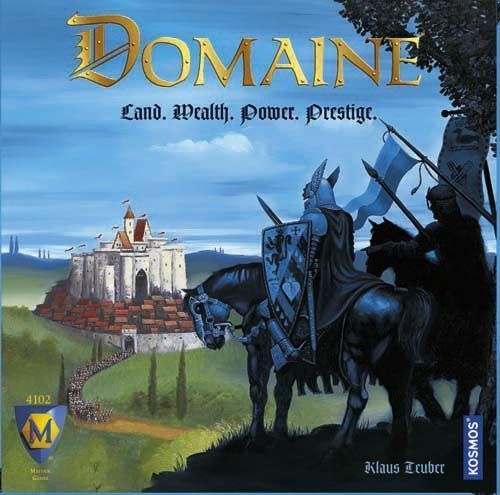
Each player is a duke who builds castles and encloses them with border markers to create a Domaine. The owner of a castle controls the Domaine it encloses. Forests, villages and the royal city in controlled areas are worth victory points, and the player with the most victory points wins.
Mise en place
- Assemble the board edge pieces. Place the land tile with the royal city in the center, shuffle the other tiles and place them face up in any orientation to fill the board.
- Each player chooses a color and takes 15 knights and 4 castles (3 castles each in a four-player game).
- Sort the action cards into four piles by the letter on the back, shuffle each pile, then stack them in alphabetical order with A on top. Place the stack in one of the two top boxes as the action deck. The other box holds used action cards.
- Each player draws three action cards from the deck and keeps them hidden.
- Each player places their crest token on the starting space of the scoring track.
- Set the border markers beside the board. Each player starts with 7 ducats (one 5-ducat coin and two 1-ducat coins).
- Place the king token on the scoring track: space 30 in a four-player game, 40 in a three-player game, and 50 in a two-player game.
- Castles are placed in turn order, starting with the oldest player and moving clockwise. A castle goes on an unoccupied meadow, with a knight on an adjacent forest or meadow space. Continue until each player has placed all their castles and knights.
- Castles of the same color must be at least 6 spaces apart, not counting diagonals.
- Knights can only be placed on meadows or forests.
Un tour de jeu
The last player to place a castle goes first, and play continues clockwise.
At the start of your turn, collect ducats from any mines you control (see income from mines). Then take one of two actions:
- Sell an action card to the Chancery.
- Play an action card.
At the end of your turn, refill your hand to three cards by drawing the top card of the action deck or taking a card from the Chancery.
Selling: Place the card face up in the Chancery row and take ducats equal to the price shown in brackets on the card. You cannot draw that card back when refilling your hand this turn.
Playing: Place the card face up on the discard pile and take the action shown. Some cards show two symbols, and you choose one of them.
- Place borders: Place 1, 2 or 3 border markers, as the card allows. Borders go between two territories. They cannot go between adjacent castles or knights of the same color, and never inside a Domaine. Board edges and seas and mountains need no markers. When a new Domaine is created, its owner scores immediately: forest 1 point, village 3 points, royal city 5 points, mine or meadow 0 points. Move your crest token accordingly, then remove any extra markers inside that Domaine.
- Place knights: Place 1 or 2 knights on meadow or forest spaces, not on the city, villages or mines. A new knight must be horizontally or vertically adjacent to a castle or knight of the same color, with no border between them. Placing a knight in a forest costs 1 extra ducat, except during setup. You cannot place knights once your supply is empty.
- Expand your Domaine: Expand one of your Domaines by one or two territories using border markers. The first territory must touch the Domaine horizontally or vertically. The second may continue straight beyond it or border another territory in your Domaine. You may not enter a territory occupied by an opposing castle or knight. You may not expand into your own Domaine. You may expand into an opponent's Domaine only if you have more knights in your Domaine than they have in theirs. You may expand into territories outside any Domaine. Expanding into two different Domaines in completely different directions is not allowed.
- Deserter: Choose one of your Domaines and an adjacent opponent's Domaine, both with at least one knight. Choose one of your opponent's knights to switch sides between the two Domaines. The opponent returns that knight to their supply. You may not pick a knight in the middle of a line, and a knight's connection to its castle may never be broken. Then place one of your own knights in your Domaine, paying the forest cost if needed.
- Alliance: Choose one of your Domaines and an adjacent opponent's Domaine. Rotate a border marker between the two by 90 degrees. For the rest of the game, neither Domaine may expand into the other.
Fin de la partie
The game ends in one of two ways:
- A player moves their crest token onto the king token space (30 points in a four-player game, 40 in three players, 50 in two players). That player wins immediately.
- A player draws the last card from the action deck. After that, no one may draw from the Chancery, though players may still sell cards. Once the last action card has been played or sold, the game ends and players count their remaining ducats.
Décompte des points
Victory points come from Domaines, expansions and mine monopolies.
- Each new Domaine scores when created: forest 1, village 3, royal city 5, mine or meadow 0.
- Expanding into a Domaine scores forest 1 point, village 3 points and royal city 5 points for each territory gained. If an expansion takes territory from another player's Domaine, that player moves their crest token down by the points they lost. Neutral zones enclosed by borders but not part of any Domaine can also be created.
- A mine monopoly (3 or 4 mines of the same type) is worth 5 points, and it is lost if an opponent's expansion breaks it, causing a 5-point loss.
At game end, the player with the most ducats moves their crest token 5 spaces forward on the scoring track. The player (or players) with the second most ducats moves 3 spaces forward. The player with the most victory points wins. If there is a tie on points, the tied player with the most ducats remaining wins.
Variantes
- Two-player game: Each player chooses one color, and a third color is neutral. Both players take turns placing their own 4 castles and 4 knights. Then they take turns placing the neutral castles and knights. The neutral castles must also be at least 6 spaces apart.
- Three- and four-player games: The setup changes, including the king token start space and the number of castles per player (3 castles in four-player games). Rules are otherwise the same.
- The rulebook gives no solo or short-game variant.
Modifications
- Variantes, par le brouillon tiré du livret de règles, le 23 novembre 2026 (affichée maintenant)
- Décompte des points, par le brouillon tiré du livret de règles, le 23 novembre 2026 (affichée maintenant)
- Fin de la partie, par le brouillon tiré du livret de règles, le 23 novembre 2026 (affichée maintenant)
- Un tour de jeu, par le brouillon tiré du livret de règles, le 23 novembre 2026 (affichée maintenant)
- Mise en place, par le brouillon tiré du livret de règles, le 23 novembre 2026 (affichée maintenant)
- Résumé, par le brouillon tiré du livret de règles, le 23 novembre 2026 (affichée maintenant)