Règles de Endeavor
Résumé
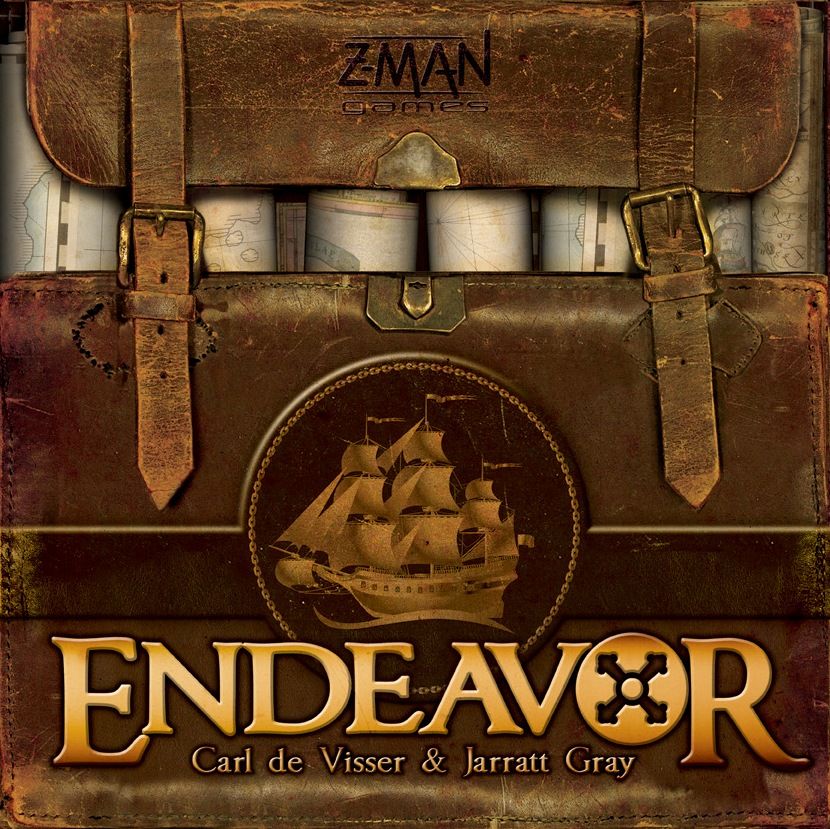
Endeavor is an empire-building game for 3 to 5 players, played over seven rounds. You expand across seven world regions by building structures, shipping, occupying cities, attacking rivals, and drawing cards. Glory comes from your Industry, Culture, Finance and Politics scores, occupied cities, controlled connections, certain cards and buildings, and leftover population. The player with the most Glory at the end wins.
Mise en place
Place the board in the middle of the table. Randomly place one Trade Token glory-side down on every Shipping Track space, city and connection.
Sort the Asset Card decks by type and stack them face up in their regions. Each stack runs from bottom to top as 5, 4, 3, 2, 1, Governor. The Slavery and Europe & the Mediterranean decks have no Governor and run 5, 4, 3, 2, 1, 0.
Make stockpiles of Building Tiles by Build Level: 5 each of Level 1, 4 each of Level 2, 3 each of Level 3, 2 each of Level 4, and 1 each of Level 5. Keep matching levels together near the board.
Each player takes a Player Board, the four Status Markers and all 30 Population Markers in one color, and returns unused components to the box. Place your Status Markers on the 0 spaces of the four Status Tracks and make a supply of Population Markers. Randomly choose a first player, who receives the First Player Marker. Set the large Scoring Chips aside until the end.
Un tour de jeu
The game has seven rounds, each with four phases. The First Player acts first in each phase, and others follow clockwise.
- Build Phase: In turn order, each player takes one Building Tile from the stockpile and places it on an empty building space on their board. You may choose a building at or below your Build Level. If none remains at that level, you may take one from the next level up. Duplicates are allowed, but you may not build a second Level 5 building. Each icon on a new building raises the matching Status Track.
- Growth Phase: In turn order, each player adds Population Markers from their supply to their Harbor, equal to their Growth Level (set by Culture). Take as many as you can if your supply runs short.
- Salary Phase: In turn order, each player performs Payments equal to their Salary Level (set by Finance). A Payment returns one Population Marker from a building to the Harbor. You choose which markers to return if you have more on buildings than Payments. Extra Payments are lost if you have fewer markers. A building with a marker on it cannot be activated.
4. Action Phase: Starting with the First Player, players take one action at a time in clockwise order until everyone has passed. Actions are taken by activating a building (moving a Harbor marker to its empty Activation Circle, then performing its action) or by spending a blue Trade Token from the Harbor. The available actions are:
- Ship: place a marker on a region's Shipping Track to take the farthest free space and its Trade Token. You may still ship to a full track, but you get no token.
- Occupy: place a marker in an empty city in an open region where you already have presence.
- Attack: pay two markers to displace an opponent's marker from an occupied city in an open region where you have presence. The displaced marker returns to its owner.
- Payment: return a marker from one building to your Harbor, but not from the building it is on.
- Draw: take the top card of an open region's stack if you have at least that card's value in markers in that region. Cards and tokens gain you Status increases.
A region opens when its last Shipping Track space is taken. The player with the most markers on that track receives the Governor card, with ties going to the most recently placed marker. Cards and tokens can never be traded or given to others.
Pass: once you pass, you take no more actions this phase. You must discard down to your Card Limit (set by Politics), where discards lose their icons. Governors discarded are removed from the game. Slavery cards discarded are kept face down by your board.
When the Action Phase ends, recheck every Status Track against your held cards, tokens and buildings. Then pass the First Player Marker to the left and begin the next round.
Fin de la partie
The game ends after the seventh round. The seventh round is recognized when all building spaces on the Player Boards are full during the Build Phase.
Décompte des points
Remove the remaining Trade Tokens from the board and boards, first confirming every Status Track is correct. Use the glory-side tokens, where each token is 1 Glory, and trade up to large chips at 10 and 50.
Score the following:
- Cities: 1 Glory per glory icon in each city where you have a marker (most have 1, a few have 2).
- Connections: 1 Glory per connection you control.
- Status Tracks: each marker on a space without an icon drops to the nearest lower space with an icon, then that track's value counts as Glory.
- Cards: Glory icons on your held cards.
- Free Governor space: 3 Glory if it is empty.
- Universities: 3 Glory per University you have.
- Harbor: 1 Glory for every 3 Population Markers in your Harbor.
- Slavery: lose 1 Glory per Slavery card set aside by your board. Face-up Slavery cards do not count.
The player with the most Glory wins. If players tie, they all share victory.
Variantes
The rulebook gives one alternative: instead of doing each phase for all players in turn, each player completes the Build, Growth and Salary phases in turn order before passing play to the next player. The rulebook says this can help individual planning or speed up the game. No solo, team or short rules are given.
Modifications
- Variantes, par le brouillon tiré du livret de règles, le 23 novembre 2026 (affichée maintenant)
- Décompte des points, par le brouillon tiré du livret de règles, le 23 novembre 2026 (affichée maintenant)
- Fin de la partie, par le brouillon tiré du livret de règles, le 23 novembre 2026 (affichée maintenant)
- Un tour de jeu, par le brouillon tiré du livret de règles, le 23 novembre 2026 (affichée maintenant)
- Mise en place, par le brouillon tiré du livret de règles, le 23 novembre 2026 (affichée maintenant)
- Résumé, par le brouillon tiré du livret de règles, le 23 novembre 2026 (affichée maintenant)