Règles de Faiyum
Résumé
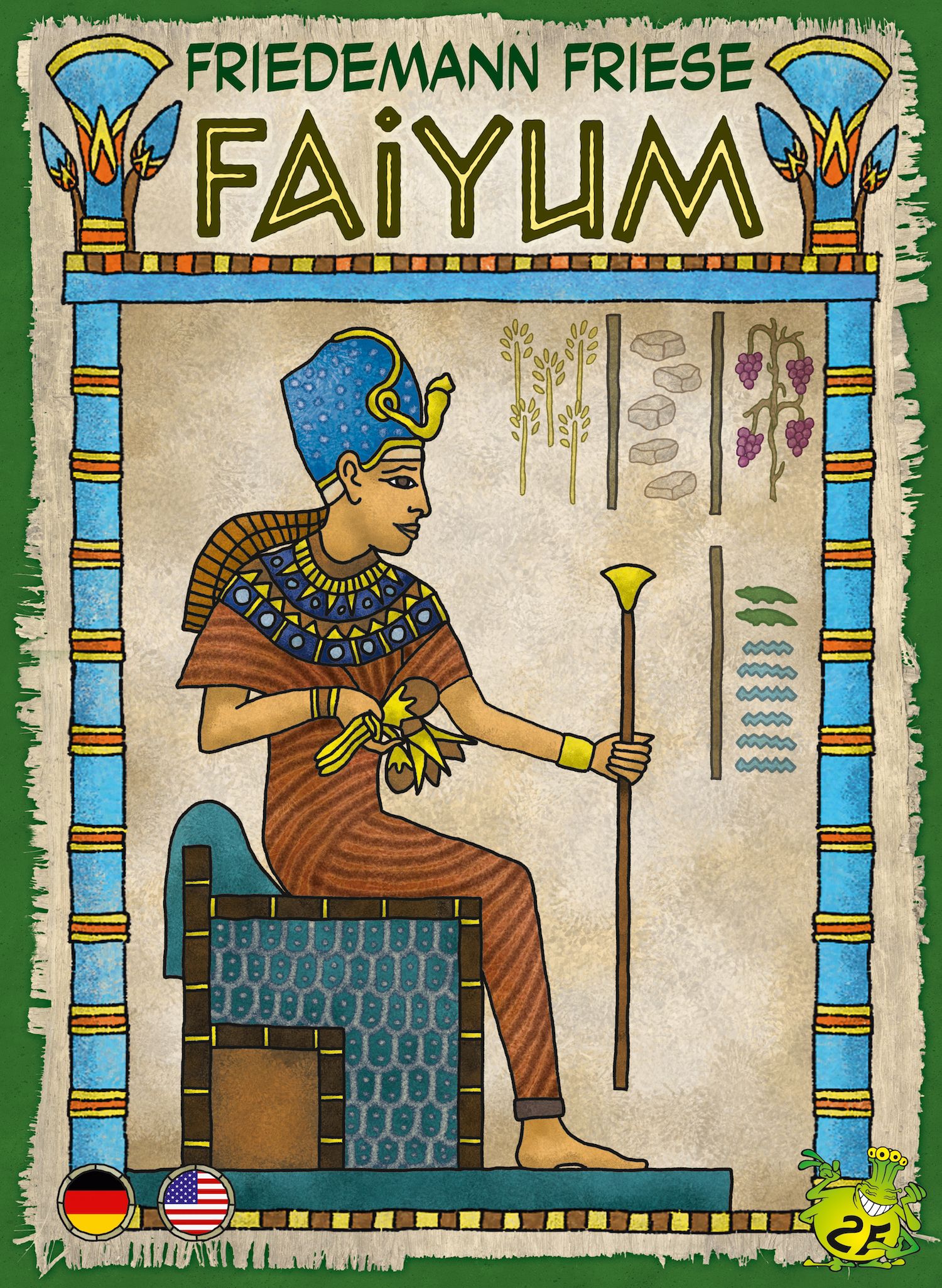
Faiyum is a strategy game in which players act as advisors to the pharaoh, developing the Faiyum basin in ancient Egypt. Players play cards from hand to use their actions, buy stronger cards from a market, and recover played cards through the administration action. The player with the most reputation when the game ends wins.
Mise en place
Place the game board on the table. Put a settlement on the red starting space and a road on the dam between the two peninsulas. Place a crocodile on every wheat and grape space.
Each player chooses a color and takes the matching starting cards, reputation disc, 50/100 reputation marker, and an administration overview card. Put the reputation disc on the 0 space of the reputation track and the 50/100 marker near the track's end. Take your starting cards into your hand.
Choose a first player. The first player takes $3, the second and third players take $4, and the fourth and fifth players take $5.
For the draw pile and market, set aside the yellow-bordered cards 114-120. From the yellow natural disaster cards 122-128, keep only the four matching the player count and return the rest to the box. Place these four on top of the 114-120 cards and set them aside. Shuffle the blue-bordered cards 2-112 face down as the draw pile. Draw the top 12, sort them by number, and place the 8 lowest face up in ascending order in the market. Show the 4 highest to everyone, then shuffle them with the 8 yellow cards and place this face-down stack beside the draw pile as the final turns stack. Put a red discount token on each of the 4 lowest market cards.
Sort the wooden parts and money tokens into supply piles. Limited components are workers, settlements, towns, workshops, extensions, roads, bridges, grand bridges, building blocks, and palaces. Wheat, grape, stone, fish, roses, and money are unlimited, so use substitutes if you run out.
Un tour de jeu
Starting with the first player and moving clockwise, each turn you take exactly one of these actions:
- Play a card from hand. Place the card face up in your play area. Either use its complete action, paying any red cost and then taking any green gain, or instead gain $2 from the supply. Then place the card on top of your personal discard stack. Cards in the discard stack keep their play order.
- Buy a card from the market. Choose one of the 4 lowest market cards and pay its price, $3, $4, $5, or $7. If it has a discount token, pay $1 less. Take the card into your hand. Move the discount token to the space above the market for the next administration. Then draw from the draw pile and insert the new card in numerical order so the whole market stays ascending.
3. Carry out administration. Take these steps in order:
- I. Gain income: gain $3 minus the number of cards in your hand, never less than $0. Then remove up to 2 of your workers from the board, or as the rules allow, and gain $1 for each one removed. Then take the top 3 cards of your discard stack into your hand, or all of them if fewer remain.
- II. Buy back more cards: pay $1 per card to take further cards from the top of your discard stack into your hand, as many as you like. Keep the remaining order.
- III. Replace cards in the market: with 2 to 3 players, remove the lowest card with a discount token and the lowest card without one when needed, then place discount tokens on the remaining untokened cards and refill the market. With 4 to 5 players, remove the lowest two discount-tokened cards as applicable, and refill with two new cards. Refill draws follow the rules printed on the administration overview card and do not get discount tokens. Discount tokens are used only during the first game phase, so only 2 or 3 are needed after setup.
Workers placed on spaces stay put until removed. Only one worker may occupy each space. Resources and reputation gained belong to the player who gained them, while buildings on the board are shared by everyone.
Fin de la partie
The game ends when the fourth natural disaster card is placed in the market. Once the draw pile is empty, continue drawing from the final turns stack. The natural disasters stay on the rightmost market spaces, and you can no longer take the administration action after the game is triggered to end.
After the trigger, on your turn you may play a card, buy a card, or quit by taking the natural disaster card in the market that offers the most reputation. Other players keep taking turns until everyone has quit. The last player to quit gains no reputation from a natural disaster.
Décompte des points
Reputation counts toward the score. The player with the most reputation wins. If players tie, the tied player with more leftover resources and money wins. If the tie remains, the rules give no further tiebreak.
Variantes
Solo game: Follow the normal setup with these changes. Use the solo administration overview card. Do not use discount tokens, so return them to the box. Start with $4.
Solo rule changes: during administration, buying back cards beyond the 3 free ones costs $1 for the first, $2 for the second, $3 for the third, and so on. In step III, choose two market cards to remove to the box, then draw two cards to refill the market.
Solo campaign: play a series of games with goals. The starting goal is to reach at least 150 reputation. Later games pick one of the other goals, each usable once, including placing 3 bridges, placing 2 palaces, reaching 250 reputation, finishing all 4 monuments with all 15 building blocks, placing 9 workshops, and leaving 10 or fewer crocodiles on wheat and grape spaces. Completing all seven goals finishes the campaign. Each completed goal unlocks an achievement, used top to bottom in later games. Achievements include starting with $10 and a fish and a rose, removing up to 3 workers in administration, taking back the top 4 cards in administration, substituting a basic resource for $2 instead of $3, and replacing only 1 market card during administration.
Modifications
- Variantes, par le brouillon tiré du livret de règles, le 22 novembre 2026 (affichée maintenant)
- Décompte des points, par le brouillon tiré du livret de règles, le 22 novembre 2026 (affichée maintenant)
- Fin de la partie, par le brouillon tiré du livret de règles, le 22 novembre 2026 (affichée maintenant)
- Un tour de jeu, par le brouillon tiré du livret de règles, le 22 novembre 2026 (affichée maintenant)
- Mise en place, par le brouillon tiré du livret de règles, le 22 novembre 2026 (affichée maintenant)
- Résumé, par le brouillon tiré du livret de règles, le 22 novembre 2026 (affichée maintenant)