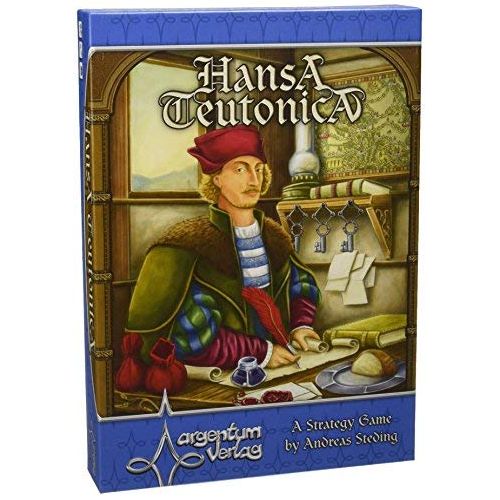
Règles de Hansa Teutonica
Résumé
Hansa Teutonica is a game about merchants in the Hanseatic League. Players place traders and merchants on trade routes between cities, claim routes, and establish offices or improve abilities to gain Prestige Points. The player with the most Prestige Points wins.
Mise en place
Place one Bonus Marker on each of the three tavern spaces, arrow pointing toward its trade route. Shuffle the other Bonus Markers face down beside the board as a supply.
Each player takes the traders and merchants in their color and fills the tracks on their player board: merchants go on the round book track and traders on the square tracks. The leftmost space of each track is uncovered and shows the starting level. Each player places one trader on the 0 space of the Prestige Point track.
Choose a start player. The start player takes 5 traders and 1 merchant as a personal supply, the next player clockwise takes 6 traders and 1 merchant, the next takes 7 traders and 1 merchant, and so on. The remaining pieces form the general stock.
Un tour de jeu
On your turn you may take as many actions as your action track allows, in any order, repeating actions if you like. Finish each action before starting the next, and you may stop early.
1. Take Income: Move the number of pieces shown on your money bag from the general stock to your personal supply.
2. Place a piece: Put one trader or merchant from your supply onto an empty house on a trade route. You may place on a route partly occupied by others, and you do not need to finish a route in one turn.
3. Displace another player: Remove one opponent's trader on a route (not in an office) and replace it with your own piece. Pay a penalty of one piece from your supply back to the stock. To displace a merchant, pay two pieces. The displaced player must then move the displaced piece plus the required pieces from their stock onto nearby routes. You cannot displace if you cannot pay the penalty.
4. Move your own pieces: Move up to the number shown on your book track of your own pieces on routes. You may not displace in the same action.
5. Claim a route: When all houses on a route between two cities hold your own pieces, you may claim it as an action. Claiming is not automatic. Then, in order:
- a) Each player controlling an adjacent city gets 1 Prestige Point. You may score for others too.
- b) If the route has a Bonus Marker, you take it.
- c) You receive one benefit: establish an office in an adjacent city, or, if the city shows an ability pictogram, improve that ability instead. Establishing an office returns all but one of the route's pieces to the stock, and the remaining piece goes into the city. Improving an ability clears the route to the stock and moves one piece from your board to your supply. The Coellen-Warburg route also allows placing a merchant on a bonus space instead.
Bonus Markers are used free of action, at any time except the action that won them. At the end of your turn, place replacement markers from your plate face down onto empty routes that have an adjacent office and no marker already.
Fin de la partie
The game ends immediately when any one of these occurs, even during another player's turn:
- A player reaches 20 or more Prestige Points.
- A replacement Bonus Marker is needed but none remain.
- A route claim establishes an office that completes the 10th city.
The game ends after the action that triggered it. The current player does not finish their turn.
Décompte des points
During play, you score 1 Prestige Point for each adjacent city you control when a route is claimed, 1 point for a gold-coin office, and bonus points for linking Stendal and Arnheim (7, 4, or 2 for the first, second, or third player to do so).
At game end, add:
- Developed abilities: 4 points for each fully developed ability, except the town key.
- Bonus Markers: Count all your markers, face up or face down. 1 marker: 1 point; 2-3: 3; 4-5: 6; 6-7: 10; 8-9: 15; 10 or more: 21.
- Coellen table: Points for the spaces your merchants occupy on the special track next to Coellen.
- Controlled cities: 2 points for each city you control.
- Largest chain: Find your longest chain of connected offices, including branches. Each office in the chain scores the value shown by your rightmost uncovered town key space.
A city is controlled by the player with the most offices there. Ties go to the tied player with the rightmost office. The rulebook does not give a tiebreaker for equal final scores.
Variantes
Two-player game with a neutral player: Place neutral traders on routes leading to cities with skill scrolls and on routes with Bonus Markers at setup. When a neutral trader is displaced, the opponent moves it and one extra neutral trader to an adjacent route. If a route fills entirely with neutral traders, it is established immediately and a Kontor is placed in an adjacent city of the active player's choice. The neutral player never uses merchants and cannot win. Bonus Markers gained by the neutral player are discarded. Neutral players can control cities, which prevents a real player from scoring the 2-point control bonus for that city.
Board side: The front side is for 4-5 players and the back side is for 2-3 players.
Modifications
- Variantes, par le brouillon tiré du livret de règles, le 23 novembre 2026 (affichée maintenant)
- Décompte des points, par le brouillon tiré du livret de règles, le 23 novembre 2026 (affichée maintenant)
- Fin de la partie, par le brouillon tiré du livret de règles, le 23 novembre 2026 (affichée maintenant)
- Un tour de jeu, par le brouillon tiré du livret de règles, le 23 novembre 2026 (affichée maintenant)
- Mise en place, par le brouillon tiré du livret de règles, le 23 novembre 2026 (affichée maintenant)
- Résumé, par le brouillon tiré du livret de règles, le 23 novembre 2026 (affichée maintenant)