Règles de Homesteaders
Résumé
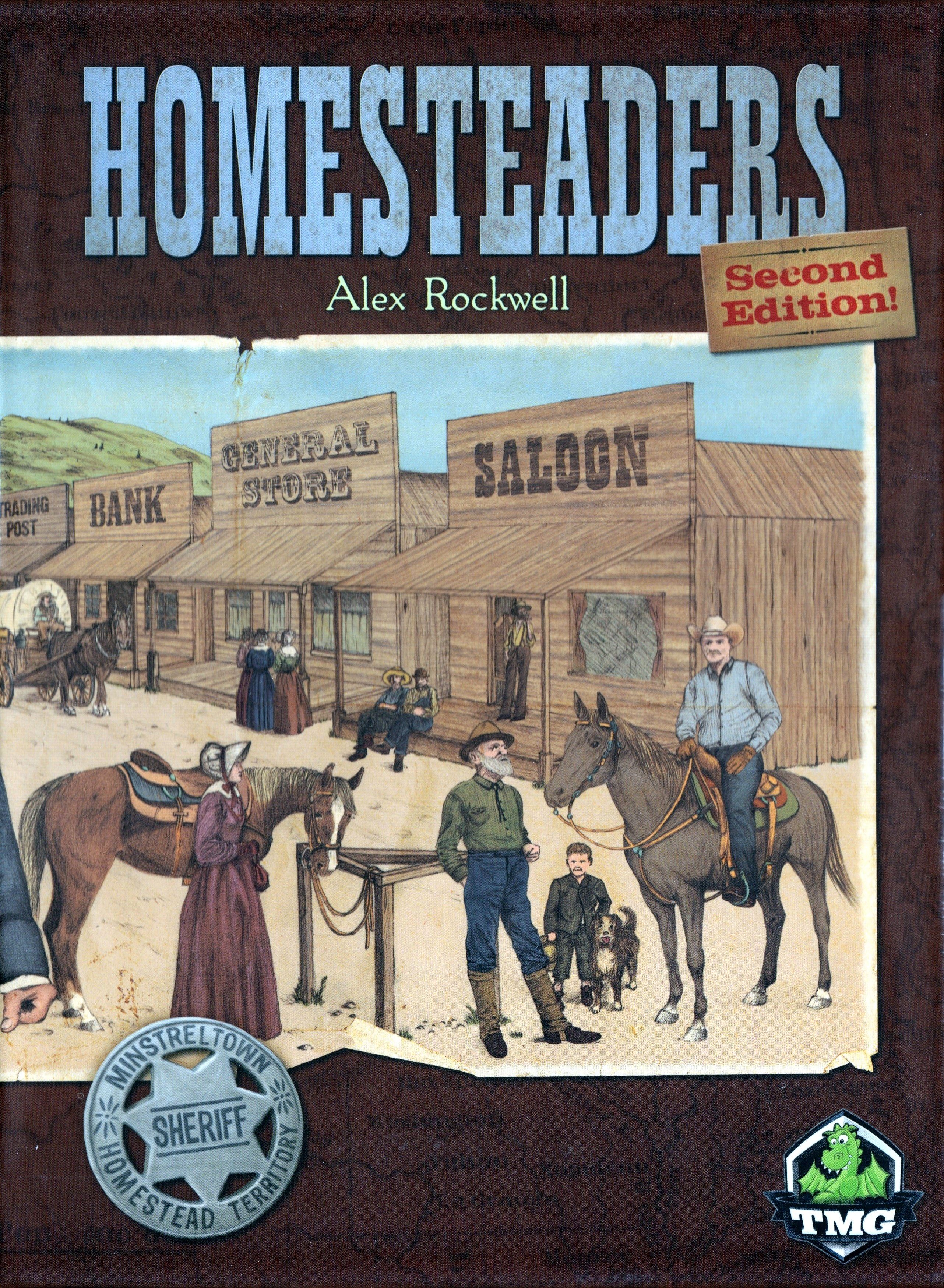
Homesteaders is an auction and resource management game set in the Old West, where players bid on land and develop buildings to grow a town into a city. Over ten rounds, players gather income, bid for auction tiles, and build buildings. The player with the most Victory Points at the end is declared the winner and has the city named after them.
Mise en place
Place the Auction board, resources, workers, silver, trade, debt, rail line and point chits within reach. Give each player a player screen, a Homestead tile, matching player markers, 1 worker and 6 silver. Each player places one marker at the start of the Railroad Development track and keeps the other for bidding. Return unused components to the box.
Sort the auction tiles into piles for Auction 1, 2 and 3. Place the Auction 1 tiles face up, ordered by round number. For Auction 2, shuffle the two City tiles face down at the bottom, then the four Town tiles face down above them, then the four Settlement tiles face down on top. Do the same for Auction 3 only in a 4 player game; in a 2 or 3 player game, remove those tiles.
Place the Settlement and Settlement/Town buildings in the Building Supply, sorted by colour, and set the Town and City buildings aside. In a 2 player game, include only one copy of each building except two each of Farm, Market and Foundry. Randomly choose a starting player and give them the Start Player marker.
Keep resources, silver, trade chits, debt chits and victory point chits hidden behind player screens. Workers, buildings and rail line chits are public.
Un tour de jeu
The game lasts 10 rounds, each with an income phase and an auction phase.
Setup of round: Players retrieve their bid markers and the top face-down auction tile of each pile is revealed. Old auction tiles are removed. At round 5 the Settlement stage ends, unbuilt Settlement buildings are removed, and Town buildings are added. At round 9 the Town stage ends, unbuilt buildings are removed, and City buildings are added. Buildings already owned by players stay in play.
Income phase:
1. Allocate workers: players simultaneously assign workers to worker slots on their buildings. Extra workers stay idle on the Homestead tile. Workers may be reallocated every round. Buildings with double slots need two workers to produce anything. Players who want to see others allocate first may do so in player order from the Start Player.
2. Collect income: each player collects automatic income from buildings and rail lines (each rail line gives 1 silver), plus worker income from occupied slots. Players should show their income before hiding it.
3. Pay workers: each player pays 1 silver per worker, including idle ones. Shortfalls can be covered through the Marketplace, Gold, or debt.
Auction phase:
Bidding: starting with the Start Player and going clockwise, players either place a bid on an available auction or pass. Bid values are 3, 4, 5, 6, 7, 9, 12, 16 and 21. The first bid must be at least 3 and each new bid must exceed the current high bid on that auction. Players may bid regardless of cash on hand. A player who is outbid may rebid on the same or another auction on a later turn, or pass. A player who holds the high bid does nothing on their turn. Once a player passes they are out of the auction and advance their marker one space on the Railroad Development track, taking the reward for that space or any earlier one. Bidding ends when every player has passed or holds a high bid. Auctions with no bids are discarded without reward.
Building: starting with the winner of Auction 1, then the winners of Auctions 2 and 3, each winner pays for the auction and may then build a building of the type shown on the tile. The tile is then discarded and cannot be saved. The Auction 1 winner also takes the Start Player marker. Some tiles award workers or track advances instead of a building. Some tiles also give a one-time extra bonus, such as a worker or an exchange of resources for points or a rail line, which may be taken after building. Bonuses gained from the building can help pay for these extras, but bonuses from an auction advance cannot help pay for that auction.
To build, the player takes a building of the matching type from the Building Supply and pays its cost. Players may not build two buildings with the same name.
Fin de la partie
After the 10th round, a Final Income and Scoring round is played. Players repeat the income phase once and then may use the Marketplace freely to pay off debt and convert trade chits, silver and resources into points.
Décompte des points
Each player totals:
- Victory Point chits collected during the game
- Point values of their buildings
- Point values of any bonuses on their buildings
- 2 points for each Gold, Livestock and Copper. Wood, Food and Steel are worth nothing.
Each debt chit can be paid off for 5 silver during scoring. Unpaid debt is a penalty: the first debt chit costs 1 point, the second 2 points, the third 3 points, and so on. Five unpaid debt chits cost 15 points in total.
The player with the most Victory Points wins. In a tie, the tied player with the most silver wins. If still tied, all tied players win.
Modifications
- Décompte des points, par le brouillon tiré du livret de règles, le 23 novembre 2026 (affichée maintenant)
- Fin de la partie, par le brouillon tiré du livret de règles, le 23 novembre 2026 (affichée maintenant)
- Un tour de jeu, par le brouillon tiré du livret de règles, le 23 novembre 2026 (affichée maintenant)
- Mise en place, par le brouillon tiré du livret de règles, le 23 novembre 2026 (affichée maintenant)
- Résumé, par le brouillon tiré du livret de règles, le 23 novembre 2026 (affichée maintenant)