Règles de Isla Dorada
Résumé
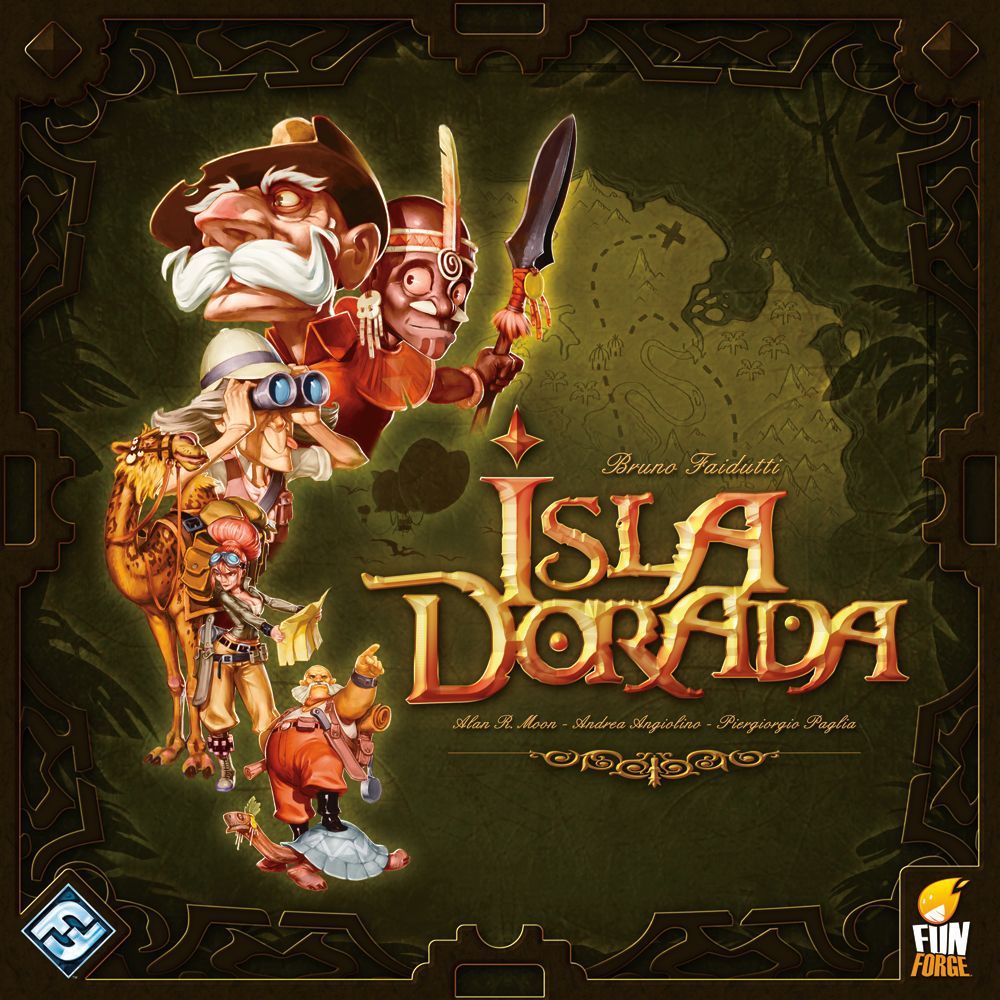
Set in 1934 on the mysterious Isla Dorada, the explorers travel together as one expedition, but each player wants to bring back the richest treasures. Players bid adventure cards to move the expedition, collect treasures and gold, and try to finish with the highest score once the game ends.
Mise en place
- Place the board, then put the 16 exploration markers on the numbered spaces at the top, with the two red markers on spaces 4 and 9.
- Put the expedition figure in base camp.
- Give each player 10 gold. Gold cannot go above the amount you started with.
- Give the leader token to the youngest player.
Goal cards:
- Shuffle each goal card type separately. Put the standard treasure cards facedown beside the board as the treasure deck.
- Deal each player three starting treasure cards, two destiny cards and one curse card.
- Keep the curse card secret in hand. Keep one destiny card and discard the other face down. Keep two starting treasure cards and return the third, unseen, to the box.
- Return the unused curse cards to a facedown deck by the board. Put discarded destiny cards at the bottom of the destiny deck, then place that deck facedown beside the board.
Adventure cards:
- Shuffle the adventure cards and deal six to each player. Place the rest facedown as a draw pile, then reveal the top four in a row.
- If a starting hand or a faceup card shows a bolt symbol, discard it and replace it, repeating as needed. Shuffle discarded bolt cards back into the deck.
The game lasts at least 16 rounds. Hand sizes and gold amounts are public, but goal and adventure cards must stay hidden.
Un tour de jeu
Each round has these steps:
1. Bidding: The leader places the expedition figure at the start of the path they want, then bids any amount they can pay, including 0, with adventure cards. Going clockwise, each player passes or makes a higher bid, and may move the figure to a different path. Bidding ends when everyone else has passed after a bid. Players who passed may re-enter. The highest bidder becomes the new leader, takes the leader token, and discards cards equal to the bid.
- Air travel uses only Zeppelin and/or Drako cards, and the first bid cannot be 0.
- Yak, Kamel and Gonogo cards pay for mountain, sand and jungle paths. Kayak cards pay for water paths, and each Kayak is worth 2.
- The bidder may play Ovetos on a bid of 4 or more to end bidding at once. The Juju card, played when bidding, stops another player from bidding this round.
- Moving: The expedition goes to the destination. Place the lowest available exploration marker there. Do not place one at base camp. Returning to an explored site adds another marker. Sea travel is tracked with sea travel tokens for the Mar Maldita destiny card. Any player may play a Sangaia card during movement to send the expedition on along a path of the same type.
- Curses: If the expedition is at a site matching a curse card the player holds, that player must reveal it with their gold and treasures.
- Treasures: Players with a treasure card for the current site play it face up beside their gold. Two or more cards for the same site can be played together. A matching Bonus card (+3) may be added. A Bongo card allows playing one treasure card from a neighboring site.
- Cable news: In round 4 and round 9, when the red marker is placed, each player takes treasure cards from the deck. In round 4 they keep one of two. In round 9 they keep two of three. Discarded cards are shuffled and put at the bottom of the deck.
- Drawing adventure cards: Starting with the leader and going clockwise, each player draws one card free. Then they may buy one more for 1 gold. Cards can come from the faceup row, which is refilled immediately, or from the top of the deck. Bolt cards are discarded at once and their effect applies. Then any player with more than 10 cards discards down to 10.
Fin de la partie
The game ends when the final exploration marker has been placed and the round in progress is completed.
Décompte des points
Each player reveals destiny cards and scores:
- 1 point per gold left.
- Points for played treasure cards and Bonus cards.
- Points from their destiny card.
- Negative points for each curse card they played.
The player with the highest total wins. The rulebook does not give a tie-break rule.
Variantes
The rulebook gives an alternative cooperative bidding system for experienced players, with these changes:
- Players may add to an existing bid, and two or more players may share one bid. A shared bid's players cannot bid elsewhere.
- A player may open a new bid with at least 1 for a different destination, even below the current top bid, hoping others will add to it.
- The Ovetos card can be played by the most recent bidder when the total is 4 or more.
- A player who has bid on one path can switch to another only if they were alone in that bid.
- Each player in a shared bid pays their share. The largest payer becomes leader. A tie goes to whoever entered the bid first.
- For a river or jungle choice on certain routes, the bidder must say which, and Gonogos cannot add to a river bid nor Kayaks to a jungle road bid.
The rulebook gives no solo or short-game variant.
Modifications
- Variantes, par le brouillon tiré du livret de règles, le 23 novembre 2026 (affichée maintenant)
- Décompte des points, par le brouillon tiré du livret de règles, le 23 novembre 2026 (affichée maintenant)
- Fin de la partie, par le brouillon tiré du livret de règles, le 23 novembre 2026 (affichée maintenant)
- Un tour de jeu, par le brouillon tiré du livret de règles, le 23 novembre 2026 (affichée maintenant)
- Mise en place, par le brouillon tiré du livret de règles, le 23 novembre 2026 (affichée maintenant)
- Résumé, par le brouillon tiré du livret de règles, le 23 novembre 2026 (affichée maintenant)