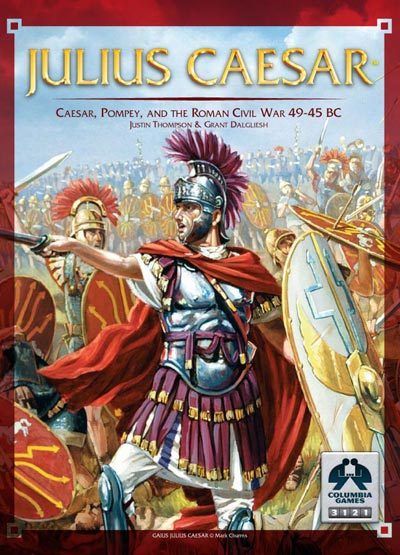
Règles de Julius Caesar
Résumé
Julius Caesar is a two-player game of the Roman Civil War (49–45 BC). One player commands Caesar's forces and the other commands Pompey's. Over five Years of five game turns each, players move blocks across the Mediterranean map, fight battles, and try to hold cities worth Victory Points. A player wins by reaching 10 VP after a Year ends.
Mise en place
Each player receives the blocks for their side. Deploy them in the historical positions for 705 (49 BC), with each block placed upright at full strength. Place any blocks not on the map in your Levy Pool off-map, standing upright so their identity stays hidden. Shuffle the 27 cards (20 command and 7 event) and deal six to each player. Each player looks at their hand and discards one card face down without revealing it.
Un tour de jeu
Each game turn has three phases.
- Card phase: Each player plays one card face down, then both are revealed. The higher Move value makes that player Player 1 for the turn. If the Move values are equal, Caesar is Player 1. An event card always makes its player Player 1. If both players play event cards, both are cancelled and the turn ends.
- Command phase: Player 1 completes all Moves and Levies, then Player 2 does the same. Each Move point lets one group in a single city or sea move one or two adjacent locations, but a group that moves two locations cannot attack or reinforce. Each Levy point either adds one step to an existing block or deploys one new block from the Levy Pool at minimum strength in a Friendly city. Levies are chosen after all movement is finished. Players may take fewer Moves or Levies than their card allows, but unused points cannot be saved.
- Battle phase: Battles occur one at a time in an order chosen by Player 1. Battles last up to four Rounds. Blocks fire by their combat rating, and hits reduce the strongest enemy block first. Attacking blocks must retreat by Round 4.
Fin de la partie
After all five cards in a Year have been played, a Winter Turn follows. The events are resolved in order: Cleopatra returns to Alexandria, Navis move to friendly ports, winter supply limits are applied, and players recruit a new hand of cards. Then players check for a winner. If neither player has reached 10 VP by the end of Year 5, the game is decided by the scoring rules below.
Décompte des points
Victory Points come from two sources: the total value of Friendly cities, and 1 VP for each enemy leader killed. The killed leader is given to the opponent as a trophy. A player wins immediately on reaching 10 VP. If neither player has 10 VP after Year 5, the player with more VP wins. If the VP are tied, the player holding Rome wins. If Rome is not held by either player, the game is a draw.
Variantes
The rulebook gives one optional variant: free deployment. Players still deploy by the historical order of battle, but may swap blocks between cities on the map, as long as each city keeps the same number of blocks it started with. Blocks from the Levy Pool cannot be swapped in.
Modifications
- Variantes, par le brouillon tiré du livret de règles, le 23 novembre 2026 (affichée maintenant)
- Décompte des points, par le brouillon tiré du livret de règles, le 23 novembre 2026 (affichée maintenant)
- Fin de la partie, par le brouillon tiré du livret de règles, le 23 novembre 2026 (affichée maintenant)
- Un tour de jeu, par le brouillon tiré du livret de règles, le 23 novembre 2026 (affichée maintenant)
- Mise en place, par le brouillon tiré du livret de règles, le 23 novembre 2026 (affichée maintenant)
- Résumé, par le brouillon tiré du livret de règles, le 23 novembre 2026 (affichée maintenant)