Règles de LYNGK
Résumé
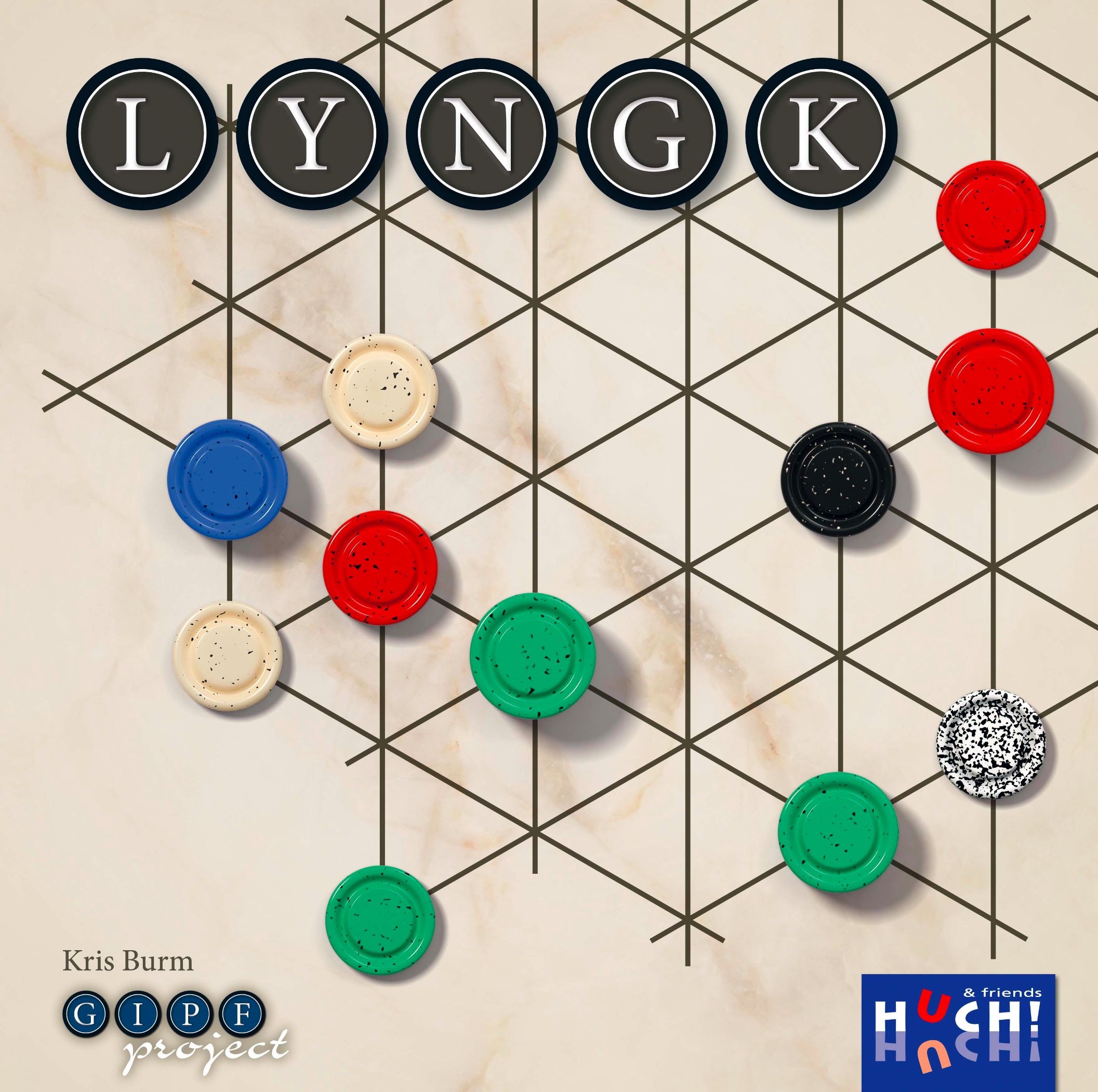
LYNGK is a two-player abstract game about building stacks from pieces in five colors, with three white jokers that can stand in for any color. Each player claims two colors during play, and claimed pieces can be moved in chains only the claimer can use. A player wins by owning the most stacks of five differently colored pieces at the end of the game.
Mise en place
Fill every intersection of the board with 8 pieces of each of the five active colors plus the 3 white jokers, placed randomly. Set aside one piece of each of the five active colors next to the board; these are used only to claim colors. Decide the starting player by lot.
Un tour de jeu
On your turn, you may first claim one color by taking its set-aside piece to your side of the board. You may claim only one color per turn, and only before you move. Then move one piece or one stack of a neutral color or of one of your claimed colors. Moves must end on an occupied spot and can go to an adjacent spot or along a straight line over empty spots only; you cannot jump over pieces or stacks. A stack always moves as a whole and its top piece decides who controls it. A stack holds at most 5 pieces, all of different colors, and a white joker counts as any color not already in the stack. A single neutral piece can land only on a single piece of another color. A neutral stack can land only on a single piece or a stack of equal or lower height, and a single neutral piece cannot land on a stack. Pieces and stacks of your claimed colors can land on any piece or stack that the stack rules allow. When a stack of five is completed, it is removed and kept on your side as a point if its top piece is your claimed color. If its top piece is neutral, it stays on the board as an obstacle and scores nothing. Passing is not allowed unless you have no legal move; if one player is stuck, the other keeps playing. The LYNGK rule gives an extra way to move with claimed colors: a piece may move onto a piece of the same claimed color without landing on it, and that piece becomes a link from which you continue the move. Each link must be of the same claimed color, a white joker cannot be a link, and no link can be used twice in one turn. For a stack used as a link, only the top piece's color counts.
Fin de la partie
The game ends when no player can make a legal move anymore.
Décompte des points
The winner is the player with the most stacks of five differently colored pieces removed to their side. If the number is tied, the player with more stacks of four pieces on the board wins, then stacks of three, and so on. If still tied, the game is a tie.
Variantes
Stack of 6 pieces: this is a sudden-death variant with the same rules as the standard game, with these changes. Five-piece stacks stay on the board. A white joker also represents a color of its own called white, but it still cannot be claimed or moved alone and must move only as part of a stack. A stack of six needs at least one joker representing white, and it can contain more jokers to fill missing colors. A player who completes a six-piece stack with one of their claimed colors on top wins at once. A six-piece stack with a neutral piece on top does not win. If no moves remain and no one has made a six-piece stack, the player with the most five-piece stacks on the board wins, then the player with more stacks of four colors, and so on.
Modifications
- Variantes, par le brouillon tiré du livret de règles, le 22 novembre 2026 (affichée maintenant)
- Décompte des points, par le brouillon tiré du livret de règles, le 22 novembre 2026 (affichée maintenant)
- Fin de la partie, par le brouillon tiré du livret de règles, le 22 novembre 2026 (affichée maintenant)
- Un tour de jeu, par le brouillon tiré du livret de règles, le 22 novembre 2026 (affichée maintenant)
- Mise en place, par le brouillon tiré du livret de règles, le 22 novembre 2026 (affichée maintenant)
- Résumé, par le brouillon tiré du livret de règles, le 22 novembre 2026 (affichée maintenant)