Règles de Necromunda
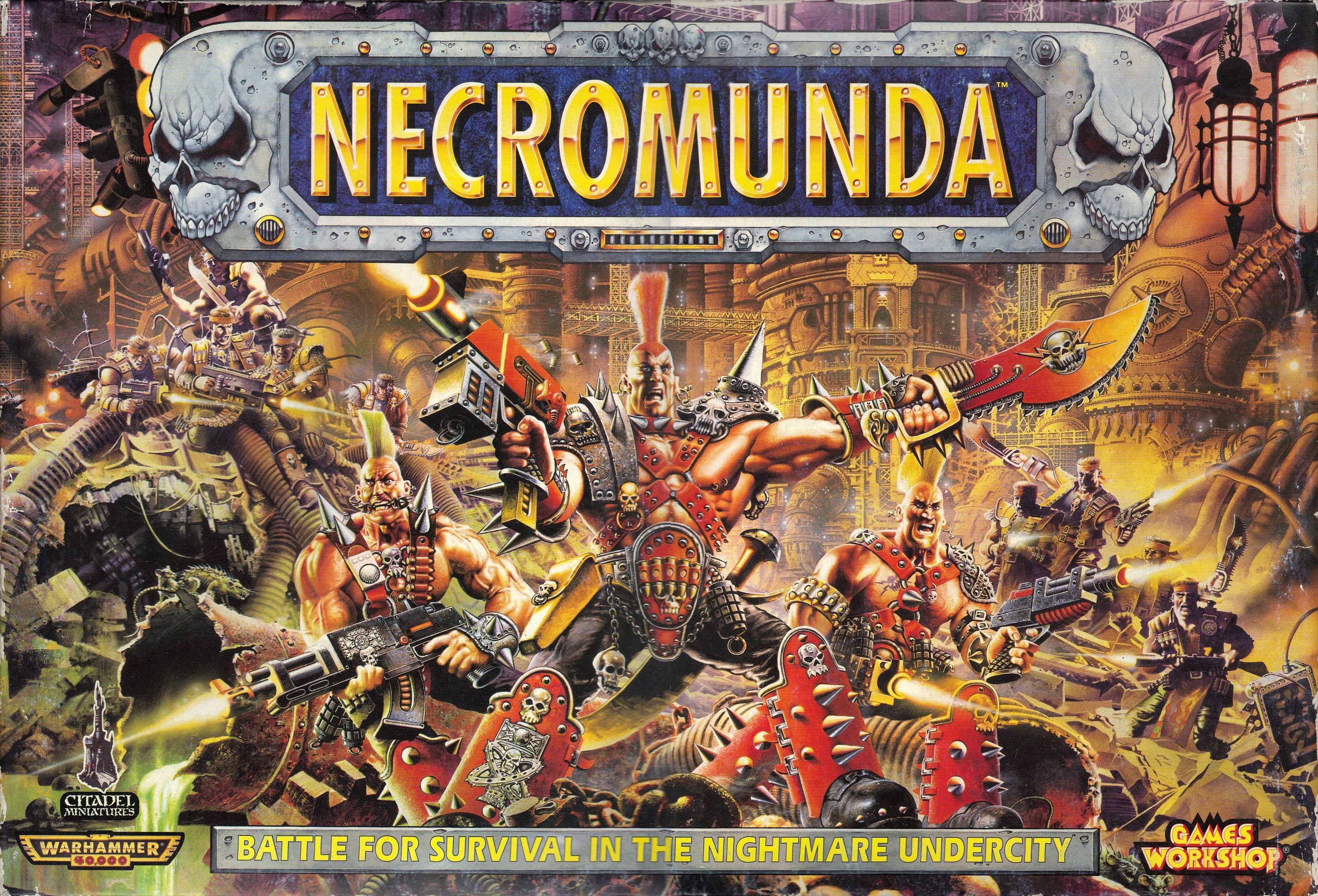
Résumé
Necromunda is a skirmish game in which each player controls a gang of fighters battling over underhive turf. This part of the rulebook covers the core rules: fighter profiles, dice, visibility, measurement, statuses, terrain, the round structure, actions, shooting, close combat, injuries, and psykers. It does not give a general way to win, which is left to the scenario being played.
This part of the rulebook covers the War of the Gods campaign variant: Enforcer and Subjugator equipment and skill access, outlaw and law-abiding gang rules, cult gangs (Corpse Grinders, Helot Chaos Cults, Genestealer Cults) and their Dark Ritual, mutations, and Chaos Spawn, plus the Dominion Campaign and Law and Misrule Campaign rules. Players win Triumphs or Territories by winning battles over a fixed campaign period.
This part is a campaign supplement for a skirmish game about rival gangs fighting in an underhive. Gangs fight battles to claim Rackets (income and boon sources) and build reputation. In the Law and Misrule Campaign, players ally with Law Abiding or Outlaw alignment and earn Triumphs. In the Uprising Campaign, gangs fight for Order or Chaos over Territories while the hive collapses. This part covers only the pre-battle and post-battle sequences and the campaign variants, not the core battle turn.
Mise en place
Doors are closed at the start of a battle unless a scenario says otherwise. Locked doors carry door terminals placed within 1" of them during the pre-battle sequence. Each player needs a Fighter card for each fighter, plus Ready, Broken, Out of Ammo and Condition markers, and a Priority marker.
Founding a gang: Choose a House, then spend up to your budget on fighters, which depends on whether the gang is founded for Skirmish or Campaign play. Unspent credits go to the Stash in a Campaign gang and are lost in a Skirmish gang. Every gang needs one Leader, and its Gangers must equal or outnumber all other fighters, not counting Hangers-on. A fighter carries at most three weapons, and weapons marked with an asterisk take the space of two. Campaign gangs may start with no more than two Champions. Fighters are limited to their House Equipment List in a Campaign, but may also buy from the Trading Post in a Skirmish. Battle setup: Booby traps are placed after the battlefield is laid out but before any fighters deploy. If both gangs use them, the defender places first, or the winner of a roll-off if there is no defender. Ammo caches are set up after the last fighter is placed. If a gang is defending in a scenario with an attacker, roll a D6 for each cache: a 5 or 6 means it is available, and a 1-4 means it cannot be used. Each usable cache is placed within 1" of one of the gang's fighters, and within the deployment zone if the scenario has one. It is then removed from the Stash.
The rulebook gives setup for the Dominion Campaign: the Arbitrator sets start and end dates and deals out a number of Territories based on player count, drawn from House decks and a shuffled pool. Each player founds a gang with 1,000 credits, and every gang starts with a Settlement Territory it cannot lose. Law and Misrule Campaign setup gives each player two random Rackets from the Racket cards, with the rest kept as an unclaimed pool.
Pre-battle sequence (Law and Misrule): Rescue Missions: if a fighter was Captured, its owner may challenge to a Rescue Mission, with no Racket staked.
- Draw Intrigues: each player draws three Intrigue cards and keeps them face down beside the battlefield.
- Set up the battlefield: use the scenario's terrain instructions or the default method.
- Choose crews: the scenario sets the selection method and fighter count.
- Announce boons: any boon not announced cannot be used in the battle.
- Tactics cards: each player builds a deck as the scenario states.
- Deployment: use the scenario's zones or the standard rules.
Uprising Campaign setup: the Arbitrator sets start and end dates and splits the campaign into weeks. Each gang starts with 1,000 credits, a Reputation of 1, and three Territories, one being its home base.
Un tour de jeu
Each round has three phases, taken in order:
Priority phase: Both players roll a D6. The higher roll takes the Priority marker. On a tie, the player who held Priority last round passes it on. Then every fighter on the battlefield gets a Ready marker.
Action phase: If a gang has failed a Bottle test, each of its fighters makes a Cool check, and any fighter who fails flees the battlefield. Then, starting with the Priority holder, players alternate activating one of their Ready fighters. A fighter can make up to two actions. A Leader or Champion can also bring nearby Ready fighters into a Group Activation. Once all fighters have activated, the phase ends.
End phase: Bottle tests are made if needed, Recovery tests are rolled for Seriously Injured fighters, and Cool checks are made to Rally Broken fighters.
Actions come in three types: Basic (one per activation), Simple (can be repeated), and Double (counts as two actions). A Standing and Active fighter can Move, Charge, Shoot, Take Cover and more. A Standing and Engaged fighter can only Fight or Retreat. Prone fighters have a limited set of actions.
Battles are fought on a challenge basis, with each game staking a Territory or Racket. The pre-battle sequence covers challenges, buying Advancements, determining scenario, announcing Boons, Tactics cards and deployment. The post-battle sequence covers wrap-up, reassigning territory, rewards, income, post-battle actions such as Trade and Sell to the Guilders, updating the roster, and reporting results. Gangers gain Experience from taking enemies Out of Action and advance through characteristic and skill advancements.
Fin de la partie
The Dominion Campaign ends when the Takeover phase time runs out. The Law and Misrule Campaign ends after its Justice phase. Players may extend campaigns by adding further phases.
Law and Misrule Campaign: the campaign ends when the time set for the Takeover phase runs out. The Arbitrator then reads the results of each battle, awards Triumphs, and weighs the balance between Law and Misrule.
Uprising Campaign: the campaign runs through the Insurrection phase (three campaign weeks), one Downtime week, and the Damnation phase (three weeks). The final battle decides the fate of the hive.
Décompte des points
In the Dominion Campaign, Triumphs are awarded for Most Territories (Dominator), Most enemy fighters taken Out of Action (Slaughterer), Largest Wealth (Creditor), Most battles fought (Warmonger), and Highest Reputation (Powerbroker). A player may earn more than one Triumph, and a tie for any Triumph means no one is awarded it. In the Law and Misrule Campaign, the Arbitrator totals enemy Leaders taken Out of Action, final Wealth, battles fought, final Reputation and Rackets controlled to decide which side tips the balance.
Law and Misrule Triumphs: Racketeer (most Rackets), Hit Man (most enemy leaders of a different alignment taken Out of Action), Financier (largest Wealth), Muscle (most battles fought), and Lord of Law or Misrule (highest Reputation). A player may win several Triumphs. A tie for a Triumph means nobody gets it. Each Triumph won is worth 1 point, and the alignment with the most points has Tipped the Balance.
Uprising Triumphs: Champion of the Dark Gods (most Chaos scenario wins), Scion of the Imperium (most Order scenario wins), Flesh Harvester (most Meat), Icon of Salvation (most fighters on the roster at the end), Legendary Status (highest Reputation), and Survivor (fewest fighter deaths). The rulebook does not say how ties are handled for these.
Battle outcomes: the winner of a battle takes control of the staked Racket. In a draw, a contested uncontrolled Racket is claimed by neither side, and a controlled Racket stays with its holder.
Variantes
Multi-player games are covered in this part. Priority is rolled as normal, but ties among several players are re-rolled and play order is set by dice score. Other variants, such as campaigns, skirmish and arbitrated games, are listed elsewhere in the rulebook and are not covered here.
The Dominion Campaign has the Old Kingdoms variant, with two Takeover phases and no Occupation phase, and the Into the Unknown variant, where Territories stay hidden until fought over. The War of the Gods rules include optional Outlaw and Law Abiding alignment rules that the Arbitrator can use if all players agree, and Dark Pact or Genestealer Cult options for House gangs. Players can also form splinter gangs in a later campaign.
Law and Misrule: Splinter Gangs let a player found a new gang led by a Champion from a past campaign. Campaigns can be extended beyond seven weeks by lengthening each phase. Intrigues can be played with an Intrigues card pack or with half a playing-card deck.
Uprising Campaign alternates: Order from Chaos (reversed phases with a stipend for Order), Hive War (open warfare with a Trading Post stocked at Common rarity), War of the Gods (four Ruinous Power allegiances, all in the Damnation phase), Cannibal Kingdoms (expanded Starvation and devouring territories), Survivors of the Apocalypse (survival focus, no sides), and Rise of the Four-armed Emperor (a Xenos allegiance and infiltration).
War of the Gods Campaign is also a named variant of the Law and Misrule rules, which keeps the same Reputation and Racket framework.
Modifications
- Variantes, par le brouillon tiré du livret de règles, le 23 novembre 2026 (affichée maintenant)
- Décompte des points, par le brouillon tiré du livret de règles, le 23 novembre 2026 (affichée maintenant)
- Fin de la partie, par le brouillon tiré du livret de règles, le 23 novembre 2026 (affichée maintenant)
- Un tour de jeu, par le brouillon tiré du livret de règles, le 23 novembre 2026 (affichée maintenant)
- Mise en place, par le brouillon tiré du livret de règles, le 23 novembre 2026 (affichée maintenant)
- Résumé, par le brouillon tiré du livret de règles, le 23 novembre 2026 (affichée maintenant)