Règles de Paths of Glory
Résumé
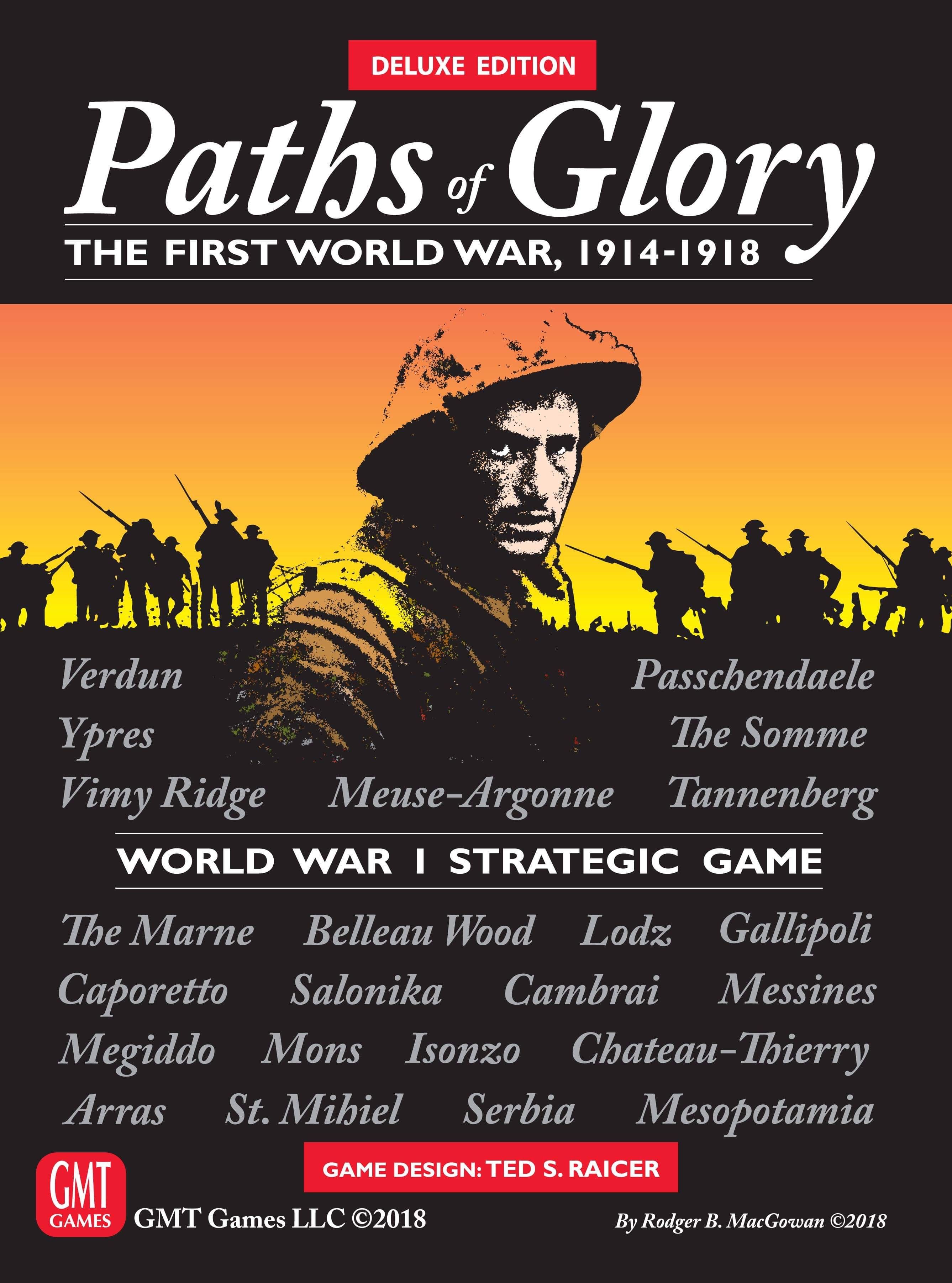
Paths of Glory: The First World War is a two-player game simulating the Great War. The Central Powers player tries to use his central position and German armies to defeat the numerically superior Allies, while the Allied player brings larger numbers to bear and tries to avoid a Russian collapse until United States forces arrive. Victory is decided by the Victory Point level when the game ends, with automatic victories possible at the extremes.
Mise en place
Place the Game Turn marker on August 1914, the Victory Point marker on 10, all three War Status markers on 0, and the replacement and Russian VP markers on 0 as listed on the General Records Track. Place the Mandated Offensive, US Entry and Russian Capitulation markers in their starting boxes, and give each player six Action markers. Place the five Move/Attack markers near the Central Powers player, who acts first.
Units are placed on the Set-Up Chart. Neutral nations' units enter only when their entry event is played. Reinforcement corps go to each player's Reserve Box. Each Central Powers player may choose whether to start with the Guns of August card in hand, and must tell the Allied player his choice. Each side shuffles its Mobilization cards and draws seven cards (the Central Powers player counts Guns of August toward the seven if chosen). An optional alternative set-up for tournament play is also given.
Un tour de jeu
Each turn has these phases in order:
- Mandated Offensive: each player rolls a die to see whether a nation must attack this turn. A missed required attack costs 1 VP.
- Action: there are six Action Rounds. In each round the Central Powers player acts first, then the Allied player, taking one action each. An action is one of: play a card as Operations (move and attack using Activation Points equal to its OPS value), Strategic Redeployment, Replacement Points, or an Event; offer Peace Terms if the VP level allows; or take a free one-point Operation without a card.
- Attrition: out-of-supply corps and armies are eliminated, and spaces lacking supply may change control.
- Siege: each besieged fort is rolled for surrender.
- War Status: VP changes are applied, automatic victory is checked, an Armistice is checked, and each player's War Commitment Level may rise.
- Replacement: each side spends its Replacement Points; unspent points are lost.
- Draw Strategy Cards: each player draws back up to seven cards.
- End of Turn: advance the Game Turn marker and start again, unless the game has ended.
In combat, the attacker and defender each fire on a Fire Table using their combat strength, and the higher Loss Number wins. Losers retreat or are eliminated, and winners may advance.
Fin de la partie
The game ends when a player achieves an automatic victory, when an Armistice is declared, when a scenario's final turn is reached, or when a player accepts Peace Terms. Automatic victory for the Central Powers occurs when the VP total is 20 or higher during the War Status Phase; for the Allies, when it is 0 or lower. An Armistice is declared when the Combined War Status reaches 40 or more during the War Status Phase. Accepting Peace Terms ends the game immediately in a draw.
Décompte des points
Victory is decided by the VP level when the game ends, compared against the thresholds for the scenario being played. For the Introductory scenario (ends after Turn 3), the Central Powers win at 14 or more, a draw is 11 to 13, and the Allies win at 10 or fewer. For the Limited War scenario (ends at Summer 1916 or earlier), the Central Powers win at 17 or more, a draw is 13 to 16, and the Allies win at 12 or fewer. For the Campaign scenario (ends after Winter 1919 or earlier), the thresholds depend on whether the Treaty of Brest-Litovsk event was played: with it, the Central Powers win at 11 or more, a draw is 10, and the Allies win at 9 or fewer; without it, the Central Powers win at 13 or more, a draw is 10 to 12, and the Allies win at 9 or fewer.
In tournament play, the VP bid made at the start is subtracted from the final total at game end, and a draw counts as an Allied victory.
Variantes
Tournament play: the Limited War or Campaign scenario is used, and sides are chosen by a bidding process in which each player rolls a die and bids a VP amount to cede to the opponent. The bid is only applied at game end and does not affect automatic victory. Under tournament rules, a draw counts as an Allied victory, and if the game ends by accepted Peace Terms, both sides count as having lost.
Optional rules: an optional alternative set-up places one Austro-Hungarian and one Russian corps at Stanislaw and Lutsk, and an optional eight-card hand may be used. The rulebook also gives an Optional Historical Scenario that changes set-up, trenches and some Victory Point spaces for both sides, and a set of special rules for the Campaign scenario, such as extra VP for American armies not on the map at game end.
Modifications
- Variantes, par le brouillon tiré du livret de règles, le 23 novembre 2026 (affichée maintenant)
- Décompte des points, par le brouillon tiré du livret de règles, le 23 novembre 2026 (affichée maintenant)
- Fin de la partie, par le brouillon tiré du livret de règles, le 23 novembre 2026 (affichée maintenant)
- Un tour de jeu, par le brouillon tiré du livret de règles, le 23 novembre 2026 (affichée maintenant)
- Mise en place, par le brouillon tiré du livret de règles, le 23 novembre 2026 (affichée maintenant)
- Résumé, par le brouillon tiré du livret de règles, le 23 novembre 2026 (affichée maintenant)