Règles de Sylla
Résumé
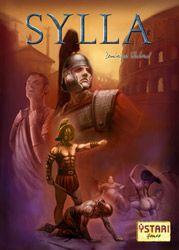
Sylla is a game for 3 or 4 players in which players are Roman senators competing for prestige. Over five turns they recruit characters, buy buildings, fight events, build great works and manage the mood of Rome. The player farthest along the Road to Glory at the end takes control of Rome and wins; tied leaders all win.
Mise en place
- Place the board in the middle of the table. Set the Ecclesia card aside beside the board for the end of the game.
- Shuffle the building tiles by letter. Pile them face down on the board in the order C, then B, then A (A on top). Reveal the first 6 A tiles at the bottom of the board by the coloured locations.
- Place the Decadence event card in its marked spot. Shuffle the other event cards, pile them face down, and deal 3 face up to the right of the board above Decadence.
- Shuffle the Great Works cards and pile them face up. Remove the first card from the game, so everyone knows which work will not be built. The next card is the Great Work for the first turn.
- Place one Res Publica token of each type (civic spirit, health, leisure) on the central square of the Res Publica ladder as markers. Keep the other tokens nearby. Put the Famine marker on the first space of the ladder.
- Each player takes a random Revenue tile (I to IV) and the Character cards with the same number. Each player secretly picks 4 characters, then everyone reveals them. Shuffle the remaining characters, pile them face down on the board, and deal the top 6 face up to the left of the board.
- Each player takes a screen, the cubes of one colour, and 3 deniers plus 1 per Merchant among their picks. Place their marker on 10 of the Road to Glory. Gather the remaining money as the stock pile.
- Put the turn counter on the circled I. The player with tile I is the first First Consul.
Un tour de jeu
A game has 5 turns of 7 phases. The First Consul moves the phase marker after each phase.
- First Consul: Players bid clockwise, starting after the current First Consul, with upright face-up Senators (one vote each) plus any deniers (one vote each). Each player may pass or raise. The highest bidder pays the deniers into the stock pile and becomes First Consul, then takes a Res Publica token of their choice from the pile and shows its colour. The Famine marker moves right by the total famine symbols on the four events in play (maximum 6).
- Recruitment: Starting with the First Consul, clockwise, each player takes one face-up character from the left of the board. Leftover cards go to the bottom of the character pile.
- Buildings: The First Consul offers one of the six building tiles. Its edge position sets the sale colour (red, yellow or grey), and only characters with that coloured hexagon can pay. Clockwise, each player offers a number of hexagons or passes, ending with the First Consul. If everyone passes, the tile is discarded. The top bidder pays by turning that many matching characters sideways, and those characters cannot be used again this turn. The winner then offers the next tile. Five tiles are sold in total and the last one is removed.
- Revenue: Starting with the First Consul, each player takes 3 deniers from their Revenue tile, plus 1 for each upright face-up Merchant, plus any income from buildings with phase IV effects.
- Events: Each upright face-up Vestal Virgin or Legionary places one cube on an event card with the matching symbol, clockwise from the First Consul, until all cubes are placed. For the first three events, the player with the most cubes gains a Res Publica token of the event's colour (ties all gain one). On Decadence, the player with the most cubes gains 1 prestige. Of the four events, the two with the most cubes are prevented and the other two take effect, the top one first. Of the prevented pair, the one with the most cubes is removed (the First Consul decides ties). Decadence cannot be removed, so the other prevented event is removed instead. Replace removed events with a new one. Players take their cubes back.
- Great Works: Each upright face-up Senator counts as a vote, and each denier put in counts as a vote. Each player secretly chooses thumb up (finance the work) or thumb down (give to the Plebeians), then all reveal together. Each 2 votes given to the Plebeians earns 1 prestige, and those deniers go to the stock pile. If the work is financed, its effects are resolved as on its card, and the work is turned face down. The next Great Work is then revealed.
- Famine and Crisis: See the end section for famine and crisis effects.
At the end of each turn, put new characters beside the board and new buildings in the building zone. Turn all characters upright and reset the phase marker to I.
Fin de la partie
The game ends after the fifth turn. The Ecclesia (the Church) is then built automatically:
- Advent of Christianity: each face-up Christian character (fish symbol), even if turned sideways, earns its owner 2 prestige.
- Freeing of slaves: players may pay 2 deniers per face-up Slave, even turned sideways, to free it. Each freed Slave earns 3 prestige.
- Political outcome: all players reveal their Res Publica tokens. Each token is worth the number of prestige shown by its marker's position on the ladder.
Before scoring the final effects, players also apply the last famine and crisis checks.
Décompte des points
Prestige is tracked on the Road to Glory. Famine and crisis are applied during phase VII of each turn:
- Famine: each player loses prestige equal to the famine level minus 2 for each Field visible in their zone. A player with enough Fields does not gain prestige from this. Prestige never drops below 0.
- Crisis: if a Res Publica marker (health, civic spirit or leisure) is in the crisis zone, the crisis occurs. Players reveal all tokens of that type. The player or players with the most tokens gain 3 prestige. The player or players with the fewest lose 3 prestige. Tokens then go back behind the screens.
Surplus money earns no prestige at the end. The player farthest along the Road to Glory wins. If players are tied for first, all of them win.
Variantes
Three-player game: it follows the same rules with these changes:
- During setup, each player chooses 6 characters instead of 4.
- In each Recruitment phase, players choose from 5 face-up characters instead of 6.
- In each Buildings phase, 4 buildings are sold instead of 5, and the last 2 buildings are removed from the game.
Modifications
- Variantes, par le brouillon tiré du livret de règles, le 23 novembre 2026 (affichée maintenant)
- Décompte des points, par le brouillon tiré du livret de règles, le 23 novembre 2026 (affichée maintenant)
- Fin de la partie, par le brouillon tiré du livret de règles, le 23 novembre 2026 (affichée maintenant)
- Un tour de jeu, par le brouillon tiré du livret de règles, le 23 novembre 2026 (affichée maintenant)
- Mise en place, par le brouillon tiré du livret de règles, le 23 novembre 2026 (affichée maintenant)
- Résumé, par le brouillon tiré du livret de règles, le 23 novembre 2026 (affichée maintenant)