Règles de Turing Machine
Résumé
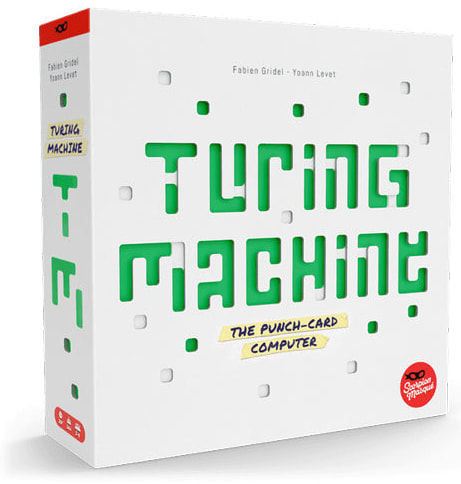
Turing Machine is a deduction game in which players operate a proto-computer to crack a secret 3-digit code made of a number, a number and a number, each shown by a coloured card. Four to six Verifiers each check one hidden criterion, and players question them to work out which criteria apply. The code is the only one that passes every Verifier's test. The first player to find it wins.
Mise en place
Place the Machine tile in the centre of the table. Assemble the punch-card support and leave it assembled, storing it in the box that way at the end. Load the punch cards into the support, with the first set at the front.
Choose a problem. Each Verifier gets a Criteria card placed in front of it, and its matching Verification cards placed face down beside it. On the back of each Verification card, tick the letter of its Verifier (A, B, C or D) to avoid mix-ups.
Give each player a Player Aid and a note sheet. If playing an online problem, note its number. For a game with fewer Verifiers, draw a line through the unused columns (E and F in the first example).
Un tour de jeu
Each round, every player works at the same time:
- Compose a 3-digit proposal by overlaying three punch cards of different colours. If a card you need is in use, wait for it.
- Question up to three Verifiers, keeping the same proposal for the whole round. Place a Verification card under your proposal, aligned with the corner symbols. Look through the single hole to read the answer, then mark a V (pass) or X (fail) on your note sheet. Return the Verification card face down afterwards.
- Deduce by returning the punch cards to the support, then recording what you have learned on your note sheet.
- End of round: on a count of three, everyone points a thumb up if they think they have the code, or down if not.
Fin de la partie
If at least one player points up, the round ends the game stage. Each player who thinks they have the code writes it secretly on their note sheet, then checks it against the solutions in the booklet or in the app. Players who were wrong are eliminated, and the others keep playing. If nobody is correct, the round simply continues. The game ends when a correct code is found, or when only one player remains, who then wins by default.
Décompte des points
There are no points. If several players find the correct code, the winner is the one who asked the fewest questions, which is why every answer must be recorded. If players are still tied on questions, all of them win.
Variantes
- Classic mode works with the problems as presented in the rules.
- Extreme mode gives two Criteria cards per Verifier, with only one valid criterion among them.
- Nightmare mode hides which Verifier matches which Verification card.
- Solo and cooperative play follow the rules in the solo and cooperative section, still with a maximum of three questions per round.
- Handicap: when an experienced player plays newer ones, the experienced player fills in one answer square in the first round for a small skill gap, or two for a larger gap. Each filled square counts as a question they have already asked.
- Take on the Machine: solve an online problem in the fewest rounds and questions, using one note sheet, and match or beat the Machine's count.
Modifications
- Variantes, par le brouillon tiré du livret de règles, le 22 novembre 2026 (affichée maintenant)
- Décompte des points, par le brouillon tiré du livret de règles, le 22 novembre 2026 (affichée maintenant)
- Fin de la partie, par le brouillon tiré du livret de règles, le 22 novembre 2026 (affichée maintenant)
- Un tour de jeu, par le brouillon tiré du livret de règles, le 22 novembre 2026 (affichée maintenant)
- Mise en place, par le brouillon tiré du livret de règles, le 22 novembre 2026 (affichée maintenant)
- Résumé, par le brouillon tiré du livret de règles, le 22 novembre 2026 (affichée maintenant)