Règles de Underwater Cities
Résumé
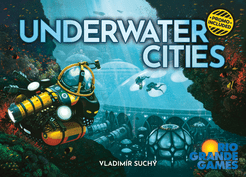
Underwater Cities is a game where players build an undersea nation of connected cities, tunnels, buildings and resources across three eras. Each round, players take turns placing action tiles on slots while playing cards, and at the end of the game the player with the most points wins.
Mise en place
- Place the main board in the middle. Use the two-player side for a two-player game.
- Shuffle the Era I deck and place it on the board. Put the era marker on the first space of the era track and each score marker on zero.
- Split the Special cards into a one-or-two-credit group and a three-credit group. Shuffle the cheaper group onto the board and flip its top card face up. Shuffle the three-credit group, deal six face up to the center spaces, and return the rest to the box.
- With fewer than four players, leave the action-cloning tile out. Use 7 symbiotic domes for two players, 10 for three, and all 13 for four.
Each player chooses a color and takes 3 action tiles, a Personal Assistant card, a final scoring card and a player info card. Everyone starts with 1 kelp, 1 steelplast, 1 science and 2 credits. Each player takes a random player board, with a starting city in the lower right, the brown metropolis in the upper left, and the two blue metropolises on the other spaces.
For the first round, place the play-order markers randomly, then place the Federation markers in reverse order. The third player gets 1 extra credit. The last player gets 1 credit and 1 steelplast.
Each player draws 6 Era I cards, keeps 3 and discards 3.
Un tour de jeu
On your turn, play one card from your hand and place one of your action tiles on a slot that no one else has taken this round. The always-available slot can be chosen even if occupied.
- If the card's color matches the slot, you may resolve the card's effect and the slot's action, in either order. Each must be fully resolved before the other.
- If the colors do not match, or you chose the always-available slot, perform only the slot's action and discard the card with no effect.
- You may use only part of an action or card effect, but you cannot choose a slot you cannot use at least partly.
At the end of your turn, draw 1 card. If you hold more than 3 cards, discard down to 3 before your next turn.
A round lasts until each player has taken 3 turns.
Fin de la partie
After each round, the era marker advances one space. When it reaches a Production space, the era ends and a Production phase follows.
Production:
- Each connected building and tunnel next to a connected city produces its resources, and symbiotic cities produce points.
- Claimed production cards and connected metropolises then apply.
- Each connected city must be fed 1 kelp. If there is not enough kelp, pay 1 biomatter per unfed city. Any city still unfed costs 3 points.
End of era: rotate used action cards back to their usual orientation (not after the final era), feed cities, discard the old era's deck, and shuffle in the next era's deck. Each player draws 3 new cards, then keeps 3.
The game ends after the third era's Production phase and final scoring.
Décompte des points
Final scoring follows the order on your final scoring card:
- Score for each connected metropolis you have joined to your network, and for any end-scoring cards you have claimed.
- Score for each connected city based on the building types next to it: 2 points with no buildings, 3 with one type, 4 with two types, and 6 with all three.
- Convert remaining resources: sell biomatter for 2 credits each, then buy 1 point for every 4 credits, kelp, science or steelplast spent, in any combination. Leftovers are ignored.
The player with the most points wins. A tie is broken by the play order determined at the end of the final round.
Variantes
- Two-player board side: Use the other side of the main board for a two-player game.
- Four-player action-cloning tile: Pay 1 credit to place the tile on a slot occupied by another player, then play a card as usual. Once used, it cannot be used again that round.
- Advanced player boards: Use the other side of the player boards, which adds building sites with surcharges and production multipliers. Everyone in the game should use this side.
- Government contracts: Draw 3 contract cards at setup and place them on the board. Any player who meets a contract's criteria first claims it and gains its benefits. Claimed contracts are not replaced.
- Solo game: Use the advanced player board side and the two-player main board side. Non-player tiles occupy slots and move clockwise each round, and a fourth tile is placed using a card flipped from the era deck. You win by finishing with at least 7 connected cities and at least 100 points. Government contracts cannot be used.
Modifications
- Variantes, par le brouillon tiré du livret de règles, le 22 novembre 2026 (affichée maintenant)
- Décompte des points, par le brouillon tiré du livret de règles, le 22 novembre 2026 (affichée maintenant)
- Fin de la partie, par le brouillon tiré du livret de règles, le 22 novembre 2026 (affichée maintenant)
- Un tour de jeu, par le brouillon tiré du livret de règles, le 22 novembre 2026 (affichée maintenant)
- Mise en place, par le brouillon tiré du livret de règles, le 22 novembre 2026 (affichée maintenant)
- Résumé, par le brouillon tiré du livret de règles, le 22 novembre 2026 (affichée maintenant)