Règles de Viceroy
Résumé
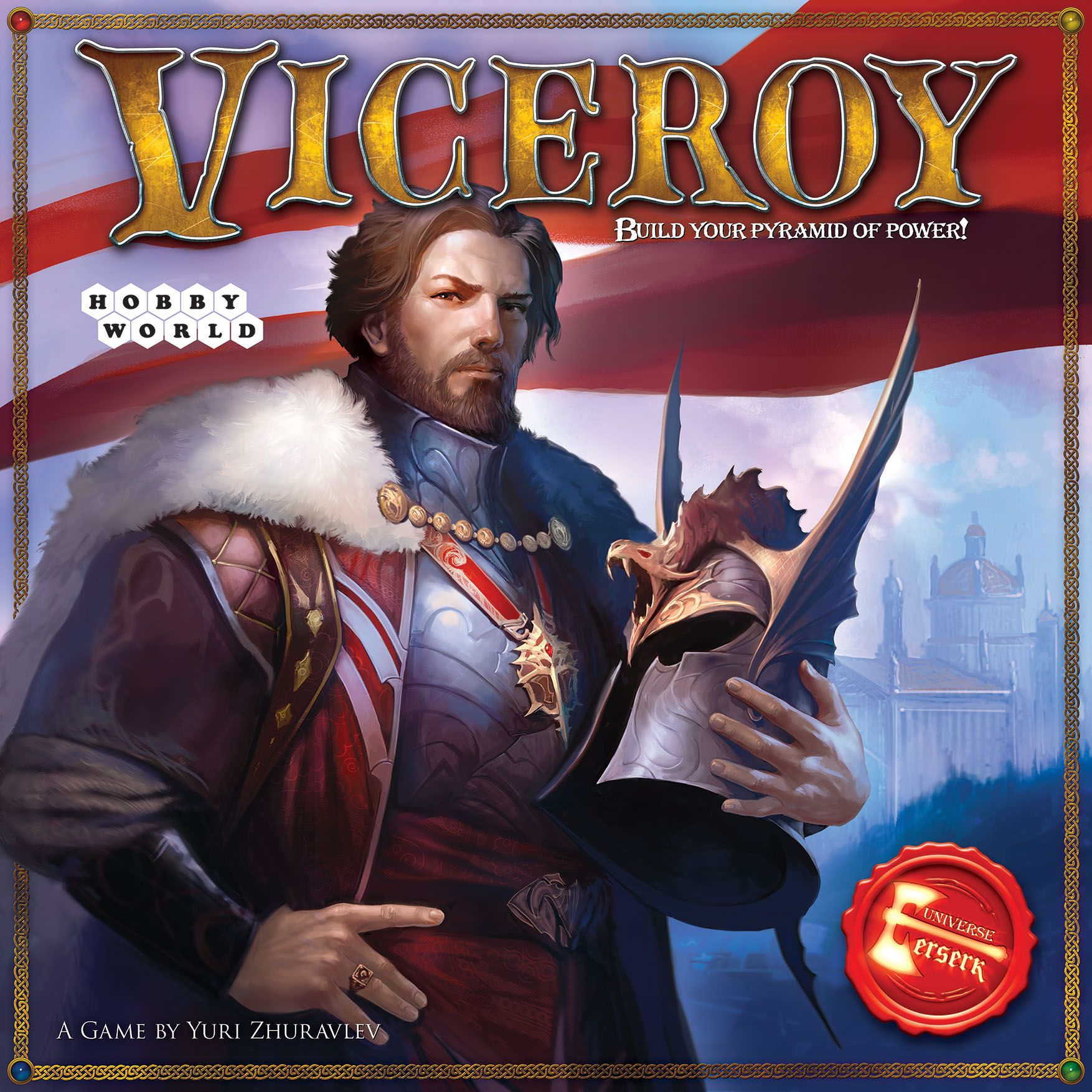
Viceroy is a card-drafting and pyramid-building game for 1 to 4 players in which each player builds a pyramid of character and law cards to gain power points. Players bid gemstones at auctions to acquire cards and spend gemstones to play them at higher pyramid levels. The player with the most power points after final scoring wins.
Mise en place
- Place four auction cards in a line in the middle of the table, all arrows pointing the same way.
- Put the magic/science, attack/defense, power point and bonus tokens in separate piles nearby.
- Form the gemstone reserve: 32 gemstones (8 per color) for two players, 48 (12 per color) for three, or all 64 for four. Return unused gemstones to the box.
- Each player takes a screen, then takes two gemstones of each color, places them behind the screen and returns two random gemstones to the reserve, leaving six behind each screen.
- Shuffle the character cards and deal each player two. Each player keeps one face-up as the first card of their pyramid and receives its lower-row reward. The other goes into their hand.
- Split the remaining character cards into a large deck of 48 and a small deck of the rest. Place the large deck face-down by the auction cards and the small deck face-down on the other side. Reveal four cards from the large deck at the bases of the arrows.
- Shuffle the law cards, deal each player three, and place the law deck face-down beside the small deck. Players keep their law cards hidden.
Un tour de jeu
The game lasts 12 turns. Each turn has two phases, and all players act simultaneously within each phase.
Auction phase:
1. Each player secretly chooses a color matching a character card they want and holds one gemstone of that color from behind their screen in their fist, or holds an empty fist to pass.
2. Bids are revealed. A color bid by only one player wins that card, and the gemstone goes back to the reserve. Players who share a color get nothing and may bid again in the next auction.
3. Up to three auctions are held per turn. A player who gets a card or passes sits out the rest of the turn. Anyone without a card after the third auction counts as passed.
4. After the auction, cards at the arrow tips are discarded, cards at the arrow bases move to the tips, and four new cards are revealed at the bases from the large deck.
When a player passes, they take three gemstones from the reserve, plus one more for each science token in their pyramid. If several players pass together, they take gemstones in order of their lowest-numbered card.
Development phase: this has up to three rounds. In each round, players secretly choose one card from hand or pass. Chosen cards are revealed and resolved in order of card number, lowest first. A played card goes into the pyramid, the player pays its cost and takes its reward.
Placement: the first card sits on the first level, and new cards go beside existing ones on the same level or rest on two cards of the level below. Each card placed on level two or higher must form a circle with the colored sections of the cards it touches. The pyramid can have at most five levels. Law cards cost nothing and can be placed on any level except the fifth.
Cost: a character card's cost is the gemstones shown for its level plus those for every lower level. Rewards are given only for the level where the card is placed. Rewards include gemstones, power point tokens, drawing cards, science or magic tokens, defense or attack tokens, bonus tokens, and infinite gemstones. Forming a single-color circle earns a gemstone of that color from the reserve.
Fin de la partie
The game ends after the final turn. The final turn starts when the last four character cards are revealed from the large deck during an auction. That turn is played to the end, and then players determine the winner through final scoring.
Décompte des points
First, players remove their screens and discard unplayed cards from hand. Using remaining gemstones, they may "paint" circle sections to make circles single-colored, without taking a gemstone for doing so.
Points are then counted in this order:
1. Single-color circles: the level of the circle's top card, plus any bonus tokens for that color.
2. Infinite gemstones: the level of each one, plus bonus tokens for its color.
3. Law cards: as their text states.
4. Power point tokens: their face value.
5. Magic: each magic token scores the total of all magic bonus tokens, but only if the player has both magic tokens and magic bonus tokens.
6. Completed sets: 12 points for each set of one defense, one magic and one science token. A token can belong to only one set.
7. Attack penalty: each unused attack token held by opponents costs 4 points. Each of your defense tokens cancels one enemy attack token.
The player with the most power points wins. The rulebook gives no separate tie-break rule.
Variantes
Solo play: the player faces a virtual opponent that acts only in auctions. After bidding, the player draws a random unused gemstone from the box without looking, and that is the virtual opponent's bid. Matching bids are handled as usual, except that the virtual opponent's gemstones always go back to the box, not the reserve. When the virtual opponent wins a card, that card is discarded. The solo player cannot lose, so they compare their score with their best result.
Virtual opponents with two or three players: up to two or three virtual opponents can be added, keeping the total at four or fewer players, using the same rules.
The rulebook gives no separate teams variant and no short-game variant.
Modifications
- Variantes, par le brouillon tiré du livret de règles, le 23 novembre 2026 (affichée maintenant)
- Décompte des points, par le brouillon tiré du livret de règles, le 23 novembre 2026 (affichée maintenant)
- Fin de la partie, par le brouillon tiré du livret de règles, le 23 novembre 2026 (affichée maintenant)
- Un tour de jeu, par le brouillon tiré du livret de règles, le 23 novembre 2026 (affichée maintenant)
- Mise en place, par le brouillon tiré du livret de règles, le 23 novembre 2026 (affichée maintenant)
- Résumé, par le brouillon tiré du livret de règles, le 23 novembre 2026 (affichée maintenant)