Règles de Villages of Valeria
Résumé
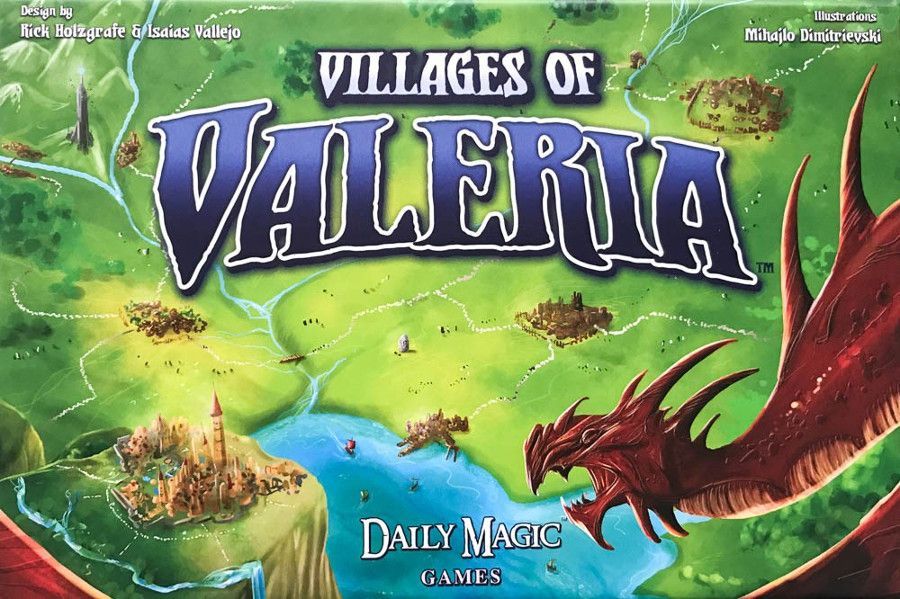
Villages of Valeria is a card game where each player, a Duke or Duchess, builds a village around their castle. You develop Resources, build Buildings that give Victory Points and powers, and recruit Adventurers that give more Victory Points and powers. The player with the most Victory Points at the end wins and gets to host the new Capital City.
Mise en place
Give each player a Castle card and a Player Aid card, and return unused Castle and Aid cards to the box. Each player places their Castle face-up as the first card of their village.
Choose a starting player and give them the Active Player Token and Action Selection Card. Form the bank with the number of Gold coins for your player count and return the rest to the box. Give each player 3 Gold coins from the bank.
Separate the Adventurer and Building cards and shuffle each deck. Deal 6 Building cards to each player as a secret opening hand. Deal 5 face-up Building cards in a row as the Building piles, and place the remaining Buildings face-down beside them as the Building draw deck. Deal 5 face-up Adventurers above the Building piles as the Adventurer pool, and place the remaining Adventurers face-down as the Adventurer deck.
Starting with the active player and going clockwise, each player chooses one Building from their hand to develop as a Resource at no cost. Slide it face-up, upside-down, under your Castle. Normal turns then begin.
Un tour de jeu
Each turn has two steps. First, Replenish: take back all Gold coins from your Castle and Resource cards and keep them.
Second, take one action. Place the Active Player Token on the Action Selection Card to choose an action, and carry it out. This is leading the action. Then each other player, going clockwise from your left, may optionally follow it. When everyone has followed or declined, pass the token and card to the player on your left.
The five actions are:
- Harvest: Lead, draw 3 Buildings. Follow, draw 1 Building.
- Develop: Lead, discard 1 card to add another card from your hand to your village as a Resource. Follow, discard 2 cards to do the same.
- Build: Lead, pay the cost of a Building in your hand to add it to your village, then draw 1 card. Follow, pay the cost and do not draw. You may not have two Buildings with the same name.
- Recruit: Lead, pay 1 Gold to the bank to add an Adventurer whose requirements you meet. Follow, pay 2 Gold. Each Adventurer requires certain Building types in your village. Take a face-up Adventurer from the pool and refill the pool from the Adventurer deck.
- Tax: Lead, take 1 Gold from the bank and draw 1 Building. Follow, draw 1 Building.
An action cost must be paid at the start of the action, and you can only lead or follow if you can pay it. To pay a Building cost, place one of your Gold coins on a matching Resource (you may use your own or other players' Resources, but not Wild Resources on other Castles), or use Resource powers. Each Resource card can hold only one Gold coin, and you may not use a Gold coin already on a Resource.
Drawing takes a card from any Building pile or the Building deck. Discards go face-up onto any Building pile. When a pile is emptied, refill it from the Building deck. At the end of your action, discard down to a hand of 8 if needed.
Powers are optional. Special powers that apply to an action can be used in later actions, and powers that are instant are used once when the card enters your village. Other powers resolve after the basic action is complete.
Fin de la partie
The game ends after a turn in which any player's village reaches the target number of Buildings and Adventurers for the player count. This can be triggered by the active player or by a player following the action. The whole turn is completed first, so all other players may still follow and add cards. Developed Resources and Castles do not count toward the total.
Décompte des points
Add up the Victory Points printed on each Building and Adventurer in your village, plus any Victory Points granted by special powers. Then add 1 Victory Point for each Gold coin you hold, including coins on your Resources and Castle. Resources and cards in hand are not scored.
The player with the most Victory Points wins. Ties are broken in this order: most Buildings and Adventurers, then most Gold coins, then most developed Resources. If players are still tied, they all share the win.
Variantes
Solo play uses the standard rules with these changes:
- Use 7 Gold coins for the bank. Shuffle the Building cards, deal 35 face-down as the only Buildings used, and return the rest to the box unseen.
- Your hand can never exceed 8 cards, so stop drawing when you reach 8.
- There is no following. You always act as the leader.
- Trashing replaces discarding for some actions. Trashed cards go back to the box, and trashing is mandatory when required.
- Develop: trash 1 card instead of discarding 1, and you cannot develop with only one card in hand.
- Tax: trash 1 Building to gain 1 Gold, and you cannot tax with an empty hand.
- Recruit costs 2 Gold.
- Special powers that would take a card from an opponent let you draw one card instead. Powers that would take Gold from an opponent let you take it from the bank.
- Replenishing is staged: Gold and Resources used on one turn stay unavailable for that turn and become available again later.
- The game ends when the Building draw deck is empty at the end of a turn. Do not refill piles or the deck after that.
- Scoring uses the standard method, then compares results against the King's ranks: 60+ Imperator, 50-59 City Builder, 40-49 Proud Mayor, 30-39 One-Horse Town, 29 or fewer Wide spot in the road.
Modifications
- Variantes, par le brouillon tiré du livret de règles, le 22 novembre 2026 (affichée maintenant)
- Décompte des points, par le brouillon tiré du livret de règles, le 22 novembre 2026 (affichée maintenant)
- Fin de la partie, par le brouillon tiré du livret de règles, le 22 novembre 2026 (affichée maintenant)
- Un tour de jeu, par le brouillon tiré du livret de règles, le 22 novembre 2026 (affichée maintenant)
- Mise en place, par le brouillon tiré du livret de règles, le 22 novembre 2026 (affichée maintenant)
- Résumé, par le brouillon tiré du livret de règles, le 22 novembre 2026 (affichée maintenant)