Règles de Wooden Ships and Iron Men
Résumé
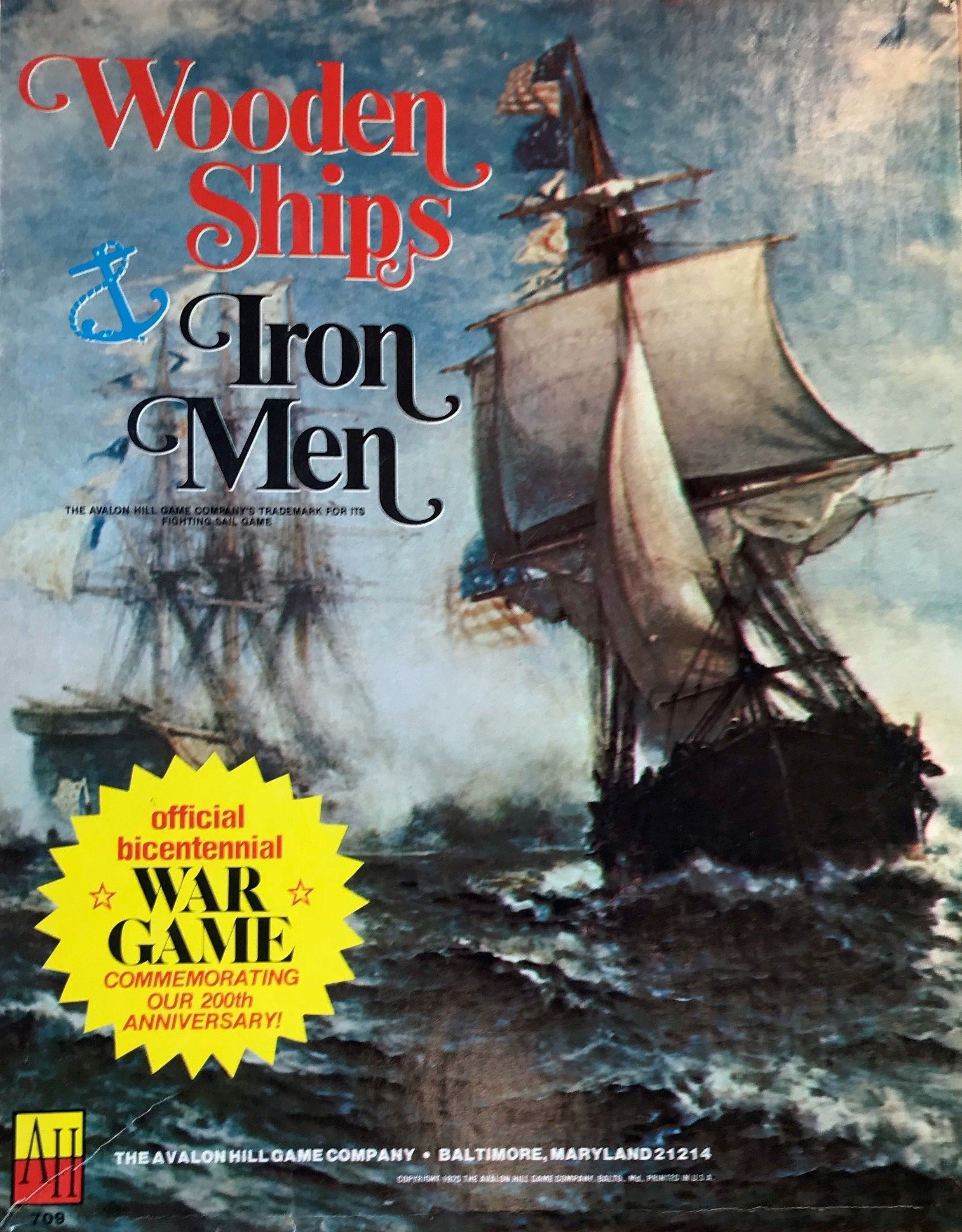
Wooden Ships & Iron Men is a tactical two-or-more player simulation of age-of-sail naval combat, where each player commands a ship, squadron, or fleet. Ships move simultaneously from written orders, fire broadsides, board and fight melees, and try to capture or force enemies to surrender. Victory depends on the scenario; in multi-ship games, surrendered or captured ships award their point value to the opposing player, and the player with the most points wins.
Mise en place
Choose a scenario and follow its set-up information. Remove the counter for each ship of the correct nationality and class. Lay out the mapboard, place each ship's bow in its assigned hex pointing in the direction matching the wind direction hex, and place the wind arrow in that hex. Mark any land, shoals, or rocks the scenario lists.
Fill out a log sheet for each ship from the counter and the Order of Battle: name and guns, counter ID, class, movement allowance for each wind attitude, crew quality (elite 5, crack 4, average 3, green 2, poor 1), hull, marine and crew sections, gun and carronade squares, rigging squares, load boxes, and the move column. Mark out any squares not in use. Beginners use only roundshot.
Un tour de jeu
Each turn follows these phases in order:
- Unfouling: Fouled ships may try to unfoul by rolling two dice on the Unfouling Table. A player may add +1 by marking off one rigging square first.
- Planning: Players secretly write movement for every ship in its log, plus any grapple attempts ("G") and boarding or other notations. Logs are open for inspection after orders are written, except the load column.
- Movement: All ships move simultaneously as written. A ship may move only into the hex its bow points to, and it may turn 60 degrees once per hex, within its movement allowance and turning ability. Ships that do not advance for two turns drift one hex downwind. Retrace routes for collisions; the higher roller keeps the hex, and collisions may cause fouling.
- Grappling and ungrappling: Ships adjacent to another ship that were plotted to grapple roll two dice on the Grappling Table. Grappled ships can only drift. Ungrappling is attempted with two dice on the Ungrappling Table.
- Boarding preparation: Players secretly assign crew sections to an offensive (OBP), defensive (DBP), or transfer (TBP) boarding party, or write NBP.
- Combat: Broadsides fire at the closest eligible enemy in their field of fire within range. Roll on the Hit Determination Table, then on the indicated Hit Table. Hits are marked on the target log at the end of the phase. Firing is simultaneous.
- Melee: Boarding is decided by a die roll with modifiers. If a melee starts, both sides roll on the Melee Crew Loss Table each turn, then check morale.
- Reload: Fired broadsides are reloaded; a ship may load only one broadside per turn.
Fin de la partie
In single-ship scenarios the game ends when one ship surrenders, and the other player wins. Losing all crew squares ends the game for that side. The game also ends immediately if a ship refuses combat and keeps moving out of range, which counts as losing. If both ships surrender at the same time, it is a draw. The scenario's own victory conditions may apply, and the game ends as soon as they are met at the end of any phase.
Décompte des points
Each ship has a point value in the Order of Battle. At the end of a multi-ship scenario, a ship that has struck or otherwise surrendered gives its point value to the opposing player. Players get no extra points for melee captures. All points are totaled, and the player with the highest total wins. A tie is not explicitly resolved in the beginners' rules; a hurricane ending the game gives the lead to the player ahead on points, or a draw if the points are even.
Variantes
The rulebook includes an Advanced Game with full sails, anchors, firefighting, musket fire, additional shot types, and a two-dice wind system. It also includes optional rules, among them timed moves, critical hit and miss variations, small target and small crew modifiers, variable seamanship, loss of rigging, towing, fore-and-aft rigging, rowing, wind velocity effects, blocked wind, variable wind, land, rocks and shoals with refloating, casting the lead, multi-player communication, scurvy, copper bottoms, and command lag. Design-your-own scenarios add fireships, merchantmen, privateers and pirates, boats, forts, bombs, and soldiers, with ships bought from point budgets.
Modifications
- Variantes, par le brouillon tiré du livret de règles, le 23 novembre 2026 (affichée maintenant)
- Décompte des points, par le brouillon tiré du livret de règles, le 23 novembre 2026 (affichée maintenant)
- Fin de la partie, par le brouillon tiré du livret de règles, le 23 novembre 2026 (affichée maintenant)
- Un tour de jeu, par le brouillon tiré du livret de règles, le 23 novembre 2026 (affichée maintenant)
- Mise en place, par le brouillon tiré du livret de règles, le 23 novembre 2026 (affichée maintenant)
- Résumé, par le brouillon tiré du livret de règles, le 23 novembre 2026 (affichée maintenant)