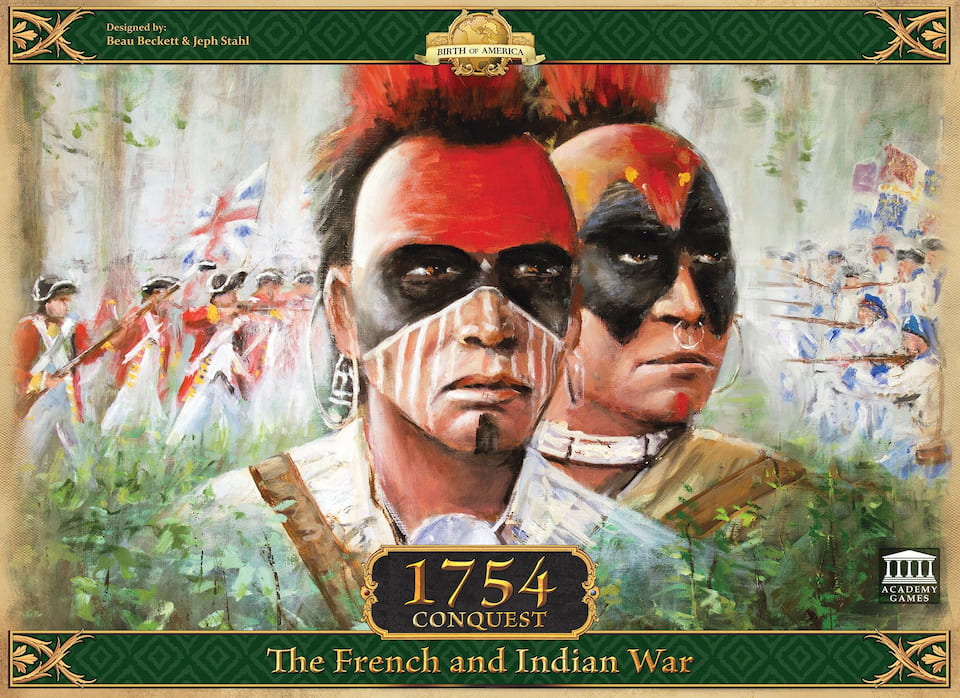
Rules of 1754: Conquest – The French and Indian War
Summary
1754 - Conquest is a two-side wargame of the French and Indian War in North America. Players each control a French or British faction and fight for control of Victory Symbol Areas on the map, while also courting the Native American nations. The side that controls the most Victory Symbol Areas when the game ends wins.
Setup
- Each player chooses a faction and takes its Units, Battle Dice, and Faction Cards. When there are fewer than four players, some players control multiple factions of one side, but all factions must be played. Place the green Native Units and Native Battle Dice beside the map.
- Place the starting Units shown on the map, then remove the Unit symbols from play.
- Place the Muster Markers: the British Colonials place their two grey markers on Town Areas occupied by their Units, and the French Canadiens place their two yellow markers on Town Areas occupied by their Units. Each marker goes in a different Area, with the two-cube side face up.
- Each side places 3 Fort Markers on Fort Symbol Areas occupied by its Units, one per Area.
- Place a Control Marker on each Native Home Area with a Victory Symbol that is occupied by the corresponding side's Units. Players never place Control Markers on their own Home Areas.
- Each faction shuffles its 12 Faction Cards into a Draw Deck and draws 3 cards. If a player holds only Event Cards, they show them, reshuffle, and draw 3 new cards.
- Each faction places 4 additional Units in Areas already occupied by its own Units, spread as desired. Remaining Units go to the faction's Reinforcements Stockpile. Native Units go to their own Stockpile.
- Place the Round Pawn on Space 1 of the Round Track. Place the five Turn Cubes (white, red, yellow, purple, green) into the Draw Bag.
For the short introductory game, each Draw Deck uses only Faction Cards 7 through 10.
A turn
A round is played in the following way. At the start of each Round, all five Turn Cubes go into the Draw Bag. Cubes are drawn one at a time and placed on the Turn Track; the color drawn decides which faction takes its Turn. Once all five cubes are drawn and every faction has had a Turn, the Round ends.
On its Turn, the Active Faction performs these phases in order:
- Reinforcements Phase. Regulars pull 4 Reinforcement Units from their Stockpile and place them in one or more Harbor Areas without enemy Units. Colonials and Canadiens receive Reinforcements from their Muster Markers, placed in the marker's Area; a marker in an Area with enemy Units produces nothing. If the Stockpile is short, place only what remains. When the green Native cube is drawn, place 3 Native Units on each of the two Areas matching that cube's Native Symbol. Fled Units of the Active Faction re-enter play where Reinforcements may go, if there is room.
- Movement Phase. Play one Movement Card. It states how many Armies may move and how many Areas each may move. An Army is formed from Units in one Area, including at least one Unit of the Active Faction, and must stop when it enters an enemy-occupied Area or an Area with independent Native Units. Armies cannot drop off or pick up Units while moving, and each Unit moves only once per Turn. Regulars may also cross Open Water between two Harbor Areas, which counts as one Area, so the crossing costs two moves.
- Battle Phase. A battle occurs where opposing Units share a Land or Harbor Area. The Active Faction chooses the order of battles. The defenders roll first, then attackers, alternating until one side is gone from the Area. Each player rolls one Battle Die per Unit present, up to the number of dice the faction owns. Hit results remove an opponent's Unit to its Reinforcements Stockpile; Flee results move one of the player's own Units to the Fled Units Space; Command results let a player move one of its Units out of the battle to a friendly Area, an empty Allied Home Area, or an empty green Native Home Area, or into an adjacent battle. Hits and Flees resolve first, then Commands. If a Fort is present, a defending player rolls the Fort Die, and a Block result cancels one attacker Hit. Native Units present on both sides flee in pairs first. Control Markers are placed or removed as Victory Symbol occupation changes.
- Draw Cards Phase. Discard the played Movement card and any Event cards played, then draw back up to 3 cards. A hand must always hold at least one Movement Card; if it does not, show the hand, reshuffle, and draw 3 new cards.
End of the game
The game lasts 3 to 8 Rounds. At the end of Round 3, and at the end of each later Round, the game end conditions are checked. The game ends by treaty when all Truce Cards of one or both sides have been played. Once both factions of a side have played their Truce Cards, the game ends at the end of the current Round, after all factions have taken their Turns. The short introductory game ends at the end of Round 2.
Scoring
The side with the most Control Markers on the map wins. If both sides have the same number, the game is a draw. Control Markers are only placed on the opponent's or Native Home Areas, never on a side's own Home Areas. The Victory Symbol Areas are the basis for the count.
Variants
Short Introductory Game: each faction's Draw Deck uses only Faction Cards 7 through 10 and the game ends at the end of Round 2.
Fewer players: when there are fewer than four people, one or more players control multiple factions of one side, but all factions must still be played.
Changes
- Variants, by the rulebook draft, 22 November 2026 (shown now)
- Scoring, by the rulebook draft, 22 November 2026 (shown now)
- End of the game, by the rulebook draft, 22 November 2026 (shown now)
- A turn, by the rulebook draft, 22 November 2026 (shown now)
- Setup, by the rulebook draft, 22 November 2026 (shown now)
- Summary, by the rulebook draft, 22 November 2026 (shown now)