Rules of 1812: The Invasion of Canada
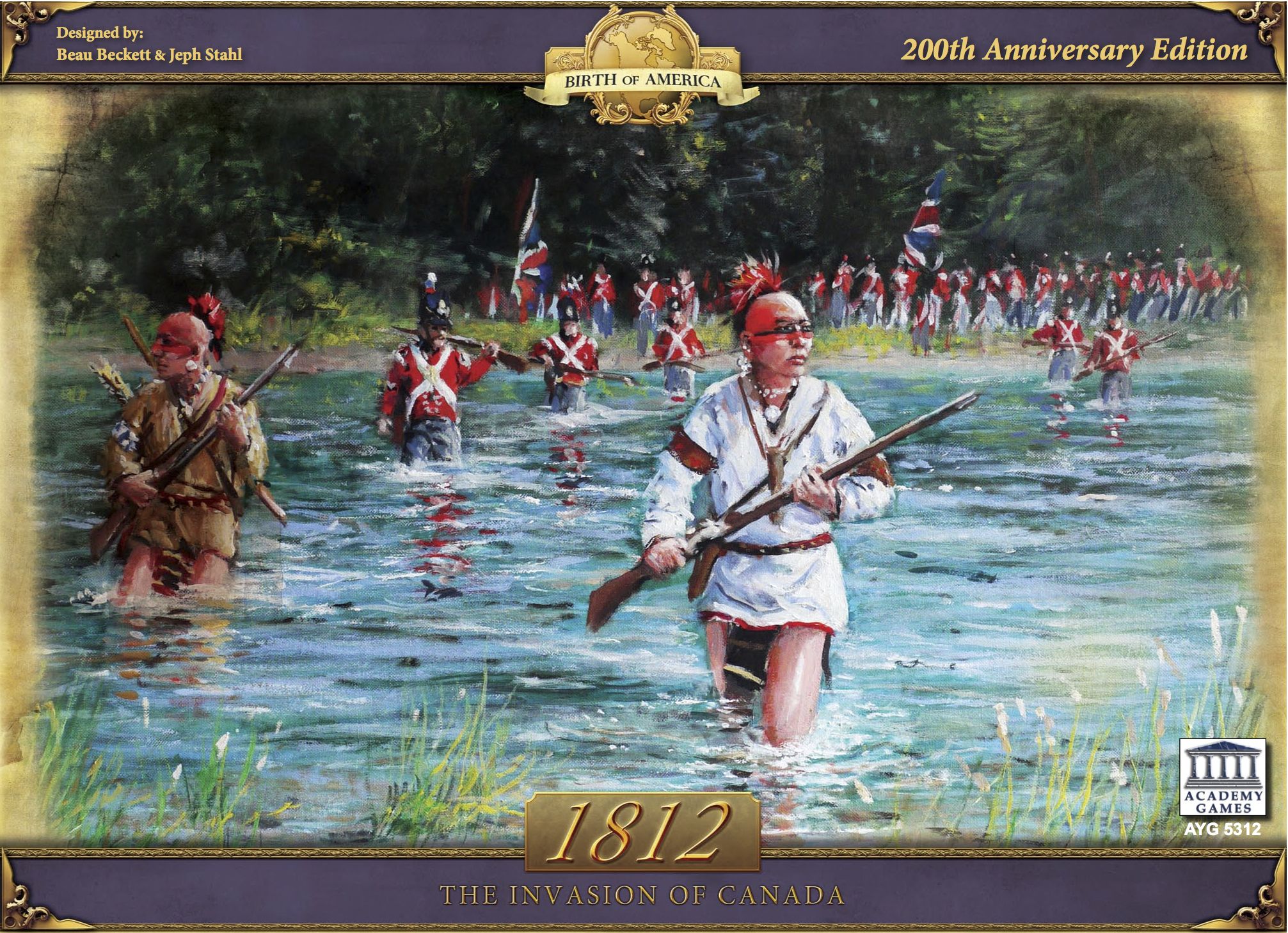
Summary
A two-sided wargame of the 1812 invasion of Canada. British and American faction players work together within their side to move armies across the map and fight battles for Objective cities and forts. When the game ends, the side controlling more enemy Objectives wins.
Setup
Place the map between the players, with the American side on the south edge and the British side on the north. Each player chooses a faction and takes its units, battle dice and cards. If there are fewer than five players, some players control several factions on one side, but all five factions must be played.
Place the starting units shown on the map for the chosen scenario, then add any extra units that scenario lists. Remaining units go to each faction's Unit Force Pool. Each player shuffles his deck and draws three cards. If a player holds only Special Cards, he shows them, reshuffles and draws three again.
Put the Round Marker on round 1 of the round track. Place all Turn Order Markers in the Draw Bag. In the Full Campaign, the American Regulars marker goes on the 1st Turn space first.
A turn
Each round, draw one Turn Order Marker from the bag and place it on the 1st Turn space. The faction it shows takes its turn, and the next marker is drawn only after that turn ends. Once all five factions have had a turn, return the markers to the bag and advance the Round Marker. The American Regulars go first in round 1 of the Full Campaign.
On its turn, the active player does the following in order:
- Place Enlistment units in its Muster Areas, and place any Fled Units back in them. If an enemy occupies a Muster Area, nothing can be placed there that turn.
- Play one Movement Card and up to two Special Cards. Armies move across land, or across large water bodies with a suitable water card. An army stops when it enters an enemy-occupied area.
- Resolve battles where opposing armies share an area. The side whose Homeland Area it is rolls first. Each unit rolls a battle die, and results are Hit (remove an enemy unit), Flee (remove one of your own units to the Fled Units Space) or Command Decision (move one of your units to an adjacent friendly area). Battles alternate until one side is gone.
- Draw back up to three cards. A player must hold at least one Movement Card afterward.
An Objective is controlled when its occupying side has units there at the end of a turn. Place a Control Marker to show this. If the units leave, the marker is removed.
End of the game
The game end check happens at the end of round 3 and at the end of each later round. The game ends when all Truce Cards of one or both sides have been played. The British side has 3 Truce Cards and the American side has 2. Truce Cards are not discarded when played, but are set aside on the western edge of the map.
The introductory scenario instead ends after round two and does not use Truce Cards.
Scoring
The side with the most Control Markers on the map at game end wins. Each Objective controlled by the enemy counts as one point for the side holding it. The rulebook gives this example: the Americans hold three British Objectives and the British hold two American ones, so the Americans win by one. Games can end in a tie.
Variants
The rulebook includes three scenarios:
- 1812 Introductory Scenario: Recommended for new players. It uses extra units placed on the map and a short game that ends after round two, without Truce Cards.
- 1812 Full Campaign Scenario: The full game, with extra unit placements for each side, specific starting cards for each faction, and the Truce Card end condition.
- 1813 Campaign Scenario: Starts in round 3 with armies already in the field. Each faction's starting deck excludes certain cards, and the game uses the same end conditions as the full campaign.
With fewer than five players, one player may control several factions on the same side.
Changes
- Variants, by the rulebook draft, 23 November 2026 (shown now)
- Scoring, by the rulebook draft, 23 November 2026 (shown now)
- End of the game, by the rulebook draft, 23 November 2026 (shown now)
- A turn, by the rulebook draft, 23 November 2026 (shown now)
- Setup, by the rulebook draft, 23 November 2026 (shown now)
- Summary, by the rulebook draft, 23 November 2026 (shown now)