Rules of 1848: Australia
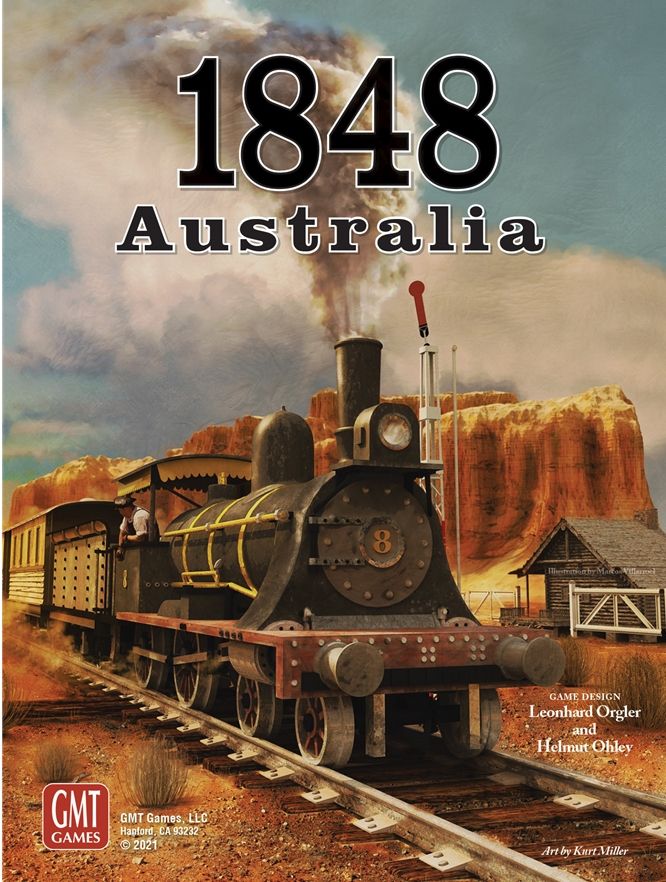
Summary
1848 Australia is a train-building and business game for 3 to 6 players. Players build track and run trains for public companies they invest in, while also holding private companies and shares in the Bank of England. The rulebook says the player with the greatest wealth at the end wins, with wealth being cash plus the value of their shares.
Setup
Deal one numbered Private Company certificate to each player; players sit clockwise starting with the lowest number. Choose a Banker and give each player starting capital: £840 with 3 players, £630 with 4, £510 with 5, or £430 with 6. Place the yellow track tiles and the 2/2+ trains beside the map, and set the Private Company certificates beside the Private Company Auction Track. Each public company keeps its cash, trains, station tokens and loan markers on its charter, kept separate from players' money.
A turn
The game opens with an auction of the Private Companies: each player in turn either buys one at its current price or lowers that price by £5, and once every Private Company has been sold, shares in the public companies and the Bank of England become available. After that the game alternates between Stock Rounds and Operating Rounds. In a Stock Round, a player may sell any number of shares and then optionally buy one share, or pass; the round ends when all players pass in succession, and the Priority Card passes to the player to the left of the last player who bought or sold. In an Operating Round, Private Companies pay their income first, then the Bank of England pays its dividend, then each operating public company takes a turn in order of share price, highest first. A company's turn is to build track, place a station token, run its trains and either pay dividends or withhold income, adjust its share price, and buy trains. The number of Operating Rounds after each Stock Round depends on the phase, rising from one to three as larger trains are bought.
End of the game
The current set of Operating Rounds is always completed before the game ends. The game ends when any one of these occurs: the Bank runs out of money; a company's share price reaches the highest position on the Share Price Chart; the Bank of England has given out 16 or more loans; or five or more companies are under the Bank of England's administration. If the Bank runs out of money during a Stock Round, one more full set of Operating Rounds is played.
Scoring
Company trains and treasury money count for nothing at the end. Each player adds the value of their shares, taken from the Share Price Chart, to their cash, including any unpaid dividends recorded on paper. The player with the greatest total wealth wins. The rulebook does not state a tie-break rule.
Changes
- Scoring, by the rulebook draft, 23 November 2026 (shown now)
- End of the game, by the rulebook draft, 23 November 2026 (shown now)
- A turn, by the rulebook draft, 23 November 2026 (shown now)
- Setup, by the rulebook draft, 23 November 2026 (shown now)
- Summary, by the rulebook draft, 23 November 2026 (shown now)