Rules of 1862: Railway Mania in the Eastern Counties
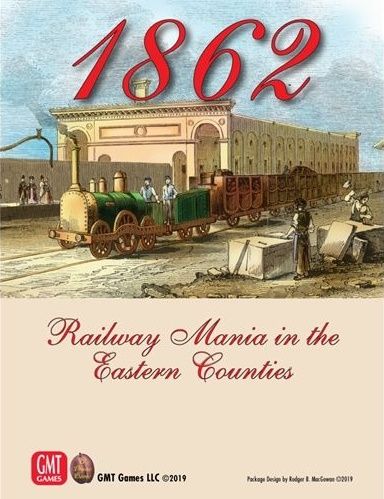
Summary
1862: Railway Mania in the Eastern Counties is a game about founding, investing in and running railway companies in East Anglia during the 1840s to 1860s. Players bid to charter new companies in Parliament rounds, buy and sell shares in stock rounds, and companies build track, run trains for revenue and pay dividends. The player with the most personal wealth at the end wins.
Setup
Place the board in the centre, with the hexagonal track tiles close by. Stack the trains in order A to H. Nominate a competent player as banker and arrange the money as the bank.
For 2-6 players, the banker shuffles the 20 directors' certificates and deals 8 onto the first IPO spaces (1-8), 4 onto spaces 9-12 (available from phase B) and 4 onto spaces 13-16 (available from phase C). The last 4 companies are removed from play and marked with white counters on their home stations. The banker shuffles 16 train permits (6 Freight, 5 Express, 5 Local) and deals one to each company that is in play.
For 7 or 8 players, add one extra company (7 players) or two (8 players) that can be started from the first Parliament round. Use six permits of each type and discard any unused ones.
Choose a game length. The standard game uses 7 A, 6 B, 4 C, 3 D, 3 E, 2 F, 1 G and all H trains. Short and long games use the numbers on the chosen train manifest card or the table at the back of the rules. Place the phase cards at the top of each train band.
Each player takes starting cash based on player count: 2 players £1200, 3 players £800, 4 players £600, 5 players £480, 6 players £400, 7 players £345, 8 players £300. Seat players randomly using the player order cards. The player with the lowest order card gets the Priority Deal token. The game begins with two Parliament rounds, then the first Stock Round.
A turn
The game runs in a repeating sequence of a Parliament round, a Stock round and operating rounds. The number of operating rounds is one in phase A, two in phases B and C and three afterwards.
Parliament round: Starting with the Priority Deal holder and going clockwise, players may start an auction on an available company by making an opening bid (a multiple of £5), or pass. Others raise in multiples of £5 or pass, and a passed player cannot rejoin that auction. The highest bidder when all others pass wins, pays the bid to the bank and must start the company. That player sets the par price, takes the charter, buys the director's certificate (three shares) and may buy up to two more shares from cash. Players who have just won a charter cannot start another auction that round. The round ends when all players in turn decline to start an auction. The Priority Deal does not move.
Stock round: Starting with the Priority Deal holder and going clockwise, each player on their turn may sell one or more shares (in blocks per company), or buy one share or start a non-chartered company. A player who does neither passes. The round ends when all players pass in succession, and the Priority Deal then passes to the player who began the run of passes.
Operating round: Companies operate in descending order of share price, with ties going to the company higher in its stack. A company's director chooses in this order: merge with another company, lay or upgrade track, place a station marker, run trains for revenue, pay or withhold dividends, buy trains, redeem one of its own shares from the Bank Pool, and acquire another company. Each company operates once per round.
End of the game
The game ends when any one of these happens:
- The bank runs out of money. The current set of operating rounds is completed first, using IOUs if needed. If this happens in a stock round, one more set of operating rounds follows.
- A company's share price reaches the top of the stock market. The current operating round is finished.
The game also reaches its final stage after the first H train is bought: the set of operating rounds that follows forms the London & North Eastern Railway (LNER). After that there are no more Parliament rounds, track building or new companies, and shares left in the IPO go to the Bank Pool. Trains can only be bought from the bank. Nationalisation then happens at the start of the next operating round, each company makes final revenue and runs three more operations, and the game ends.
Scoring
The winner is the player with the greatest total personal wealth, meaning cash in hand plus the value of their company shares. Money held in company treasuries does not count.
Shares are valued at the current stock market price. Shares in a company without a train are valued at half that price, rounded down, when they are sold or when a company goes bankrupt.
The rulebook does not give a tie-break rule for players with equal total wealth.
Variants
- Fewer train types: Simple Express (Express only, suggested for new players), Simple Freight (Freight only), Advanced Freight (Freight and Local) and Advanced Express (Express and Local). Simple games use fewer trains per company and do not use train permits. For the Advanced games, the banker deals 8 Freight (or Express) and 8 Local permits.
- Shorter game: Use the short train numbers (or the standard set with five or more players). The LNER forms after the first E train is bought, and D trains are permanent and stay in play.
- New players: Use one of the simple games and also remove these options: starting companies only in Parliament rounds, redeeming shares, buying extra warranties (A and D trains still come with a free one), and the George Hudson Manoeuvre.
- More station markers: Companies may hold up to 8 station markers instead of 7. The rulebook warns this can make late-game token placement more cut-throat.
Changes
- Variants, by the rulebook draft, 23 November 2026 (shown now)
- Scoring, by the rulebook draft, 23 November 2026 (shown now)
- End of the game, by the rulebook draft, 23 November 2026 (shown now)
- A turn, by the rulebook draft, 23 November 2026 (shown now)
- Setup, by the rulebook draft, 23 November 2026 (shown now)
- Summary, by the rulebook draft, 23 November 2026 (shown now)