Rules of 1870: Railroading across the Trans Mississippi from 1870
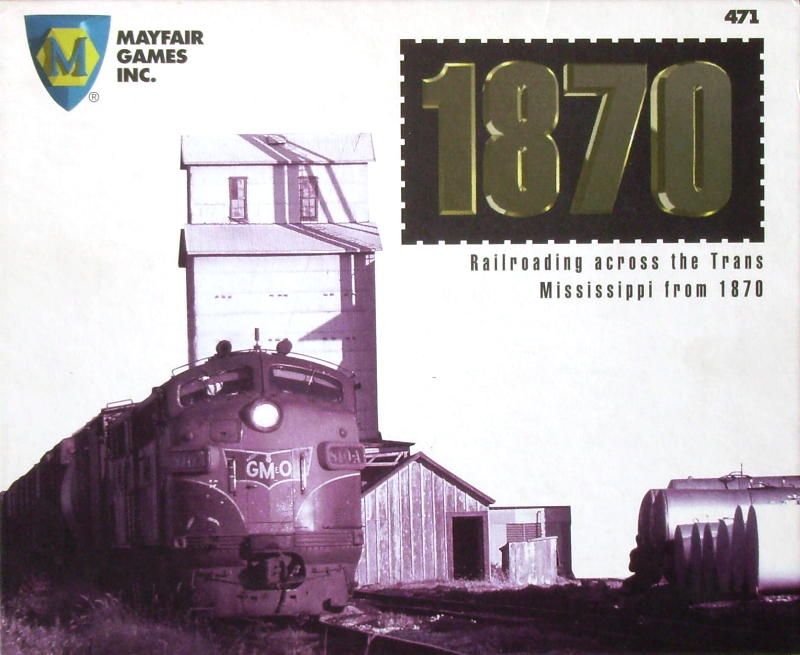
Summary
1870 is a railroad building and stock market game set in the Trans-Mississippi area after the Civil War. Players act as company presidents who lay track, buy trains and run them between cities for income, while also buying and selling shares in public companies. The player with the most wealth wins, where wealth is cash plus the market value of stock and the printed value of private companies held.
Setup
Each player receives starting capital of $2100 divided by the number of players. Starting order is drawn from a cup, and one player becomes the banker and sits by the bank tray. The bank starts with $12,000 in various denominations.
Place the round marker on the Stock Round space. Stack the public company certificates on the initial offering display with the presidents' certificates on top. Place type 2 trains in the available area and the other train types in the unavailable area. Lay the private company certificates in the center of the map in their listed order.
At the start, all six private companies are offered in order through an initial stock round with bidding, as described in the rules.
A turn
Stock round: Starting with the priority card holder and moving clockwise, each player may buy one certificate and sell any number of certificates, in either order, but may not sell and then buy and then sell again. A player may instead redeem or reissue shares for a company they preside over, or pass. A player who takes any action other than passing gets another turn. The stock round ends when all players pass in turn.
Operating round: Private companies first collect their listed revenue. Then public companies operate in share value order, and each does the following:
- Lay or upgrade track: two yellow tiles, or one upgrade tile.
- Optionally place a station marker.
- Run trains and calculate income.
- Pay a full dividend, a half dividend, or withhold earnings, then move the share value token.
- Buy a train if the company has a route and no train.
A public company may buy private companies from players during its operating turn after phase two. Each new train type purchased from the bank starts a new phase, which changes the allowed track, the train limits, and the rules for red off-board locations.
End of the game
The game ends in one of two ways:
- The bank runs out of money. Finish the current set of operating rounds, then determine the winner.
- A player goes bankrupt. This happens when a player cannot raise the cash for a required purchase. The game ends immediately.
A player cannot declare bankruptcy voluntarily.
Variants
Any variant must be agreed to by all players before the game starts. The rulebook offers:
- $400 Finish: The game ends once a company token reaches the $400 space. That company finishes operating, and the others do not.
- 1830 Diesels: Type 8 and type 10 trains are removed, and type 12 trains become Diesels. Phases seven and eight are removed, and phases five and six are changed.
- Station Marker Wars: Destination station markers for Dallas, Fort Worth, New Orleans, and St. Louis are placed as regular markers in large city spaces.
- Historical Order Start: Companies start in historical order of construction, with limits on share sales before a company is eligible to start.
- 1850/1832 Stock Market: Two $60 squares and one $40 square change color so the market matches the other two games.
Changes
- Variants, by the rulebook draft, 23 November 2026 (shown now)
- End of the game, by the rulebook draft, 23 November 2026 (shown now)
- A turn, by the rulebook draft, 23 November 2026 (shown now)
- Setup, by the rulebook draft, 23 November 2026 (shown now)
- Summary, by the rulebook draft, 23 November 2026 (shown now)