Rules of A Distant Plain
Summary
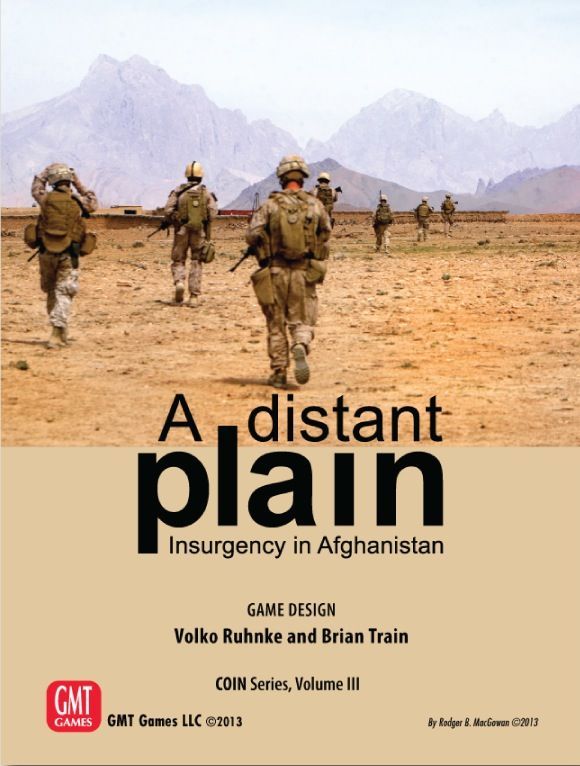
A Distant Plain is a game for 1 to 4 players about insurgency and counterinsurgency in modern Afghanistan. Each player runs one of four Factions: the Coalition, the Government, the Taliban, or the Warlords. Players use military, political, and economic actions, plus card events, to build forces, win popular support, control territory, and gather resources. A player wins by having their Faction meet its victory condition at a victory check, or by having the highest victory margin after the final Propaganda Round.
Setup
Choose a scenario and any optional rules. Separate the 6 Propaganda cards and shuffle the 72 Event cards. Remove at random the number of Event cards the scenario specifies. Any Capabilities cards drawn stay in effect, unless the no-Capabilities option is used. Split the remaining Event cards into the number of piles the scenario gives, shuffle one Propaganda card into each pile, and stack the piles into one face-down draw deck. Set aside any unused Propaganda cards.
Place forces, markers, Support, Opposition, and Control as the scenario lists. Each player takes a Faction. With 1 player, take the Coalition or the Taliban. With 2 players, take the Coalition and the Taliban. With 3, add the Government. With 4, each player takes one Faction.
Factions no one plays are non-players, run by the rules in section 8. If the non-player option is not used, players run them instead. With 3 players, the Coalition runs the Warlords. With 2 players, the Coalition runs the Government or, if preferred, the Warlords, and the Taliban runs the other.
A turn
Each turn, flip the top card of the draw deck onto the played pile and reveal the next card, so everyone sees one card ahead.
For an Event card, Factions act in the order of their symbols on the card, skipping any that are Ineligible. Only the first two Eligible Factions may act:
- First Eligible: either executes an Operation, with or without one Special Activity, or executes the card's Event.
- Passing: a Faction may pass instead. It stays Eligible and gains 1 Resource if it is an Insurgent, or 3 Government Resources if it is a COIN Faction. The next Eligible Faction then takes its turn.
- Second Eligible: its options depend on what the first did. After an Operation alone, it may take a Limited Operation (one space, no Special Activity). After an Operation with a Special Activity, it may take a Limited Operation or the Event. After the Event, it may take a full Operation, with a Special Activity if it wants.
COIN Factions (Coalition and Government) choose from Train, Patrol, Sweep, and Assault. Insurgents (Taliban and Warlords) choose from Rally, March, Attack, and Terror. Operations cost Resources, usually per space.
Once the acting Factions are done, any Faction that executed an Operation or Event becomes Ineligible. Factions that did not act become Eligible. Then play the next card.
For a Propaganda card, conduct a Propaganda Round. It has these phases in order: a victory check, Resource earnings, Support spending (Civic Action by COIN, Sharia by the Taliban), Redeploy, and Reset. Two Propaganda Rounds never happen back to back without an Event card between them.
End of the game
The game can end in two ways.
- During a Propaganda Round's victory check, if any Faction meets its victory condition, the game ends at once.
- After the final Propaganda card's Round is completed with no victory, the game ends and the winner is decided by victory margin.
On the last Event card before the final Propaganda card, Operations must be Limited and may include no Special Activities. Sweep and March are not allowed on that card.
Scoring
Each Faction has a victory condition, checked at the start of every Propaganda Round:
- Coalition: Support population plus Coalition pieces in the Available box must exceed 30.
- Government: COIN-Controlled population plus Patronage must exceed 35.
- Taliban: Opposition population plus Taliban Bases on the map must exceed 20.
- Warlords: Uncontrolled Afghan population must exceed 15, and Warlord Resources must exceed 40.
If a Faction meets its condition at a check, the game ends. If a non-player Faction is the one that meets it, all players lose equally.
After the final Propaganda Round without a victory, each Faction's victory margin is how far it is beyond or short of its condition. The Faction with the highest margin wins. A player running several Factions is scored by their lowest margin.
Ties go to non-players first, then to the Warlords, then the Government, then the Taliban.
Variants
- Scenarios: Short (2009-2013), Main (2005-2013), and Extended (2003-2013) each set their own card count, pile count, starting forces, and starting markers.
- No Non-Player option: with 2 or 3 players, players run the leftover Factions as described in setup, and no non-player rules apply.
- Non-player rules (section 8): fill any Faction not played with automated behavior, from solo play up to 4 players.
- Solo victory: a single player must avoid a non-player victory, and must have the highest victory margin at the end. Success is measured by how far ahead that margin is, from a stalemate to a clear win.
- Sudden Propaganda: if all players agree, a revealed Propaganda card swaps places with the Event card showing beside it, and a Propaganda Round is played immediately.
- Open Deployment: set up non-player forces and markers as specified, then players place their own forces within the scenario limits.
- No Capabilities: Capabilities Event cards removed during setup are not put into effect.
- Deception: at the start, each player in a 3- or 4-player game secretly draws 2 Deception markers. Empty Threat has no effect. Hidden Agenda adds +1 to the holder's victory margin. Hidden Asset turns one Limited Operation option into a full Operation with a Special Activity.
Changes
- Variants, by the rulebook draft, 23 November 2026 (shown now)
- Scoring, by the rulebook draft, 23 November 2026 (shown now)
- End of the game, by the rulebook draft, 23 November 2026 (shown now)
- A turn, by the rulebook draft, 23 November 2026 (shown now)
- Setup, by the rulebook draft, 23 November 2026 (shown now)
- Summary, by the rulebook draft, 23 November 2026 (shown now)