Rules of A Feast for Odin
Summary
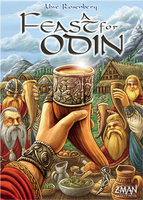
A Feast for Odin is a Viking-age saga game in which players raid, explore, trade and gather goods to build a financially secure household. Over several rounds, players place Vikings on a shared action board to take actions, and the player whose possessions are worth the most at the end wins.
Setup
- Place the large action board in the middle of the table. In a 4-player game, add the two extension tiles, choosing a side at random.
- Place the goods boxes within reach, and sort the goods tiles into them by color and shape. Store surplus tiles in the bags.
- Put the special tiles on the oval supply board and the ships by type on the small supply board.
- Sort the occupation cards into light brown and dark brown stacks. Each player draws one light brown starting card and takes a bow and arrow, a snare, a spear and a mead. Remove the remaining light brown cards. Shuffle the weapon cards and the dark brown occupation cards into face-down stacks. Decide whether to use deck A only (recommended for beginners) or decks B and C.
- Each player takes a home board and chooses the long or short side, then takes 12 Vikings in one color. Place one Viking on each numbered space of the Banquet Table track (seven for the long game, six for the short game). The rest go to the Thing Square.
- Shuffle the mountain strips, face up two (three in a 4-player game), and place the depicted goods on them. Place the four exploration boards with the Shetland, Faroe Islands, Iceland and Greenland sides up. Sort the building tiles and wood, stone, ore and silver into separate stacks.
- Place the round overview tile and set the round tracking cube on space 1. Give the start player moose to a randomly chosen player.
A turn
Each round has twelve phases in this order:
- New Viking: Move the leftmost Viking from the Banquet Table to the Thing Square.
- Harvest: Take the crop goods shown for this round from the general supply. In the long game, harvest gives only orange goods. "No Harvest" gives nothing.
- Turn exploration boards: On the rounds marked on your home board, turn the matching exploration board. Place 2 silver on each unclaimed board that is not being turned. Silver on a board being turned goes back to the supply.
- Draw a weapon: Each player draws a weapon card face up.
- Actions: Starting with the start player and going clockwise, players place Vikings from the Thing Square on unoccupied action spaces, one or more at a time, until everyone has passed or run out. Column one spaces need one Viking, column two two, column three three, and column four four. Each space can be used once per round, and you must use its effect when you occupy it.
- Start player: The player who placed the last Viking in the action phase takes the start player moose.
- Income: Take silver equal to the smallest uncovered number on your income diagonal.
- Animal breeding: Sheep and cattle breed according to the pregnancy rules, so animals breed about every other round.
- Feast: Fill each empty Banquet Table space with food tiles or 1 silver coins, following the placement rules. Each space you cannot fill gives you a Thing Penalty tile. Then return the food on the table to the supply.
- Bonus: Receive goods from each bonus space whose surrounding spaces are all covered.
- Mountain strips: Remove the leftmost resource from each face-up strip and return it to the supply. Remove empty strips, then add a new strip face up with its goods.
- Clean up: Return all your Vikings from the action board to the Thing Square.
Anytime actions, such as placing goods on your boards, buying ships, changing silver, and arming ships with ore, may be done at most times, subject to placement rules. Goods placed on a board cannot be taken back, and goods cannot be given away outside an action.
End of the game
The game ends immediately after the Feast phase of the final round. No bonuses are paid in the final round. Before scoring, place any leftover wood and stone on sheds and stone houses where they fit, and place any remaining goods on your boards if possible.
Scoring
Add your positive points, then subtract your negative points. The player whose possessions are worth the most wins. In case of a tie, the tied players all win.
Positive points:
- Ships: whaling boat 3, knarr 5, longship 8.
- Emigrated ships: knarr 18, longship 21.
- Exploration boards: 4 to 38, as printed.
- Sheds 8, stone houses 10, long houses 17.
- Sheep 2 (3 if pregnant), cattle 3 (4 if pregnant).
- Occupation cards in play, as printed.
- Silver in your supply. Silver on boards is worth nothing.
- The English Crown special tile gives 2 points to its owner, wherever it is.
Negative points:
- Negative values printed on your home board, exploration boards, sheds and houses, and occupations.
- Each Thing Penalty tile costs 3 points.
- Any goods tiles placed next to a same-colored tile against the rules cost one Thing Penalty per wrong pair if not corrected earlier.
Variants
- Short game: Played over six rounds with the short side of the home board. Players start with one extra Viking, and exploration boards are turned one round earlier.
- Solo game: Uses a second Viking color as blocking Vikings on the action board, with a waiting space on the home board. Phase 3 can be skipped after familiarization, and phase 6 is always skipped. A score of 100 is considered very good in the long game.
- Four-player extension: The extension tiles add grey imitation spaces in two of the four columns, chosen at random at setup. These let you use a space already occupied by another player in the same column. Imitation spaces can also be used only once per round.
- Card decks: Beginners use only deck A. Experienced players use decks B and C, or shuffle all decks together.
Changes
- Variants, by the rulebook draft, 22 November 2026 (shown now)
- Scoring, by the rulebook draft, 22 November 2026 (shown now)
- End of the game, by the rulebook draft, 22 November 2026 (shown now)
- A turn, by the rulebook draft, 22 November 2026 (shown now)
- Setup, by the rulebook draft, 22 November 2026 (shown now)
- Summary, by the rulebook draft, 22 November 2026 (shown now)