Rules of Agra
Summary
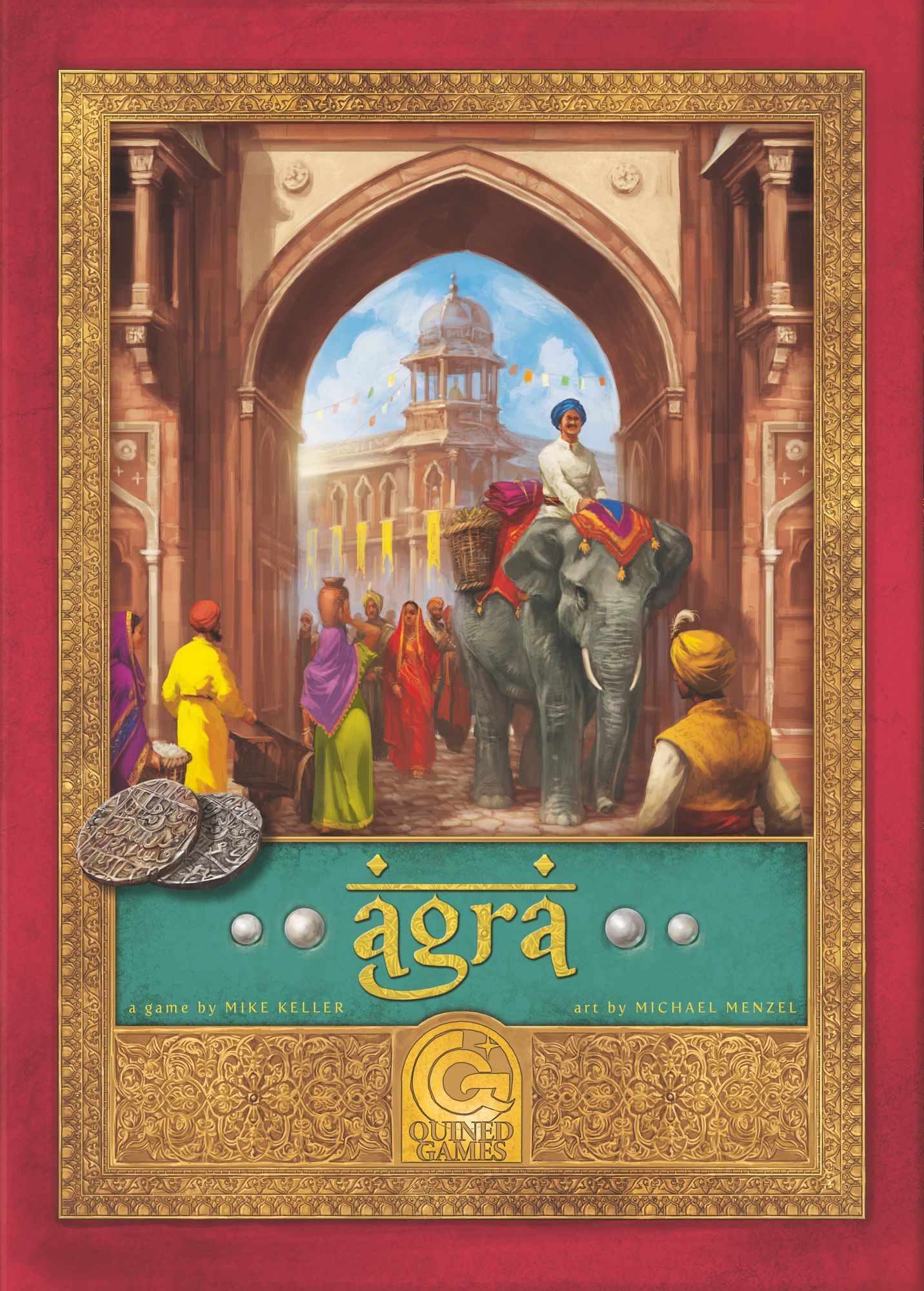
Agra is a worker-placement game set in Akbar's capital in 1572, where players produce, process and trade goods to earn Rupees, fulfil Guild Orders and win Notables' Contracts. The player with the most Rupees at the end of the game is the winner.
Setup
Place the three Price tokens on the Trader spaces with the lesser number of flags face-up, and put the Building Bonus tiles face-up on their spaces. Place the Under Construction tiles on the 2nd, 3rd and 4th Level Buildings.
Roll the die to place the Merchant on one of the four leftmost Buildings, moving down the line by the pips shown, rerolling a 5 or 6. Roll again to place the Builder on the Under Construction tiles in the same way.
Randomly place 14 Notables along the river (5 Level I, 4 Level II, 3 Level III, 2 Level IV) so that the three Guilds are represented roughly 5/5/4, adjusting Level I Notables if needed. Return the rest to the box. Place the Order Limit markers between the Piers, the Boat by the first Pier, and the Meditation marker on the "Deliver a Good" space.
Each player takes a player board, 8 Cover tiles on the marked left-side squares, a Meditation tracker on the first symbol, 2 Rupees, 4 Farmers on the centre squares of each row and column, 10 Workers, 22 Player markers and a cloth bag for Rupees. On the Imperial board, each player places an Influence marker on the start of each of the three tracks. Roll the die once per Guild Order column and place a Guild Order marker on the matching number. Draw and place 3 Favour tiles face-up beside the board. Randomly choose the starting player, who takes the Starting Player marker.
A turn
Each turn has three phases.
- Meditation (optional): Lay down any number of your standing Workers to generate Meditation Points, using your Meditation tracker to set the value of the first Worker and each later one, with a minimum of 1 MP per Worker. Spend MPs on Meditation actions: deliver a Good to a Notable for 3 MP, process a Good along one arrow for MP equal to its value, remove a Cover tile for 2 MP, move a Farmer for 1 MP, or trade a Good for another of the same value for MP equal to that value. Unused MPs are lost. Then move the Meditation marker to the last outer action used, blocking that action for others. "Move a Farmer" is never blocked.
- Action (mandatory): Place one Worker on a Main Character, a built Building or the Under Construction tile holding the Builder, and perform that action. If the space holds another player's laid-down Worker, that Worker is kicked out and you act. If it holds another player's standing Worker, that player gets 1 Favour (2 from the 4th Meditation step) and you act. If it holds your own Worker, you may pay 2 Rupees to stand it up instead (the Peon effect). If the Merchant is there, gain 2 Favour after acting, then move the Merchant. If the Builder is there, build for free and process Goods, then move the Builder.
Main actions: Architect (move an Influence marker up one, or build a Building by paying Building Materials, taking a Bonus tile, and placing a Worker); Sailor (deliver Goods to Notables and/or fulfil one Guild Order); Trader (exchange up to three Goods for goods of one less total value, and place or flip a Price token); Botanist (two different actions from increasing Meditation, removing a Cover tile, and moving Farmers). Production Buildings produce Basic Goods equal to the open farm spaces next to the matching symbol. Processing Buildings convert Goods along arrows, and other players may process one Good along the same arrow, giving you 1 Favour each.
- Order (optional): Either deliver exactly one Good to Emperor Akbar, or fulfil exactly one Order on a Guild Order track.
At any time during your turn you may also use Secondary actions: Oil and Curry (spend to stand Workers upright, once per turn), Favour tiles and actions, and Luxury Goods actions (each Luxury Good used once per turn).
Scoring
Each player counts their Rupees, adding the following:
- Notables marked with the Game End symbol pay according to their Contract.
- On each Influence track, the player on the top step receives 2 Rupees per Player marker in that Guild's Order column, and the player in second place receives 1 Rupee per marker. If players tie for the top step, each gets 1 Rupee per marker and second place gets nothing.
- A player whose Meditation tracker reached the last space receives 5 Rupees.
- Each removed Cover tile of yours is worth 1 Rupee.
- Deliveries to Emperor Akbar pay 1 / 3 / 5 / +3 Rupees for 1 / 2 / 3 / more than 3 Goods.
The player with the most Rupees wins. In a tie, the tied players total the values of their remaining Goods and Favour (each Favour counts as a Good of value 1), and the highest total wins. If still tied, the victory is shared.
Variants
For a 2-player or 3-player game, place 10 Notables instead of 14 (guild distribution 4/3/3). Then place neutral markers on the Emperor Akbar section (4 for two players, 2 for three players) and on the Guild Order columns (6 for two players, 3 for three players), rolling the die to choose which Goods and Orders to cover, following the specific steps given in the rulebook. Neutral markers come from an unused player colour.
Changes
- Variants, by the rulebook draft, 22 November 2026 (shown now)
- Scoring, by the rulebook draft, 22 November 2026 (shown now)
- A turn, by the rulebook draft, 22 November 2026 (shown now)
- Setup, by the rulebook draft, 22 November 2026 (shown now)
- Summary, by the rulebook draft, 22 November 2026 (shown now)